Engineering, business and the arts converge on May 8 for a single-day showcase of what nearly 1,000 graduating students have built
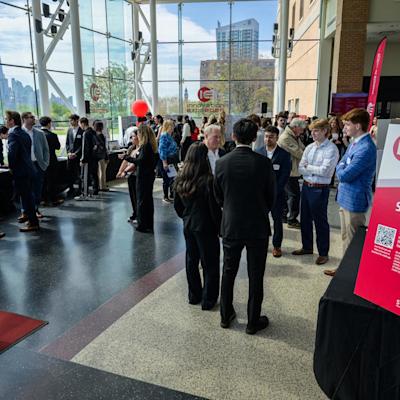
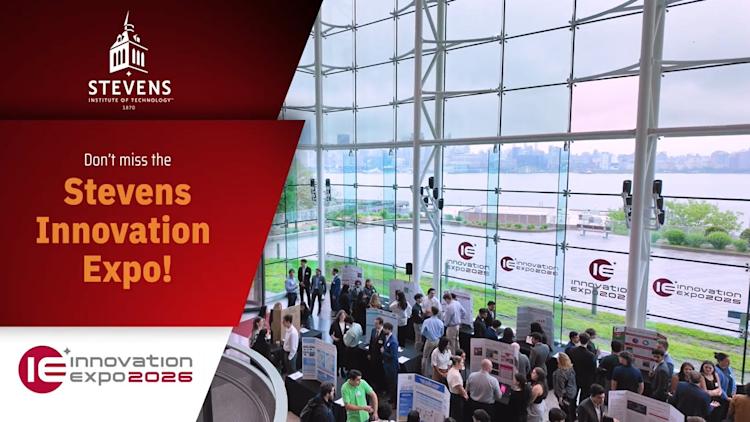
On Friday, May 8, Innovation Expo 2026 will transform the Stevens campus into a working portrait of what the university produces. More than 250 student projects — engineered, researched, consulted, designed, performed and pitched — will be on display across 14 venues, from Canavan Arena to the Babbio Center to the University Center Complex. Nearly 1,000 students will present their work alongside an autonomous robot competition, an entrepreneurship pitch competition, a visiting entrepreneur lecture and celebrations of senior artists and musicians.
It is the largest single-day showcase Stevens stages each year and the clearest view of the model the university has built. At Stevens, the senior capstone — what the university calls senior design — isn’t a final assignment. It is the culmination of an eight-semester design spine that begins in students’ very first semester and builds across four years of hands-on courses, interdisciplinary teamwork and a focus on entrepreneurial thinking. By the time students reach Innovation Expo, they have been preparing for this moment since the day they arrived — a years-long arc brought into focus in a single day.
“What you’ll see on May 8 is a generation of students ready to lead — students who have spent four years learning to solve real problems, think creatively across disciplines and translate their ideas into work the world can use” said Nariman Farvardin, president of Stevens. “These are the qualities that will matter most in the years ahead. And these are the students who will build what comes next.”
The work, by the numbers
This year’s Expo brings together:
258 student projects across three schools
162 from the School of Engineering and Science
50 from the School of Business
46 from the School of Humanities, Arts and Social Sciences
More than 100 projects developed with external partners, including corporate sponsors, government agencies, community organizations and alumni mentors
Within the engineering and science capstones, the concentration of topics reflects where many of today’s most urgent challenges lie. Forty-six projects in medical technology sit alongside 37 incorporating artificial intelligence, 30 in robotics and 15 focused on sustainability and clean energy. Eighteen projects carry intellectual property or patent-pending designations, and 10 are advancing through Launchpad@Stevens, the university’s student venture pathway.
Different paths, one outcome
Stevens students don’t all do the same kind of capstone — and that’s the point. They choose paths that reflect what they want to learn.
Some choose research, pursuing questions whose answers aren’t yet known. Some choose to consult, working directly with organizations to solve real problems on real deadlines. Some choose to build, designing systems that have to function in real-world conditions. And a growing number choose to launch, developing ventures they intend to carry beyond graduation.
At the School of Business, 32 of 50 capstones are client-based consulting engagements, with clients ranging from Hoboken neighbors — Mile Square Theater, the Hoboken Public Library, the Hoboken Business Alliance — to the Port Authority of New York and New Jersey. The remainder split between entrepreneurial ventures and applied research. Across the School of Engineering and Science, nearly half of all capstones involve an external sponsor or partner, including L3Harris, Merck, Memorial Sloan Kettering Cancer Center, Hackensack Meridian Health, the Port Authority, the National Science Foundation and the U.S. Army Research Office.
The result is work that, in most cases, has already been tested against the expectations of a client, sponsor or market before it ever reaches a faculty grade.
What students built this year
A handful of projects suggest the breadth:
Infrastructure and robotics: L.I.N.C., the Lincoln Investigation and Navigation Cadet, an autonomous robot built by six undergraduates for the Port Authority of New York and New Jersey, designed to monitor catwalks deep inside the Lincoln Tunnel. All six students were offered Port Authority internships last summer.
Healthcare innovation: SensiTear, a tear-based diagnostic tool exploring earlier detection of Alzheimer's disease, and an autonomous IV system that resolves infusion problems before alarms sound.
AI and research: LabNinja, a platform helping research labs capture and reuse their own institutional knowledge — a Launchpad-track venture.
Cross-disciplinary entrepreneurship: Showcase, an audition-discovery platform for working actors, built by five business students who partnered with five computer science students, conducting more than 100 interviews with industry professionals along the way.
Business and community: Revival Vintage Boutique, where a team of business and technology majors helped a Hoboken brick-and-mortar store build out an e-commerce presence and customer rewards program.
Markets and data: SynopticFeed, a quantitative finance project using satellite weather data to give electricity traders an information edge.
Sustainability: SAF from Palm Oil, where four chemical and environmental engineering seniors built their own bimetallic nickel catalyst to convert palm oil into jet-ready sustainable aviation fuel.
The pattern that emerges across these projects is one students recognize themselves. “We had a pitch presentation, and we got to talk to actual investors and get real-life feedback about what we were good at and the ‘invest-ability’ of our company,” said Nicole Cheung, a business and technology major on the Showcase team.
More than a project showcase
Innovation Expo is designed as a full-day interactive environment, not a poster session. Alongside the project displays:
The Gallois Autonomous Robot Competition tests engineering systems in real time.
The Ansary Entrepreneurship Competition, now in its second decade, returns with $17,500 in prizes for student teams pitching their ventures to a panel of investors, alumni and industry leaders. The competition asks students to do something the Stevens curriculum prepares them for and the marketplace will demand of them: take a technical achievement and translate it into a business case the world can understand. Some past winners have used their prize money to launch real companies.
The Thomas H. Scholl Lecture by Visiting Entrepreneurs brings Christine A. Miller M.S. ’08 MBA ’09 — a life sciences executive and most recently president and CEO of Melinta Therapeutics — back to campus to deliver a talk titled “Transforming Through Turbulence: How Culture-Driven Leadership Creates Strategic Options.” Miller is one of nearly 60,000 Stevens alumni now working in industry, finance, medicine and entrepreneurship around the world.
The HASS Music and Technology Senior Concert, “A Celebration of Seniors,” showcases the year's graduating performers.
And Ebb and Flow — new this year — presents 16 works from student artists, marking the first time a student-curated visual art exhibit has been a formal part of Innovation Expo.
Taken together, these elements reflect the same idea from different angles: that meaningful innovation requires both depth and range, and that the people doing this work — Stevens students — are ready for what comes next.
The full 2026 agenda and additional information are available at stevens.edu/expo. The Stevens Innovation Expo mobile app is your portal to Expo day — project locations, event details and the full agenda. Download the Stevens Ducks app from the Apple App Store or Google Play, create a profile and search "Stevens Expo" in the Find Guides section.