Ideas Take Flight at Innovation Expo 2026
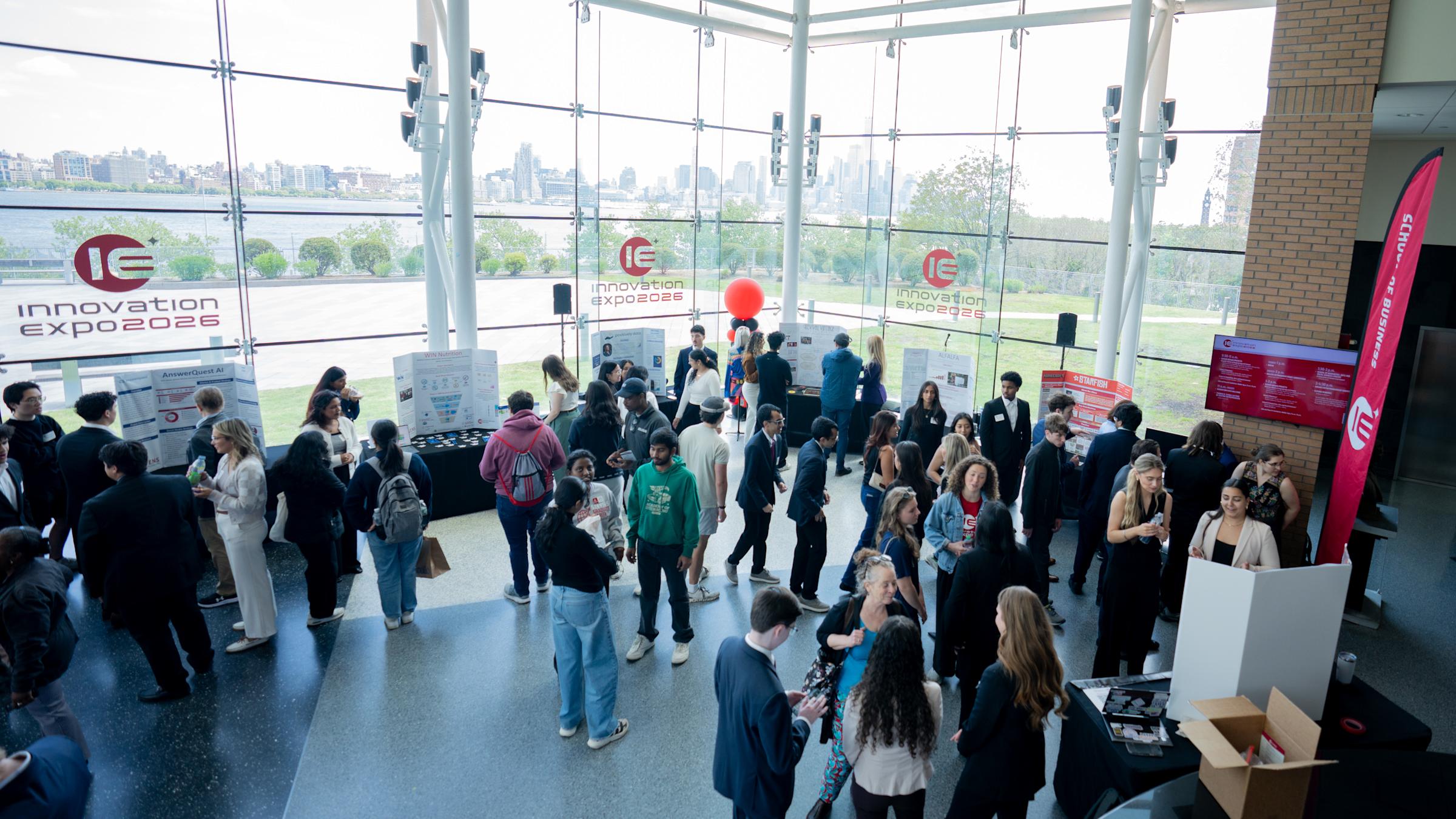
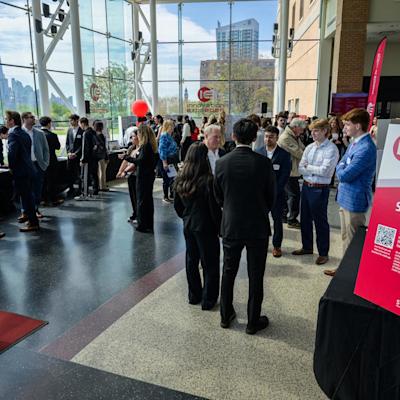
For most of their time at Stevens, business students learn by studying what others have built, but the senior design experience is their opportunity to showcase what they can build themselves. This year’s Innovation Expo displayed a wide variety of projects, ranging from sustainable streetwear to a Hudson River wildlife habitat to a neural network trained on two decades of market sentiment data.
The SSB portion of the university-wide event was divided into three areas: entrepreneurship, research and consulting.
On the entrepreneurial side, one team turned a personal passion into a sustainable fashion brand. No Signal! (Dept) is an upcycled, tailored clothing brand centered on custom, made-to-order pieces crafted primarily from denim. What began as a way for Faisal Hossain, a business and technology major from Brooklyn, to express his own style evolved into a brand that ships to customers in New York, Berlin and across Europe.
Faisal’s teammate Sandra McDonald, also a business and technology major, described the project as a direct answer to a gap in the market between throwaway fast fashion and unaffordable designer pieces.
“A lot of us in the group like raving and going to concerts, but it's hard to find clothes that are original, fit well, durable and sustainable,” she said “If you do want pieces that are a bit more sustainable or a bit more unique, they can run you up to $5,000-$10,000 a piece so that can be anywhere from a $20,000-$30,000 outfit. We wanted to solve the fast fashion and designer problem by having something in the middle. Something that is customizable, adjustable, and upcycled from old clothing, so that rather than jeans going to the landfill, we can make new pieces.”
For Faisal, who began as a software engineering major, the experience reinforced lessons from his entire experience.
“An engineering background gives you a lot of step-by-step methodology,” he said. “You’re going to keep making mistakes, but at the end of it all you’ll still have a skill. And right now, hands-on skills are super in demand.”
The research track drew students who wanted to explore new ways of thinking about and solving the challenges associated with the rapid pace of innovation. Matthew Lascoe, a senior from Los Angeles, and his team investigated whether incorporating sentiment data from machine-readable news could reduce the error in options pricing models.
Their project, “Sentiment-Augmented Neural Calibration of Stochastic Differential Equation Models for Improved Option Pricing,” was judged the winner of the Research track by a panel of esteemed judges (see below).
The team used 20 years of S&P options data alongside 20 years of news data, running it through FinBERT, a pre-trained natural language processing model to analyze sentiment of financial text, to generate sentiment scores on a scale from negative to positive. They found that sentiment does improve pricing models, but primarily in low-volatility market conditions.
“Our math and calculus classes helped with understanding a lot of these models,” he said. “The machine learning classes we took teach the fundamentals, and then more advanced level classes dealt with analysis. All these helped me really break down these equations to understand what's going on under the hood of our project. Using this knowledge is what helped us actually create a lot of these neural networks.”
Lascoe is heading into a career in data science after graduation and said the project gave him practical fluency in synthetic data generation and working through high-volume datasets, as well as a broader lesson in patience and problem-solving.
“It took a lot of input data and took a lot of time, and working through those problems was a valuable life skill to have learned,” he said.

A third group of students used their senior design opportunity to drive a real-world conservation about protecting the common tern, Hoboken’s honorary bird. The team raised funds to construct a floating nesting platform in the Hudson River, free from the predators and deterrents that threaten the species on land. A second strand of the project focused on expanding local biodiversity through a pollinator garden, funded through grants the students applied for themselves.
Isabella Rivera, a marketing innovation and analytics major from Alexandria, Virginia, said the Hoboken community’s response was a highlight of the experience.
“The community has totally backed us throughout this, from donating to sponsoring us to just coming to our events,” she said. “We couldn’t have done any of this without the community here, for sure. Increasing biodiversity is not on the forefront of people’s minds in an urban area, so to create our messaging, our fliers and all of our campaign materials in a way that would get them to care, I definitely relied on what I learned at Stevens to get it out.”
Her teammate Mickantzy Polycarpe, an information systems and management major from Carteret, New Jersey, put his technical skills to work managing the data behind the project, including tracking metrics, building spreadsheets, managing event registrations and coordinating the flow of information between systems.
“I think one of our biggest challenges was definitely scope,” he said. “When you're building a floating island, there's a million ideas that race through your mind in finding out how to fundraise. Being able to discover our scope and then develop our processes on how to build off how we're going to get sponsors and our funding was a very big issue, but we did it.”
In addition to the project displays, an annual highlight of the event is the Thomas H. Scholl Lecture by Visiting Entrepreneurs. This year’s speakers was Christine A. Miller, who earned her M.S. in 2008 and her MBA from the School of Business in 2009. Miller most recently served as president and CEO of Melinta Therapeutics, where she guided the company from an antibiotics business to a leader in hospital acute care, nearly doubling revenue and achieving sustainable profitability before a strategic acquisition in 2025.
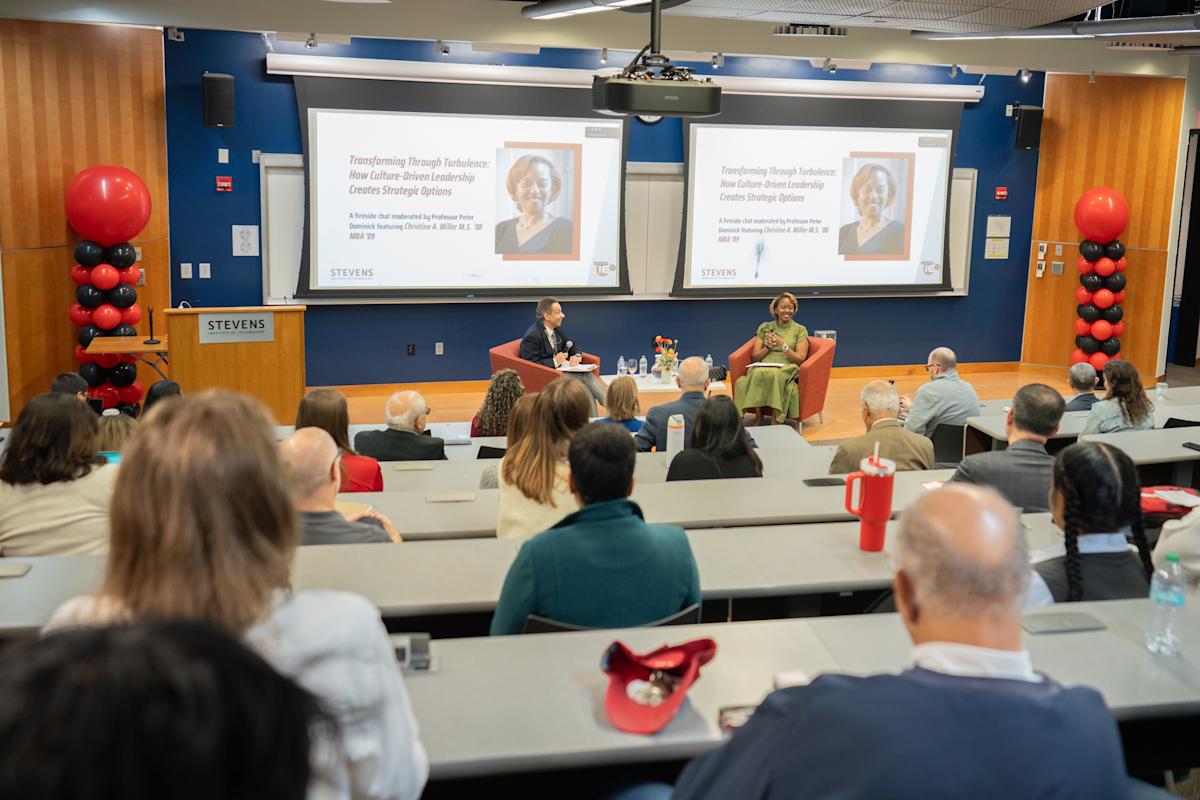 Her fireside chat, titled “Transforming Through Turbulence: How Culture-Driven Leadership Creates Strategic Options,” with School of Business Professor Peter Dominick drew on her career that spanned Merck, Sandoz, Actavis and her own CEO tenure. She spoke about leading through uncertainty, building high-performing cultures and the courage required to take on big responsibility. She offered graduating students a three-prong approach to success. Pursue purpose, embrace courage and trust the preparation Stevens has given them.
“Stevens sets you up for so much success,” Christine told the audience. “You show up here and you quickly realize you’re not the smartest person in the room. You have a lot of uncertainty around the projects you’re tackling, and this institute teaches you how to think critically, how to navigate complexity and how to overcome obstacles. You leave here with all the tools you need for problem solving and being successful. Look for the opportunities. Look for where you can apply your purpose and know that you will be able to figure it out.”
2026 School of Business Innovation Expo Award Winners
Best Consulting Project (2): Rainbow Bridge Project (Hoboken Girl) and Mile Square Theater
Team Rainbow Bridge Project
Emily Liu
Clara Lu
Rheanne Marquez
Mei McGarvey
Nhien Tran
Professor Zvi Aronson (Faculty Advisor)
A Rainbow Bridge is a symbolic memorial that honors deceased pets and gives people a place to remember them. The Hoboken Rainbow Bridge project team aimed to create a meaningful and accessible memorial space where community members could honor beloved pets and find comfort after loss. The Hoboken Rainbow Bridge team gathered project data by interviewing the community and project partners and conducting site visits. They collaborated with Sabio Engineering Services to create a durable bridge structure in Hoboken’s Elysian Park and WISE Animal Rescue, The Hoboken Girand the community to create a dedicated place for remembrance. The bridge was designed to be painted in rainbow colors and planned to include thoughtful features such as message areas, decorations and spaces for tributes. The space was intended to foster reflection, healing and community connection while celebrating the love and companionship pets bring to people’s lives.
Team Mile Square Theater
Tyler Chaput
Kotaro Konaka
Gavin Ng
Meer Patel
Keith Ezekiel Adame
Professor Theresa Howard (Faculty Advisor)
Mile Square Theatre (MST) is a local community, not-for-profit theater organization that produces live shows and operates adult and children’s theatrical and dance classes. With the theater facing challenges in optimizing the effectiveness of their marketing strategy to fill seats, the project team analyzed financial data and digital analytics to help best utilize its marketing spend. Analysis included reviewing MST’s marketing expenses in determining the return on investment for various marketing strategies to identify the most successful efforts at selling tickets, enrolling students into classes and retaining audience members. The project team also created a social media analytics dashboard to track audience engagement, audience growth and campaign effectiveness. Additionally, the team analyzed opportunities to optimize MST’s website for a better user experience and to increase conversions from site visits to ticket sales. This project also included helping MST identify and secure a social media intern to aid in their digital marketing strategies.
Best Entrepreneurship Project: CuNEXT Development
The Team
Dorothy Loffredo
Isabella Duval
Leyla Castro
Maddie Hogan
Stephanie Ryazanova
Professor Alfred Bentley (Faculty Advisor)
Out of 60 million women in the U.S. that use contraception, 4.4 million of them choose IUDs. With a shift toward non-hormonal contraception, there is one IUD option. It has been 42 years since the ParaGard Copper IUD was updated. The project team’s mission was to innovate IUDs use with a product that preserves the efficacy and longevity of traditional non-hormonal IUDs while minimizing the side-effects that discourage many women from choosing or continuing this form of birth control. With CuNEXT, women can expect more because their health deserves more.
Best Research Project: Sentiment-Augmented Neural Calibration of Stochastic Differential Equation Models for Improved Option Pricing
The Team
Matthew Lascoe
Om Patel
Samuel Shlyam
Ethan Itkis
Steve Linehan-Reckford
Professor Thomas Lonon (Faculty Advisor)
Professor Balbinder Singh Gill (Faculty Advisor)
The research team built two option pricing models: a baseline model trained only on price and option data, and a sentiment model that additionally incorporates sentiment scores extracted from financial news. The pricing accuracy of the two models was then compared to determine whether incorporating sentiment data results in a more accurate pricing model. Sentiment was extracted from financial news using Fin-BERT, giving articles time-stamped positive, neutral, and negative scores. Following the two-step deep calibration framework of Árpád Horváth, Agustín Muguruza, and Mehdi Tomas (2020), a neural network was trained offline to approximate the pricing map from implied volatility surfaces to model parameters, treating each surface as a grid of pixel-like values. To incorporate sentiment in a controlled manner during offline training, the simulated implied volatility surfaces were augmented with synthetic sentiment scores whose statistical properties matched those observed in real financial news data. These synthetic scores were generated from a regression linking empirical sentiment to return-based path statistics (e.g., mean returns, realized volatility and drawdown measures), evaluated on the simulated price paths underlying each volatility surface.
This procedure provided the sentiment-augmented model with consistent training context while enabling a direct, apples-to-apples comparison with the baseline model. This learned pricing functional replaces costly Monte Carlo evaluation during calibration, enabling rapid online parameter fitting via deterministic optimization. Once calibrated, the network outputs implied volatilities across a full surface of strikes and maturities within milliseconds, which the research team converted to option prices and compared against observed market prices. The research question was: What is the impact of including sentiment data into the training process of a neural stochastic differential equation? The research team hypothesized that sentiment-augmented models will achieve measurable reductions in pricing error compared to baseline models, with improvements expected to be most pronounced during periods of high market volatility when sentiment effects are most relevant.