Road to Innovation Expo 2026: SynopticFeed
Inaccurate weather forecasts usually mean the inconvenience of having to buy a $10 umbrella from a street vendor, but for energy traders, one wrong prediction could cost them $10 million.
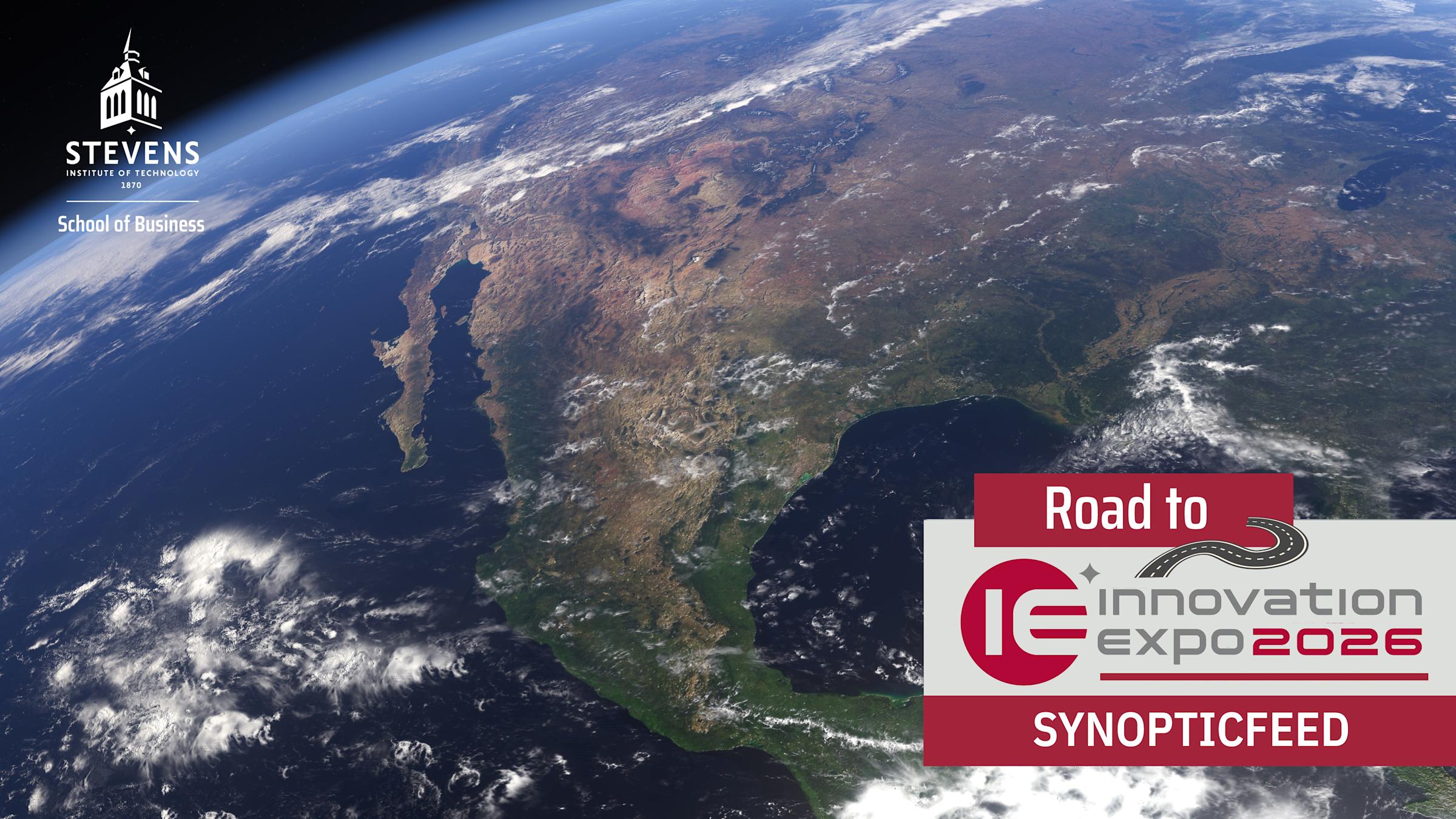
For their senior design project, a team of Stevens School of Business quantitative finance students has built a platform to help warn traders about the gap between weather predictions and what they see out their window. SynopticFeed is an online dashboard that takes real-time weather information from GOES satellite broadcasts and distributes it to subscribers 30 or more minutes faster than public channels, giving energy traders a chance to adjust their positions to match the actual conditions before it’s too late.
"Every weather company sells the forecast. We sell the alarm when it breaks,” explained Akbar Pathan, the project’s leader. “One storm in December 2022 cost electricity traders over $1.8 billion. The vast majority of the market leans on just six forecast providers, and all six build on the same two weather models. When those models break, the whole market breaks down with them. Nobody has been selling the alarm for that. SynopticFeed is the first."
In addition to building the online component, the group also constructed a satellite ground station to capture the data. Owning their own hardware is part of what enables SynopticFeed to distribute information faster than the current industry standard, alerting clients to unexpected cloud cover, sudden temperature changes or storms that form unexpectedly.
"We spent a semester and a half building our own satellite ground station," Akbar said. "Our first receiver is live right now, pulling imagery directly from the government's GOES satellites. The satellites beam information down constantly, and we decode it within seconds. That data is public, but it normally takes 30 minutes to 2 hours to reach a trader's desk. We are sending it in minutes. By Innovation Expo, our full system will be live through a partnership with a University ground station. Our own in-house hardware comes online later that month."
Akbar began formulating the idea while earning his Bloomberg Markets Concepts Certification — the same certification gained by Wall Street traders — in the Hanlon Financial Systems Center as part of the Introduction to Financial Tools and Technology course. The class is part of the core curriculum for quantitative finance students who choose the finance and business concentration.
"Without Stevens, I would not have seen this,” he said. “I was earning my Bloomberg terminal certification, and there was a module on energy trading. They covered natural gas and oil. Electricity got a brief mention. I pulled the thread, and what I found was the most weather-sensitive industry in finance, a nearly half-trillion-dollar market in the U.S. alone, with almost nobody watching the gap between what the forecast said and what the sky was actually doing."

The Team
Akbar Pathan, Quantitative Finance — Team Leader
Snehil Mahendrakar, Quantitative Finance
Shane Mangru, Quantitative Finance
Dylan Mangru, Quantitative Finance
Usman Shahid, Quantitative Finance
Faculty Advisor: Dr. Cristiano Bellavitis, Associate Professor
Q&A with Akbar Pathan
Why is a product like SynopticFeed necessary?
"Power markets are unforgiving. Electricity demand follows the weather minute by minute. A surprise rainstorm sends everyone indoors, lights and heaters come on, and the grid has to generate that extra electricity immediately. If the forecast missed the storm, the market has to scramble to cover the gap, and prices can spike 1000% within the hour. A few weeks ago, one regional power market got a forecast badly wrong. Traders caught on the wrong side lost millions in a single afternoon. One storm caught like that saves a desk several years of subscription in a single afternoon."
What was the research process to make sure this was actually viable?
"Alternative data came up in our earlier classes at Stevens, so we knew satellite and weather data was already being used for trading. We just did not realize how big the gap was in electricity. We also talked to traders directly. The same complaint kept coming up. If you are not a meteorologist, you cannot process this information fast enough to trade on it. Top-tier funds have meteorologists on staff. Nobody else does. Our biggest focus from day one was making the data actionable for a trader at the desk, in under a minute, without needing a Ph.D in meteorology."
What was the biggest challenge the team faced?
“I believe the trickiest part of the job is credibility and reputation. We're a group of 20 and 21-year-olds speaking to people in industry who have been trading electricity and energy for over 20 years. How do we speak to them? We started learning quickly that we need to speak their language; read the books, understand how these markets actually work. By doing our research, our homework, asking other people, our professors, for example, how to get an in-depth knowledge base into the industry that we're trying to break into. Despite whatever age we are, experience we do or do not have, it all comes down to being able to hold a proper conversation with the audience you're trying to speak to.”
What’s the future of the project after the Innovation Expo?
"We are working hard to land our first client. We already have formal expressions of interest, and we are converting those into Founding Partners, our first full-paying customers. The product will be ready for a full live demo at Innovation Expo on May 8. We are grateful for everything we learned at Stevens, and we are excited to carry this forward after we graduate."