Two Renovated Labs, Endless New Opportunities for Discovery

Students returning to McLean Hall this fall are finding more than renovated laboratories. They’re finding new opportunities to learn, experiment and discover.
The Department of Chemistry and Chemical Biology recently completed major upgrades to two key laboratory spaces: the Organic Chemistry Lab in McLean Hall room 212 and the Nuclear Magnetic Resonance (NMR) Lab in room 413. Together, the projects modernize critical teaching and research environments while supporting the department's commitment to experiential scientific education.
The renovated Organic Chemistry Lab was designed to create an engaging, technology-enabled environment for instruction and experimentation. New laboratory casework, fume hoods, storage systems, lighting and instructional technology have transformed the space into a modern learning environment, while upgraded ventilation, plumbing, electrical and life-safety systems support the specialized needs of chemistry education.
Accessible workstations and updated safety equipment are integrated throughout the laboratory, ensuring students can learn and work in a space designed for both functionality and safety.
For Sesha Sridevi Alluri, who will oversee the laboratory, one of the most exciting aspects of the renovation is the access students now have to advanced instrumentation and technologies commonly found in professional research and industry settings.
For Chemistry and Chemical Biology Department Chair Woo Lee, the renovated laboratories represent more than upgraded facilities. They reflect the department's ongoing commitment to creating meaningful learning and research experiences for students. "We're trying, in a very small way, to recreate that experience for our students today and in the future."
Through investments in modern laboratory spaces, advanced instrumentation and hands-on learning opportunities, the department is preparing students for careers in research, industry and graduate study.
"The lab is equipped with all the modern technology, and we have state-of-the-art instrumentation to be able to do synthesis," Alluri said.

While the Organic Chemistry Lab supports student learning, the renovated NMR Lab strengthens the department's research capabilities.
Nuclear magnetic resonance spectroscopy is a powerful analytical technique used to determine the structure and properties of molecules, making it an essential tool in chemistry research. The renovation modernized the laboratory's layout and infrastructure to support a new NMR instrument and the specialized environmental conditions required for advanced scientific instrumentation.
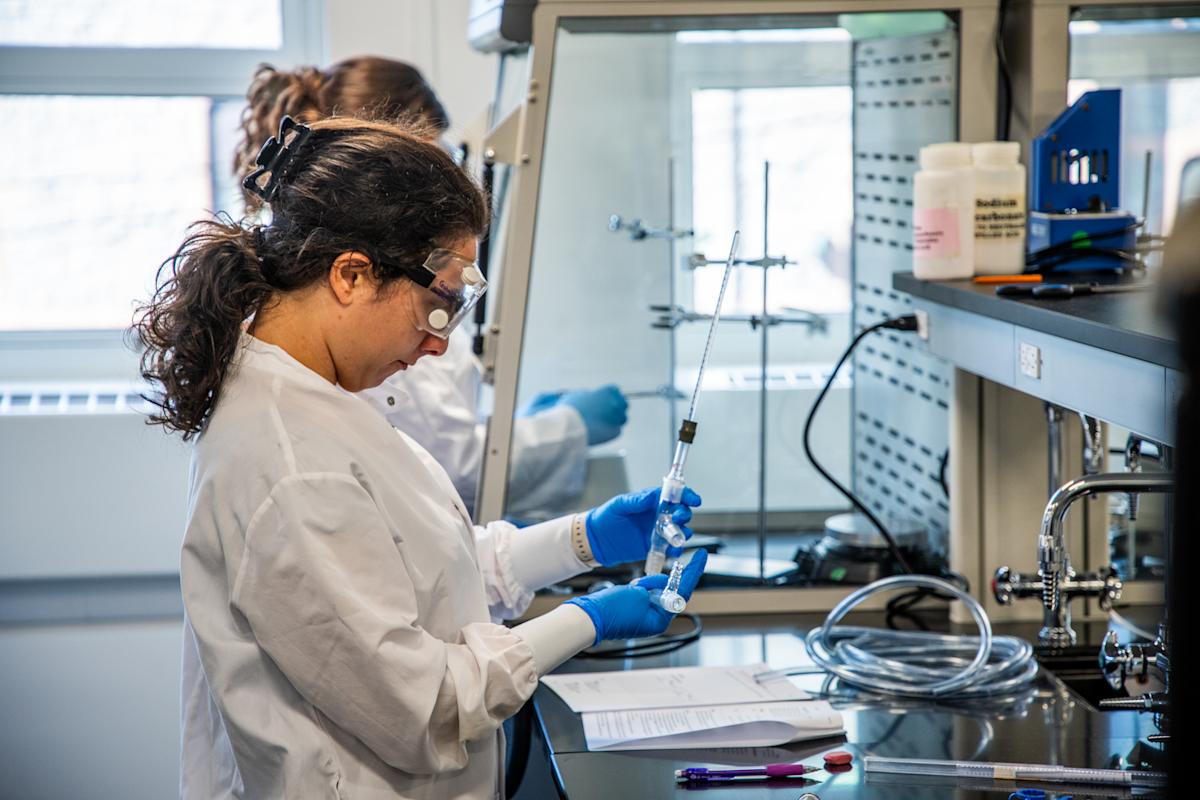
The project included upgrades to the laboratory's mechanical, electrical and life-safety systems, along with improved ventilation, oxygen monitoring and supporting infrastructure designed to enhance both performance and safety. Existing equipment and laboratory systems were carefully relocated and upgraded to improve reliability while maintaining a research environment capable of supporting sophisticated scientific investigations.
Together, the two renovated spaces represent a significant investment in the future of chemistry education and research at Stevens.
Whether students are conducting their first organic synthesis experiment or using advanced instrumentation to investigate complex scientific questions, the modernized laboratories provide an environment designed to support curiosity, creativity and discovery.
As the next generation of scientists step into these spaces, they will do so with access to the tools, technologies and experiences needed to prepare for the challenges and opportunities that lie ahead.
Learn more about academic programs and research in the Department of Chemistry and Chemical Biology: