Extended reality is turning complex ideas into immersive experiences through technology and collaboration
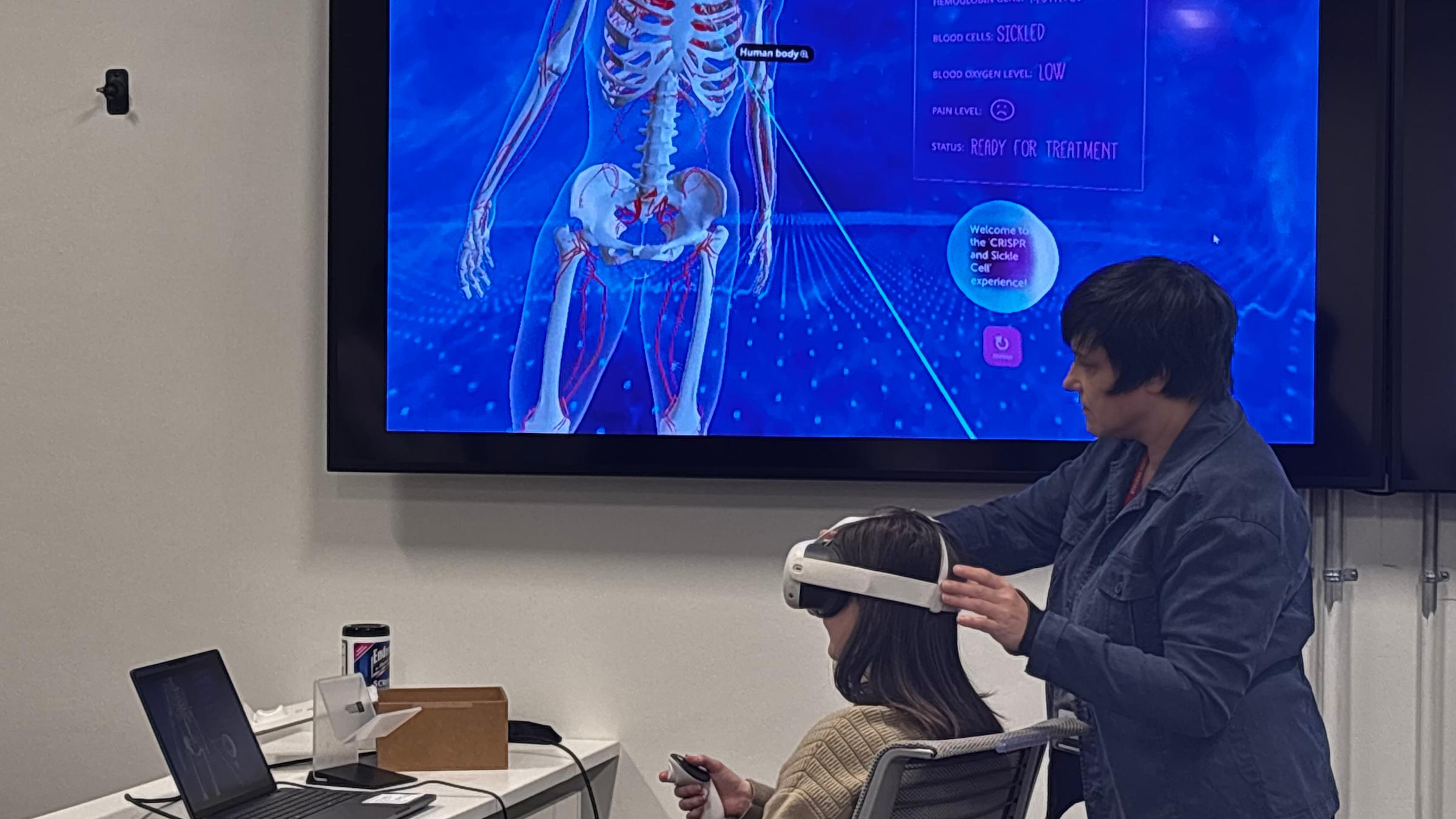
Imagine traveling inside a blood cell to identify mutations responsible for diseases like sickle cell disease — deepening understanding of cellular processes and gene editing along the way.
That's exactly what Stevens Institute of Technology’s biology students are doing using CRISPR-VR genome-editing simulations, just one example of how the Stevens Institute of Technology's Extended Reality (XR) Lab is changing what it means to learn by doing.
By combining cutting-edge immersive technologies with innovative teaching, the lab gives students and faculty new ways to explore complex ideas, collaborate across disciplines and tackle real-world challenges in new ways.
Across the university, faculty are partnering with the XR Lab to turn lessons into immersive experiences — allowing students to explore and experiment inside the concepts they're studying.
“The potential is only limited by our imagination”
“Extended reality creates powerful new learning experiences that allow students to explore and understand complex concepts in immersive and engaging ways,” said Michael Scalero, Stevens’ senior director of client support and learning technology services. “As more instructors integrate immersive technologies into their courses, we will continue exploring innovative applications that deepen student engagement and enhance learning across disciplines. The potential is limited only by our imagination.”
Established in 2017, the XR Lab serves as a campus-wide resource where students, faculty and staff explore virtual reality, augmented reality, mixed reality, 360-degree video and other extended reality technologies. Equipped with VR headsets such as the Meta Quest 3, as well as VR-ready development workstations, the lab provides the tools, expertise and collaborative space needed to integrate immersive technology into teaching, research and student projects.
A hub for interdisciplinary innovation
The possibilities come to life in courses throughout Stevens.
In collaboration with Lecturer Denver JnBaptiste in the Department of Chemistry and Chemical Biology, undergraduate biology students use immersive CRISPR-VR simulations to travel inside cells and examine the genetic mutations responsible for Sickle Cell Disease. By visualizing the gene-editing process in three dimensions, students gain a richer understanding of concepts that are difficult to grasp through traditional instruction alone.
The lab also supports innovative teaching in the Stevens School of Business. Teaching Assistant Professor Thomas Lonon wanted to increase engagement in his online graduate courses. Using the ENGAGE platform, students choose avatars, collaborate on problem sets, ask questions and interact with classmates in a virtual environment that closely mirrors an in-person classroom.
In Teaching Assistant Professor Anurag Rimzhim’s Cognitive Neuroscience course, immersive VR exercise gave students the opportunity to move beyond simply memorizing concepts such as executive control, working memory, response inhibition, and cognitive flexibility by experiencing how these processes operate together in real time.
“In dynamic, embodied environments, students coordinated perception, decision-making, and action while applying concepts introduced in class,” said Rimzhim. “The activity was developed in close collaboration with Stevens’ XR Lab, whose team provided the technical expertise, equipment, testing, and implementation support that made the experience possible.”
“It is one thing to learn that ‘updating working memory’ gets harder as more information is given, the speed is increased, or the objects are more complicated, but the activity allowed us to actually feel that. It was good to internalize what we already learned,” said a student in Rimzhim’s Cognitive Neuroscience course.
A similar approach is helping chemistry students see what otherwise may seem abstract.
Senior Lecturer Sesha Alluri's chemistry students use Nanome technology to examine molecular structures in virtual and mixed reality, enabling them to visualize drug-protein interactions, manipulate molecular models and develop a deeper understanding of chemical structures and drug discovery.
Realizing many of her chemistry students were struggling to visualize abstract concepts that rely heavily on math, Assistant Professor Alyssa J.R. Hensley turned to the XR Lab to combine computational modeling with virtual reality, helping students visualize the concept of entropy and build a more intuitive understanding of it.
Take a virtual tour of the XR Lab.
From biology and chemistry to business and neuroscience, the XR Lab continues to expand the ways Stevens students and faculty learn, collaborate and innovate. As immersive technology evolves, the lab remains a space where curiosity and learning meet cutting-edge tools.