Stevens’ Raju Datla Named to Select National Group of NAVSEA Professors
Appointment places Stevens alongside other leading institutions in a new federal initiative to build the nation's next generation of naval engineers
At a time of renewed federal investment in the nation’s shipbuilding capacity and maritime workforce, Stevens Institute of Technology has been named to a select group of universities helping shape the next generation of naval engineers.
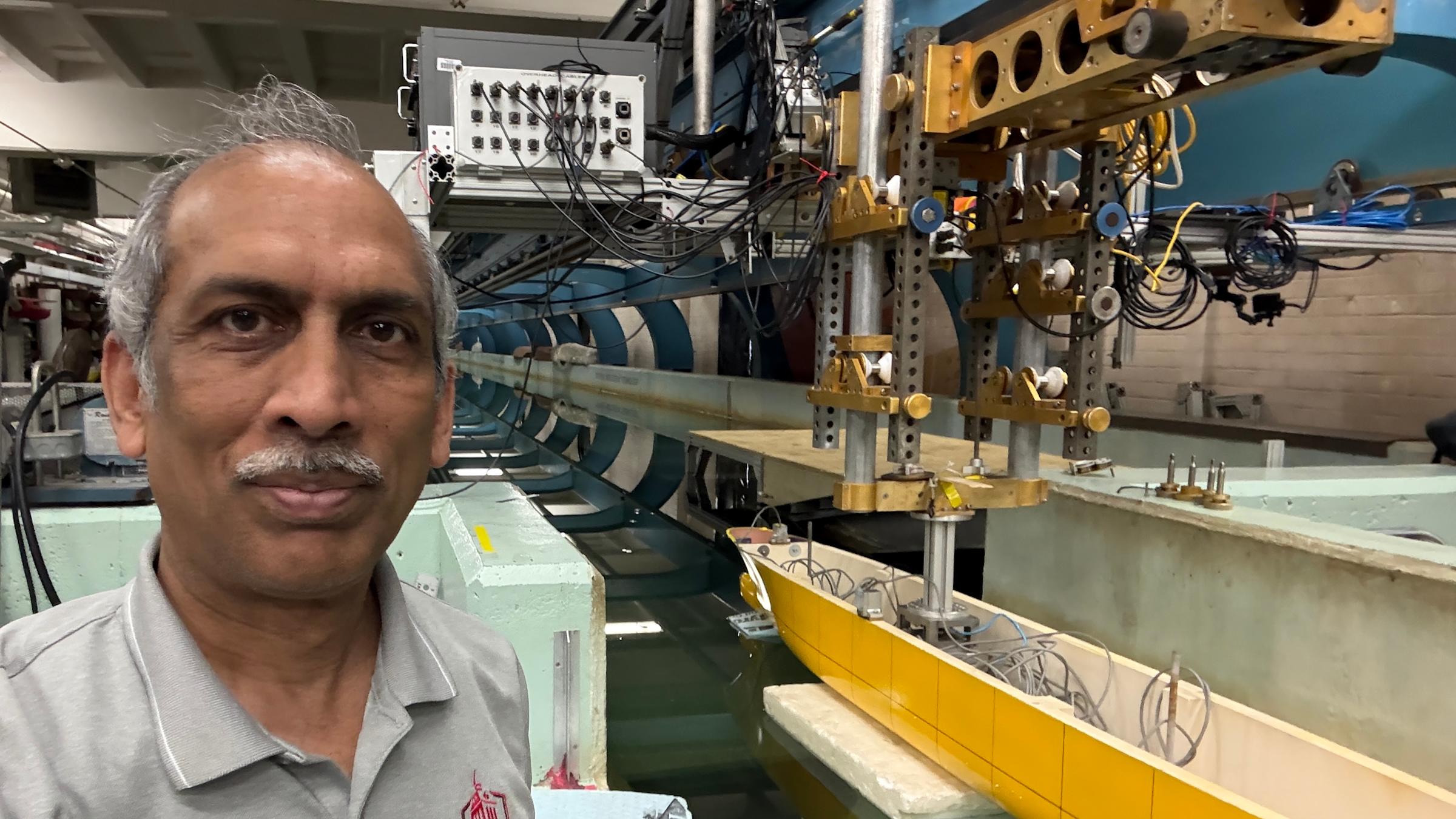
Raju Datla, a research associate professor in the Charles V. Schaefer, Jr. School of Engineering and Science’s Department of Civil, Environmental and Ocean Engineering and a researcher at Stevens’ Davidson Laboratory, has been appointed a NAVSEA Professor of Naval Engineering by the U.S. Naval Sea Systems Command (NAVSEA), among only 10 faculty nationwide selected.
The designation is part of Naval Engineering Excellence for the U.S. Navy (NEXUS), a new federal initiative designed to strengthen the pipeline of engineers who will design, build and sustain the Navy’s most complex maritime systems. The program brings together key Navy engineering and research organizations to expand education, research and workforce development in naval engineering.
“Being named a NAVSEA Professor is both an honor and a responsibility,” said Datla. “It reflects the strength of the work happening at Stevens, but more importantly, it creates new opportunities for our students to engage directly with real-world challenges in naval engineering. We’re preparing students to make meaningful contributions to a field that is critical to national infrastructure and security.”
Datla joins a highly selective cohort that includes faculty at the Massachusetts Institute of Technology, the University of Michigan, Virginia Tech, the U.S. Naval Academy and other leading institutions.
Decades of naval engineering research
The appointment builds on Stevens’ longstanding role in advancing naval engineering through the Davidson Laboratory‚ one of the nation’s oldest and most respected hydrodynamics and ocean engineering research facilities.
Founded in 1935, the lab has played a role in some of the most consequential developments in maritime technology, from early submarine design to wartime research during World War II. Today, its high-speed towing tank, the fastest of its kind for its size in the world, supports research on ship hull design, underwater vehicles, coastal resilience and emerging energy systems.
The lab operates as a major research enterprise, with more than a dozen full-time research faculty supported entirely by external funding, alongside doctoral, master’s and undergraduate researchers working on applied engineering challenges.
“This recognition underscores Dr. Datla’s standing within the academic and naval engineering communities and the depth and relevance of the work happening at the Davidson Laboratory,” said Muhammad Hajj, Department of Civil, Environmental and Ocean Engineering chair, George Meade Bond Professor of Ocean Engineering and director of the Davidson Lab. “We are combining our unique experimental tank facilities with advanced digital design and simulation capabilities to accelerate the path from discovery to deployable technology. Programs like NEXUS ensure we are building the workforce to match.”
Connecting students to high-impact careers
A central goal of the NEXUS initiative is to create clearer, more direct pathways from university programs into naval engineering careers.
Through affiliated programs such as the Naval Engineering Education Consortium (NEEC) and the Building Resources for Integration and Design in Graduate Education (BRIDGE), students gain access to internships, research opportunities and training experiences that can lead to careers in the federal workforce and maritime industry.
For Stevens students, particularly those in ocean engineering, civil engineering and related disciplines, the designation expands access to these pathways, connecting classroom learning and research to applied work in one of the nation’s most complex and consequential engineering sectors.
“This is about building a talent pipeline that is both highly skilled and deeply connected to real-world needs,” Datla said. “Our students are working on problems that matter‚ and through programs like NEXUS, they can see a clear path from their education at Stevens to impactful careers.”
Part of a broader national investment
The designation comes amid increased federal focus on rebuilding the nation’s maritime industrial base.
Recent initiatives, including the White House’s Maritime Action Plan, have emphasized workforce development, shipyard modernization and expanded domestic shipbuilding capacity. Federal agencies have also directed new funding toward workforce training and small shipyard revitalization, signaling sustained national demand for engineering talent in this sector.
Stevens’ participation in NEXUS aligns with that broader effort‚ reinforcing the university’s role in preparing engineers for critical national workforce needs.
Datla, who earned his Ph.D. in ocean engineering from Stevens in 1996, is a Fellow of both the Society of Naval Architects and Marine Engineers and the Royal Institution of Naval Architects. He also is a member of the American Society of Naval Engineers. His research spans marine hydrodynamics, high-speed craft design and wave energy systems, and he is a recipient of Stevens’ John P. Breslin Award for outstanding research in ocean engineering.
More information about internship pathways and graduate education opportunities is available at the NEEC website and the BRIDGE website, respectively.