Stevens Sets New Record with $77.3 Million in Research Funding
The Charles V. Schaefer, Jr. School of Engineering and Science at Stevens Institute of Technology marked a record year for research funding in fiscal year 2025, securing more than $77.3 million of the university's record $77.4 million in external awards. These investments reflect the school’s growing impact across healthcare, artificial intelligence, infrastructure, climate resilience, sustainability, and advanced engineering systems.
Numerous faculty and their research teams across the school contributed to the successful year in research with several groups securing funding for projects of $1 million or more:
Biomedical engineering and human health
A National Institutes of Health (NIH) grant of $2 million spurred a collaborative effort between Stevens mechanical engineering researcher Damiano Zanotto and Columbia University collaborators to monitor neuromuscular health, with Stevens contributing engineering and analytical expertise to improve tools for early diagnosis and intervention in neuromuscular disorders.
Primary investigators Jennifer Kang-Mieler and Yu Gan in the Department of Biomedical Engineering secured an additional NIH grant for $2.2 million to apply generative artificial intelligence to the rapid diagnosis of infant eye diseases, advance early detection and expand access to critical pediatric care through AI-enabled medical imaging.
Artificial intelligence, robotics, and cyber-physical systems
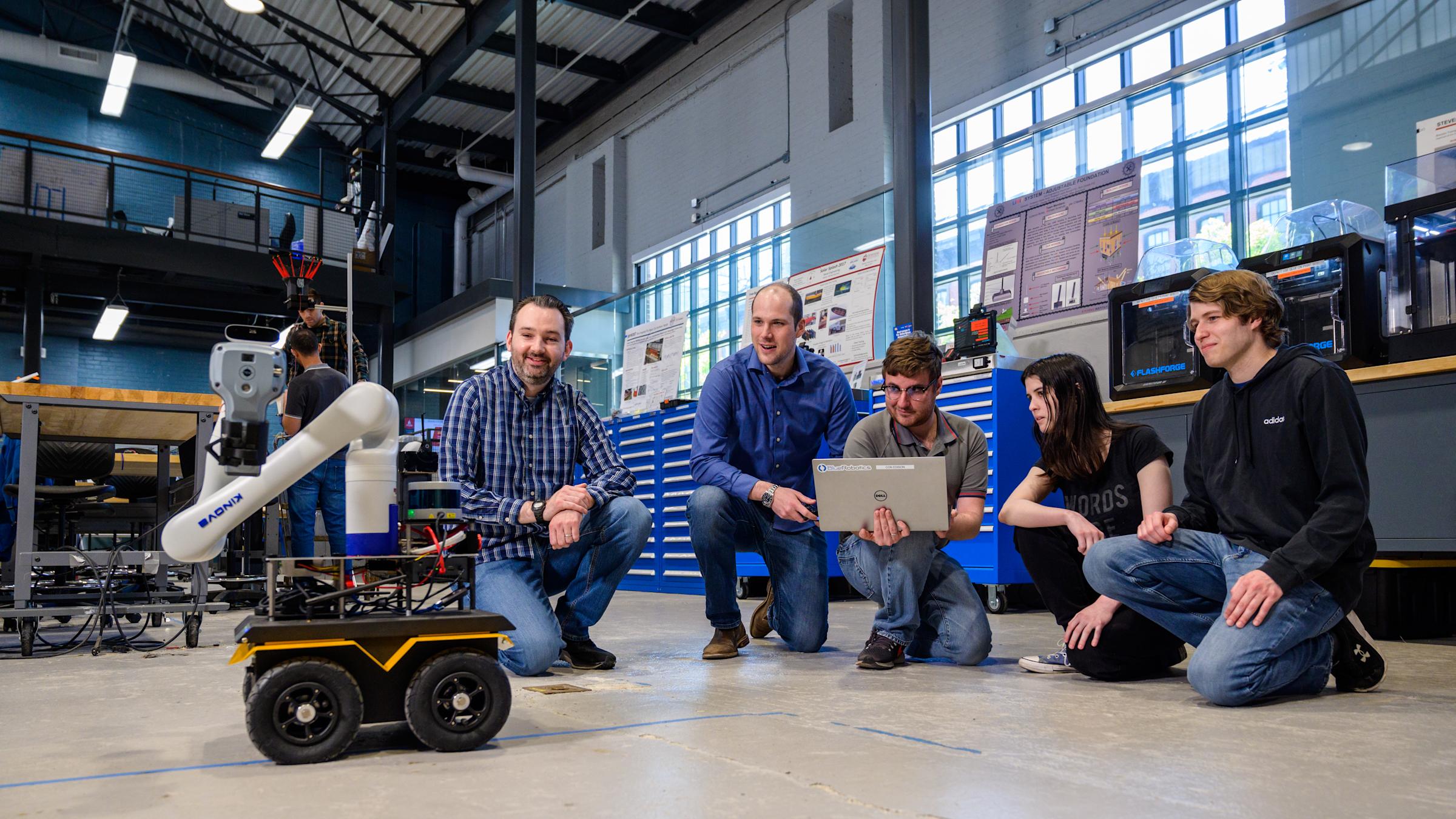
In the field of autonomous and robotic systems, a project led by Brendan Englot, professor of mechanical engineering, received a new award of $1.9 million from the Office of Naval Research (ONR) to advance autonomous boats and intelligent maritime technologies with applications in transportation, monitoring, and environmental observation.
Coastal resilience, climate, and environmental systems
Jon Miller, research professor in the Department of Civil, Environmental and Ocean Engineering (CEOE), received a total of $1 million from the National Oceanic and Atmospheric Administration (NOAA) and the New Jersey Department of Environmental Protection (NJDEP) to advance research on climate resilience, examining strategies to help communities better prepare for and respond to climate-driven risks.
Another $1.9 million award from the U.S Department of Energy (DOE) supported innovative environmental engineering research led by CEOE researchers Dibs Sarkar and Christos Christodoulatos, exploring the use of plants in nickel mining and remediation as a sustainable approach to resource extraction and environmental management.
Stevens was also approved by the National Science Foundation (NSF) as a founding partner for a new Industry-University Cooperative Research Center (IUCRC) that aims to develop marine energy resources, leveraging them to power a ‘blue’ economy by addressing technological, society, economic and environmental barriers that are holding back the growth of marine energy and blue economy. The Growing Ocean Energy Technologies and the Blue Economy (GO Blue) Center launched November 1, 2024 as a collaborative effort among Stevens, the University of Michigan and Texas A&M-Corpus Christi. The new 'GO Blue’ Center will work closely with industry partners to explore, develop and patent innovations in wind, wave and tidal power.
Energy, infrastructure, and advanced engineering systems
Civil engineering researcher Yi Bao and mechanical engineering researcher Jianmin Qu received $1 million from the U.S. Department of Transportation (DOT) for their study of pipeline integrity and monitoring, improving safety, reliability, and resilience in essential energy infrastructure systems.
Systems engineering researcher Amro Farid secured NSF funding of $1.7 million for his goal to help communities better manage complex energy and infrastructure systems through data-driven, systems-based approaches that integrate engineering, analytics, and decision science.
Mechanical engineering researcher Jason Rabinovitch was awarded $1.1 million by ONR to combine fluid dynamics with structural analysis to understand the mechanics and impact of rain droplets on vehicles traveling at supersonic speeds.
Crowning achievements
In addition to the research funding awards, two Stevens researchers were honored by the federal government for their career achievements.
Electrical and Computer Engineering Research Professor Victor Lawrence received the National Medal of Technology and Innovation, which recognizes individuals and organizations for lasting contributions to America’s competitiveness, quality of life and a strengthened technological workforce.
Department of Mechanical Engineering and George Meade Bond Endowed Professor Nicholaus Parziale received the Presidential Early Career Award for Scientists and Engineers, the highest honor bestowed by the U.S. government on outstanding scientists and engineers early in their careers.
Learn More About Research at the Schaefer School: