A Global Partnership Comes to Life: Inside the Stevens–École Centrale de Nantes Dual Ph.D. Program
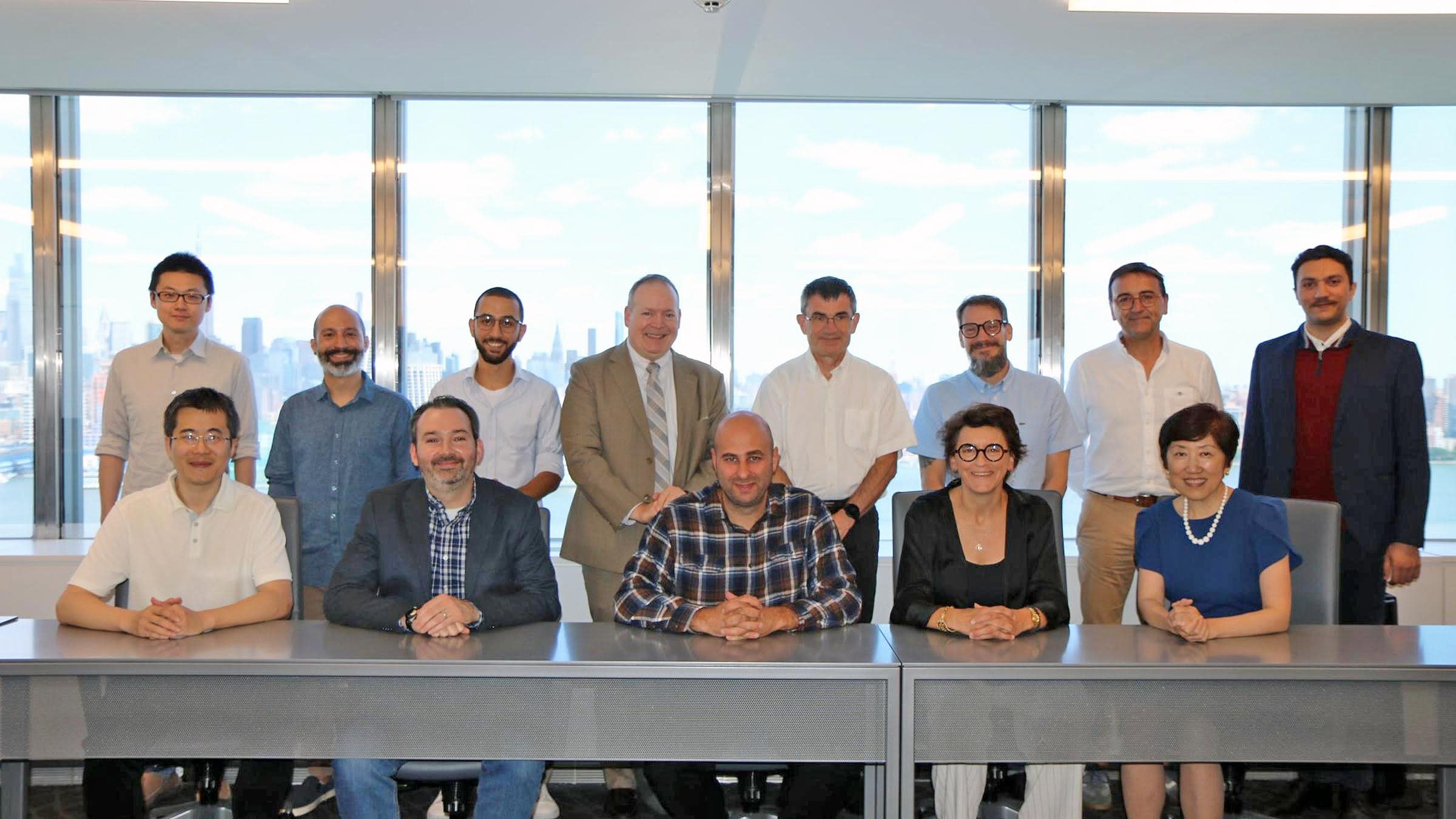
When senior leaders from renowned French university École Centrale de Nantes (ECN) visited Stevens Institute of Technology in June 2026, it was more than a ceremonial meeting. The visit reflected the strength of an innovative international collaboration that is creating opportunities for research, student mobility and global engineering leadership.
Since its 2024 launch, the Stevens-ECN dual Ph.D. program has welcomed six French engineering students to pursue both a U.S. Ph.D. from Stevens, and a French doctorate from ECN. Two more ECN Ph.D. candidates will begin their studies in the fall, and plans are underway to have Stevens students join the program and study at ECN.
"This strategic collaboration represents a new scope of our global graduate engineering education,” said Jean Zu, Lore E. Feiler Dean, Schaefer School of Engineering and Science. “Rather than simply exchanging students, now we're co-training doctoral researchers and building lasting partnerships while strengthening Stevens' global reputation for top-notch engineering education and research.”
Preparing global engineering leaders
Students complete two years of their doctoral program at ECN and two years at Stevens, in areas spanning signal/image processing (electrical engineering), mathematics, robotics (mechanical engineering) and civil engineering — fields that are among Stevens’ core research strengths.
For the students, this program provides the opportunity to experience two academic environments while benefiting from continuous mentoring by advisors working together at both schools. Those experiences shape not only their research, but also how they approach engineering challenges.
Noé Pigret ’28, who is earning his dual Ph.D. degrees (in mechatronics, robotics and automation engineering from ECN, and in mechanical engineering from Stevens), appreciates the unique personal and broader benefits.
 “It has made me realize that, despite the distance and differences, research and engineering share common foundations and a universal language that enable mutual understanding and collaboration,” Pigret said. “I believe this is one of the greatest treasures of science.”
Stephane Morcos Douaihy ’29 is pursuing his Stevens and ECN Ph.D. degrees in computer science and attended the July visit with ECN. He has also found that working in two research environments has redefined his perspective on engineering problem-solving.
“Balancing ECN’s deep analytical rigor with Stevens’ entrepreneurial, application-focused culture in the NYC metropolitan area has taught me to view research through both an academic and real-world deployment lens,” he noted. “It trained me to design artificial intelligence architectures that are not only theoretically robust, but also scalable, energy-conscious and ready for industry adoption.”
Douaihy says those experiences have also reshaped his view of what international collaboration can accomplish.
“This partnership does more than just award two degrees,” he continued. “It cultivates cross-cultural researchers capable of tackling complex global engineering challenges. Navigating two distinct academic and industry landscapes has been one of the most transformative chapters of my engineering career.”
He particularly recalled the defining moment of submitting his first Ph.D. paper.
“Working seamlessly across time zones and languages with my advisors from both ECN and Stevens, I realized how rare and powerful this dual mentorship is,” he explained. “Synthesizing top-tier French research methodologies with American industry-aligned vision gave me the confidence that our work on Edge AI isn't just academic. It has the potential to drive world-class, planetary-scale impact.”
Building research partnerships that last
While students are the heart of the program, the long-term vision reaches much further.
Faculty from both universities work together on an ongoing basis to recruit students, define research projects, supervise doctoral work and exchange ideas.
In addition, for the expert advisors on both sides of the Atlantic, every doctoral candidate naturally creates opportunities for enduring research partnerships to generate new ideas, collaborations and opportunities long after individual students graduate.
As a result, the program has evolved into an active research community across a growing range of engineering disciplines.
“The faculty begin thinking of one another as collaborators, and these partnerships often lead to opportunities for research projects and publications that likely would not have developed otherwise,” said Christophe Pierre, Jess H. Davis professor of mechanical engineering at Stevens.
The team is also exploring ways to expand the collaboration, including virtual joint research centers, to continue building a partnership that advances engineering research, innovation and Stevens' global presence.
“It’s a great example of what can happen when two institutions with similar missions and complementary strengths work together toward a common goal,” Pierre said. “By combining our expertise, both universities can accomplish more than either could independently. That benefits our faculty, our students and ultimately the quality and impact of the research itself.”