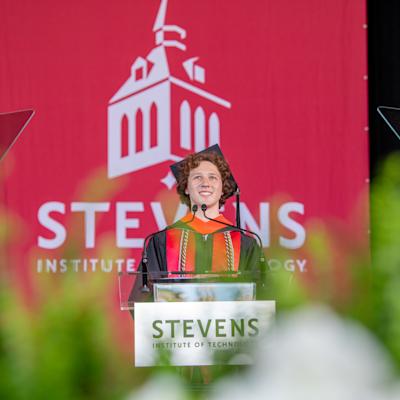
A New Frontier for Aerospace Engineering at Stevens: Meet Daanish Maqbool

When Daanish Maqbool joined Stevens’ Department of Mechanical Engineering on September 1, 2026, he brought deep industry and academic experience in aerospace engineering — and a passion for preparing the next generation of aerospace engineers and researchers to push the limits of speed and engineering in the Earth’s atmosphere and beyond.
As the university’s new Associate Professor of Practice and Director of the Aerospace Program, Maqbool is poised to build upon the department’s distinguished foundation and rapid expansion.
“In collaboration with NASA, national laboratories and military research centers, we are advancing research across hypersonics, autonomous systems, dynamic controls and artificial intelligence,” said Souran Manoochehri, Chair, Department of Mechanical Engineering. “With his scientific background, flight vehicle technology development and deployment work and success building an aerospace organization from the ground up, Daanish is the right person to grow the aerospace program at Stevens.”
The experience, expertise and energy to fuel aerospace engineering studies
Maqbool has always been interested in science, math, engineering — and “anything that was fast and loud.”
“It wasn’t just about the theatrics or the adrenaline aspect,” he recalled, “but rather that it was an impressive physical manifestation of scientific and engineering accomplishment.”
Maqbool's academic career began with propulsion studies at Massachusetts Institute of Technology, followed by a Ph.D. in aerospace engineering at the University of Maryland, where he tackled complex scientific problems in laboratory environments and published his findings in leading journals.
He then spent a decade turning research into real-world technology as founder and CEO of North American Wave Engine Corporation, which designs and builds jet engines that use pressure waves rather than moving parts. Maqbool developed the technology to dramatically reduce the cost and complexity of high-performance jet aircraft.
In addition, he has worked on aircraft development programs with government and industry partners, and overseen the development of unmanned aerial vehicles (UAVs) from a clean sheet of paper to flying devices.
After having spent his career immersing himself in novel aircraft designs and propulsion systems, he is still excited about the evolving field of aerospace engineering, particularly in the areas of alternate energy sources and the increasing miniaturization and cost-effectiveness of sensors and autopilot systems.
“Passenger aircraft like the Boeing 737 or Airbus A320 look very similar because their design has been optimized over a century of development,” he explained. “However, designs for the emerging class of smaller UAVs look very different because the technical constraints and mission requirements are very different. These designs are still being actively developed and debated and present interesting technical challenges.”
As his industry career progressed, Maqbool also returned to the classroom, teaching aerospace propulsion as an adjunct professor in the Johns Hopkins Engineering for Professionals Mechanical Engineering program. That work has yielded unexpected benefits.
“Teaching allows me to give back to society, which is satisfying,” he said. “Teaching is also an effective method to keep my foundational concepts sharp. Being constantly questioned by smart students requires me to stay on my toes, and I enjoy that. It also allows me to understand what is of interest to the next generation, which satisfies my curiosity and allows me to constantly shape teaching curriculum and research priorities.”
Fueling Stevens’ aerospace legacy
Stevens has been steadily building its aerospace capabilities for years. Faculty including Nick Parziale, George Meade Bond Professor of Mechanical Engineering, and Jason Rabinovitch, assistant professor, have expertly led research in areas ranging from hypersonics and fluid dynamics to UAVs and space systems, while growing student interest has fueled new courses, research opportunities and hands-on experiences.
Stevens graduates regularly launch careers as aerospace, aerodynamic and systems engineers with organizations including aerospace engineer, aerodynamic engineer, and systems engineer with organizations including Blue Origin, Boeing, Lockheed Martin, NASA, Northrop Grumman, RTX and SpaceX.
As a growing population of students demonstrates enthusiasm in joining their laboratories and conducting aerospace research, the team has offered more courses and cutting-edge research opportunities. Faculty are also active in innovative research projects.
Recent examples include hands-on experience in fluid dynamics and aerospace engineering preparing a test article for a shock tunnel simulating flight speeds up to Mach 6 in the specialized wind tunnel in Parziale’s lab; partnering with NASA to examine climate, monitor astronauts and develop planetary roving and landing technologies; and introducing a specialized aerospace minor and the graduate-level Master of Aerospace Engineering program.

When Stevens decided to officially launch its formal aerospace engineering program, Maqbool was a natural choice to lead this high-profile area and develop a modern, relevant curriculum to take the program and its students even further.
“His work with industry partners and end users, including fighter pilots, has given him a keen understanding of the technical and economic complexities of taking laboratory-scale results to full-scale commercial systems,” Manoochehri said, “including the realities often left out of a conventional classroom, from cost and quality control to securing capital and industry partners.”
His experience also gives him firsthand insights into how emerging technologies can challenge conventional aerospace practices, and how the industry must adapt.
“Traditional aerospace engineering programs often shy away from discussing futuristic propulsion concepts like warp drive as we’ve seen in science fiction,” Maqbool said. “However, these concepts are grounded in some form of physical reality. I think it’s important to expose students to things that seem like purely sci-fi and explain some basic physics that can serve as the catalyst for discovery and lead to the next major breakthrough.”
As Director of the Aerospace Program, Maqbool plans to expand the curriculum, particularly through lab-based courses in which students design, build and even fly aircraft. He also hopes to draw on his industry connections to bring guest speakers, inform student design projects, create research opportunities and help students develop pathways into aerospace careers.
“I hope to leverage the capable high-speed aerodynamic test facilities and UAV testing capabilities at Stevens to spark more partnerships and research opportunities,” he noted.
In the longer term, he aims to expand the program across the full breadth of aerospace engineering, grow enrollment and build a contemporary, hands-on program focused on UAVs, autonomous systems and space systems.
“With one of the country’s oldest mechanical engineering departments that also hosted the founding of the American Society of Mechanical Engineers, Stevens has an admirable heritage in this branch of engineering,” Maqbool said. “Having the chance to lead the next chapter by establishing the aerospace program is an honor and an opportunity to build something worthwhile and lasting.”
Learn more about aerospace engineering programs and research in the Department of Mechanical Engineering: