If They Build It, They Will Learn
When Professor Aron Lindberg began the new AI Build Studio, he had a plan that included four projects, a calendar and a finish line. What he didn’t define was the precise route to reach it. The paths to an autonomous ground vehicle, a coworker drone, a research agent and a documentary to film were up to the students.
The first session of the Build Studio ran from June through August and culminated in a public “Open Studio,” where the four teams presented their work to industry judges.
“It’s an attempt to connect the work that our faculty and students do more deeply to the problems that we see in our local communities, whether it’s industry, government or civil society,” said Lindberg, associate professor and the School of Business information systems and analytics area chair. “We want our students to work on real challenges, real problems and create real solutions, and not just conduct classroom exercises.”
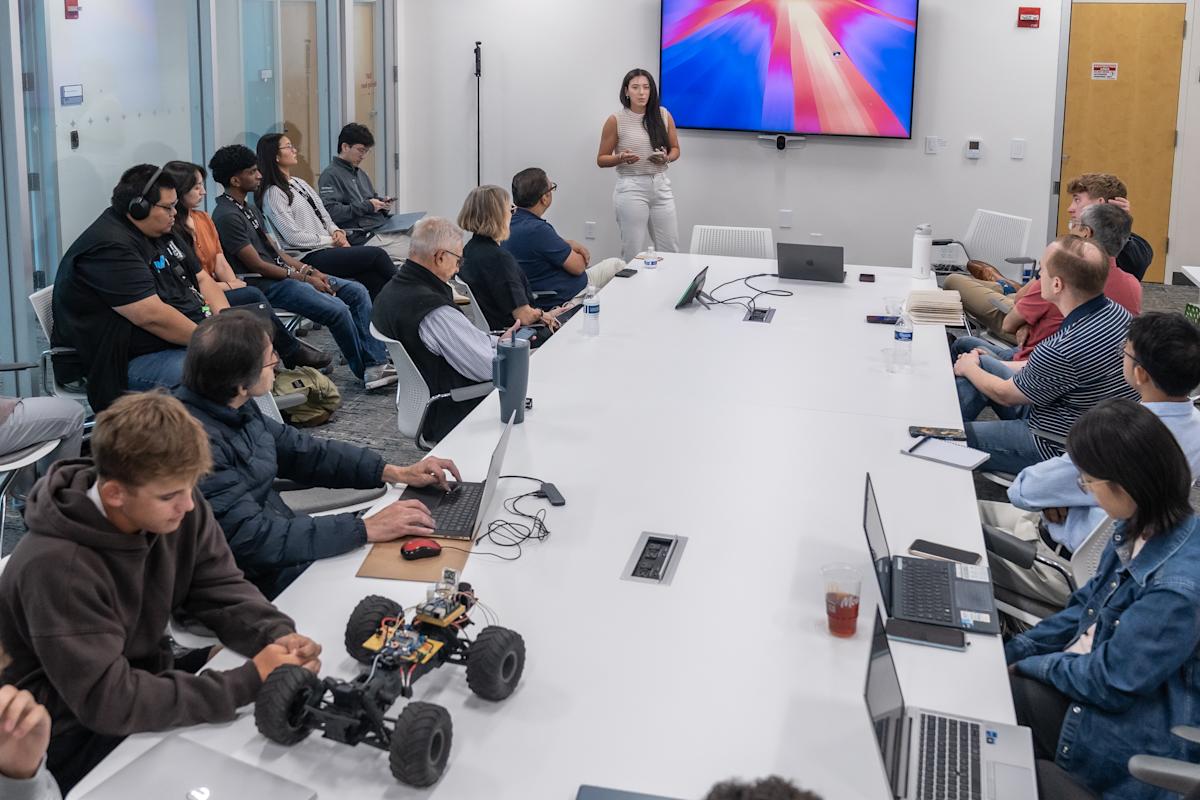
The teams met each Monday for a full-day workshop that included literal construction and the chance to build their knowledge base around careers in artificial intelligence. Sessions ended with a visit from an industry guest, including venture capitalists, startup founders, a patent attorney, product leaders and AI specialists. Before speaking with the class, the guests heard project updates and offered feedback.
For a group made up largely of engineering and computer science students, those conversations filled a gap.
“A lot of our students are technically very talented,” Lindberg said. “A lot of them told me that it was really useful for them to get feedback from a business perspective and learn about not only how do I create a better thing, but how do I create something that could be commercially viable, something that could actually solve some problem for some set of real users out there in the world?”
A business school program filled mostly with engineers is not a contradiction. The multi-disciplinary approach reflects the advantage of Stevens’ size and technology focus, which make it easier to work across schools and departments.
“As we move forward in the new world that’s emerging with AI technologies being integrated in everything that we do, I think human knowledge that cross-pollinates across multiple domains is going to become a lot more valuable,” he said. “I love having engineering students come work with us here at the School of Business. It creates a very special learning environment where learning is done through building, which I think is a crucial way of approaching learning in the age of AI.”
Build Studio will be a central component of the School of Business’ new Business and AI undergraduate major, in which students will build projects throughout their four years and graduate with examples of their work that demonstrates real-world application.
“I want each of our students to graduate with that type of portfolio so that they have more than a degree and a great transcript,” Lindberg said. “They actually have clear evidence of things that they’ve built.”
THE PROJECTS
Autonomous Ground Vehicle
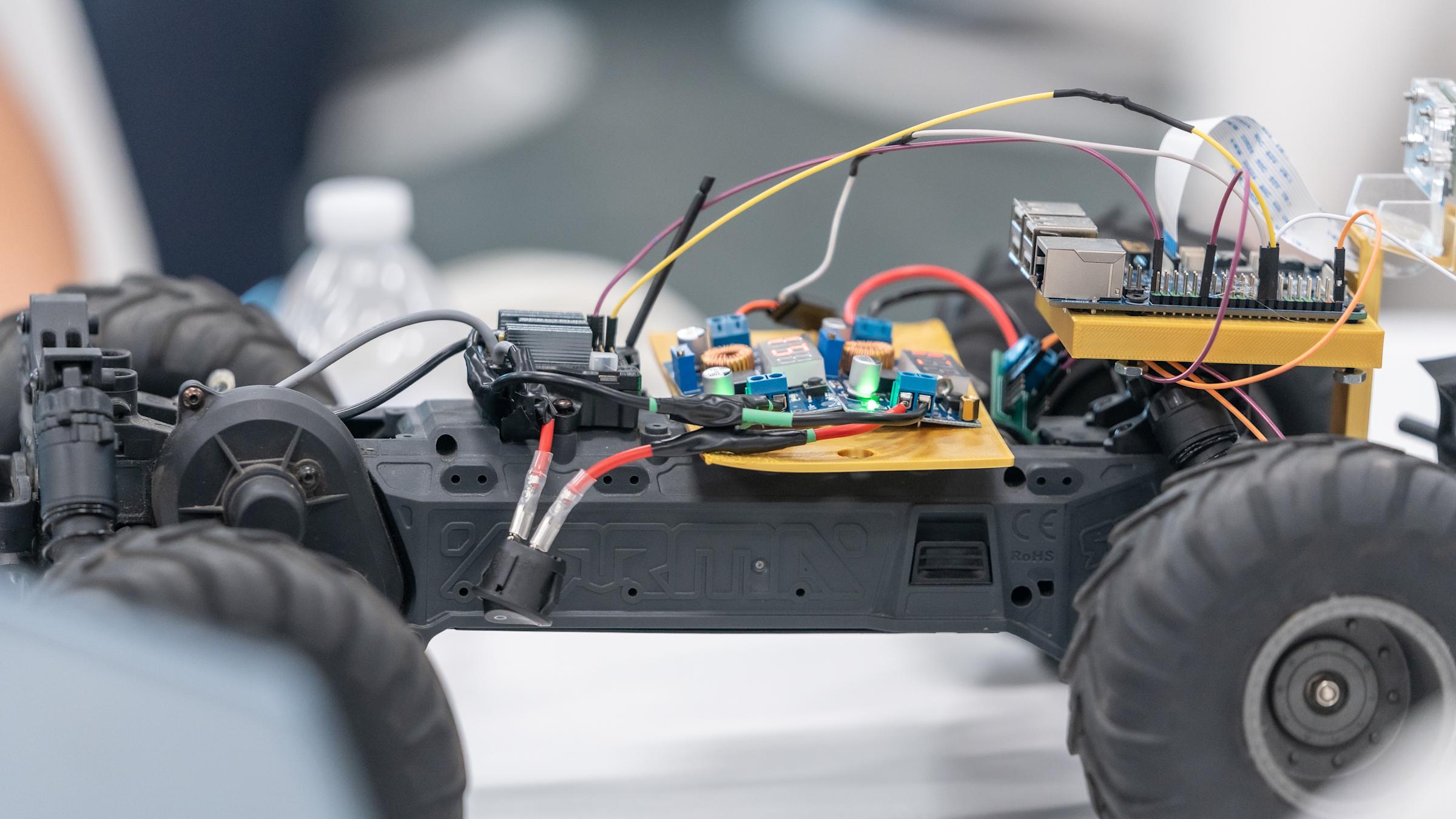
Most self-driving technology assumes there is a road. Starting with a traditional remote-control vehicle (RCV), this team set out to build something that could drive itself through Stevens Park and avoid obstacles along the way. The team converted the RCV to microcontroller control, wrote code that used camera data to steer around obstacles and trained an AI model to recognize a small set of impediments, laying a foundation for future Build Studio teams. Long-term uses of the idea could contribute to research on autonomous navigation in unstructured environments such as disaster zones, farmland and off-grid sites.
AI Coworker Drone
Workplace safety inspections often put people in harm’s way. This team continued a project started in 2025, developing a voice-commanded quadcopter designed to work alongside humans in hazardous settings such as construction sites, mines and forests. This summer, the team integrated a camera with an image recognition model trained to identify fractures in walls, calibrated the drone’s flight electronics and rebuilt its frame for better flight stability.
Lens Agent
When everyone relies on the same AI tools, ideas start to look the same. The Lens Agent is an AI research agent built to bring the hidden assumptions in typical AI outputs to the surface and generate directions that diverge from them. The team tested it against two baseline agents on novelty, diversity, evidence support, assumption challenge and usefulness.
The AI Generation Documentary
AI can mean vastly different things to people, often based on the generation they belong to. Madison DiSarno interviewed Stevens students, Hoboken residents and members of older generations for a documentary on how people experience AI in everyday life. She also captured the other Build Studio teams at work throughout the summer.
IN THEIR WORDS
Why did you want to participate in Build Studio?
Stanislav Daaboul (Autonomous Ground Vehicle | Civil Engineering | Brooklyn, New York): “I went into this experience mostly with the intent of using my Pinnacle Scholars stipend and getting some kind of hands-on research experience. Professor Lindberg’s project caught my eye since I was already interested in autonomous navigation after doing a similar project in my engineering design class, and I’m interested in transportation in general.”
Ted Janaqi (AI Coworker Drone | Mechanical Engineering | New York City): “I really liked the idea of being able to practice presenting and ‘selling’ a product at different points throughout its development. Even from the beginning, when there was very little progress to show, I had the opportunity to make a pitch and explain to industry professionals why an idea was valuable and what my thought process was in moving it forward. The Build Studio gave me a hands-on project with plenty of creative freedom and problem-solving opportunities and then provided a forum to improve my entrepreneurship skills, receive feedback and remember how to keep my work efficient and realistic.”
What did you set out to do, and what did the final product look like by the end of the summer?
Jocelyn Mo (Lens Agent | Computer Science | Queens, New York): “AI tools are very efficient and give seemingly accurate and trustworthy responses. But when people take AI answers as truth and incorporate them as their own ideas, at a group level, we see a decrease in creativity. You may have heard the term ‘trend slop,’ which refers to generic, buzzword-heavy advice that sounds impressive but lacks feasibility or real-world context. If everyone uses the same ideas for their research or inspiration, what kind of impact does that have on innovation and our creative output as a human race? We only had a summer to tackle these huge issues, so we focused on designing an evaluation framework and an experiment to test whether our agent truly generated more creative outputs. We came up with a pipeline that extracts the underlying assumptions of normal LLM outputs and deliberately comes up with directions that diverge from them.”
Madison DiSarno (Documentary | Business Undecided | Long Hill, New Jersey): “I definitely had a vision in my head of how I should structure this documentary. I did a lot of interviews, but then I realized that it’s not really about what I’m saying or what I want this film to be. It’s what the people are saying, and they shape the video. Instead of being biased and creating a film around what I wanted it to be, I let people talk and followed the storyline that way. It actually worked out a lot better. You can see the perspectives of students and what they were doing with AI, and then people who aren’t students and how they view AI, including some people who have no idea what AI is.”
Build Studio bills itself as “not a planning exercise.” When did your team have to start building and figure it out as you went?
Stanislav Daaboul: “Honestly, that came on the first day. We were given a remote-controlled robot without instructions on how to make it autonomous, so we right away researched and ordered parts that would meet that first minimum requirement, even if they couldn’t be guaranteed to hold up for all the functionality we eventually wanted. We ordered cheap parts, like a $10 component that was both a microcontroller and a camera, which we ultimately had to replace because it couldn’t process the data fast enough. That happened toward the end of the project, and replacing that part meant replacing other parts, too. We pushed through by researching, ordering new parts and letting go of our old design, since it simply no longer served us. We were able to rebuild with the new camera in time.”
Ted Janaqi: “The drone’s body was originally custom-made from 3D-printed PLA plastic. While the design was impressive, it couldn’t safely carry all the necessary electronics, and the flimsy plastic had vibration issues that prevented flight. We didn’t know that from the beginning, so all of our original electronics setups and motor testing were done on that build. We didn’t realize it would have issues until we were finally ready to flight-test it in the Stevens Safe Autonomous Systems Lab. To adapt, we had to order a whole new carbon-fiber frame and work on a new electronics setup. The final days of the project were trial and error, trying different setups for all the drone’s components on the new frame.”
How did hearing from venture capitalists, founders and product leaders change the way you approached a technical build?
Jocelyn Mo: “As a computer science student, the weekly exposure to the business side pushed me to think more about who our potential stakeholders would be, what our agent’s edge would be in today’s market and how to pitch our project to non-technical people. One piece of feedback that stuck with me was about our presentation. I mentioned how a class here at Stevens inspired me to choose this project, and one guest told me he wanted to hear more about that personal connection. He said it’s much easier to connect to a presenter who leads with those personal anecdotes.”
Stanislav Daaboul: “It forced me to take a more human-centered approach to the project and make sure I could effectively communicate the importance of what we were doing. It also forced us to consider what novelty we were actually adding through our design, and for us, that was the AI aspect of the sensing. One piece of advice was to use what has already been built and build on it. We were told to look into the algorithms from companies like Roomba. Looking into things rather than doing them from scratch saved us time and allowed us to make more of a real difference.”
What did this experience teach you about AI?
Ted Janaqi: “This project gave me real insight into the integration of AI technology with human expertise and capability. It’s easy to get caught up in the idea that AI’s function is to replace human involvement in just about anything, but it can easily be tailored to human benefit and cooperation in so many ways. Even with all its capabilities, this drone concept would require human management. It’s being built around easy, user-friendly collaboration with a skilled human worker who could command it and interpret the data it collects.”
Jocelyn Mo: “All computer science majors are required to take a humanities course called “Computers and Society.” I had it with Dr. Detwiler, and the way she taught it really resonated with me. Although it was a humanities course, I learned a lot about how LLMs are essentially language predictors trained on huge datasets, and how even the slightest biases in that data are propagated through generated responses. That focus on how LLMs are perceived and used in society is what drew me to this project in the first place, and I've learned so much more about how we can more consciously and responsibly use AI in practice through this experience."
Madison DiSarno: “A lot of people in my documentary talk about being worried about jobs being taken away. But one of the guests who came in said you don’t need to worry about AI taking your job if you can use AI. If you can use AI to do the job you think it could take over and then build off of that, you’re doing a lot more. Some circumstances could be very different, but I think that’s a key point to remember.”