Financial Engineering Students Excel In Worldwide Competition
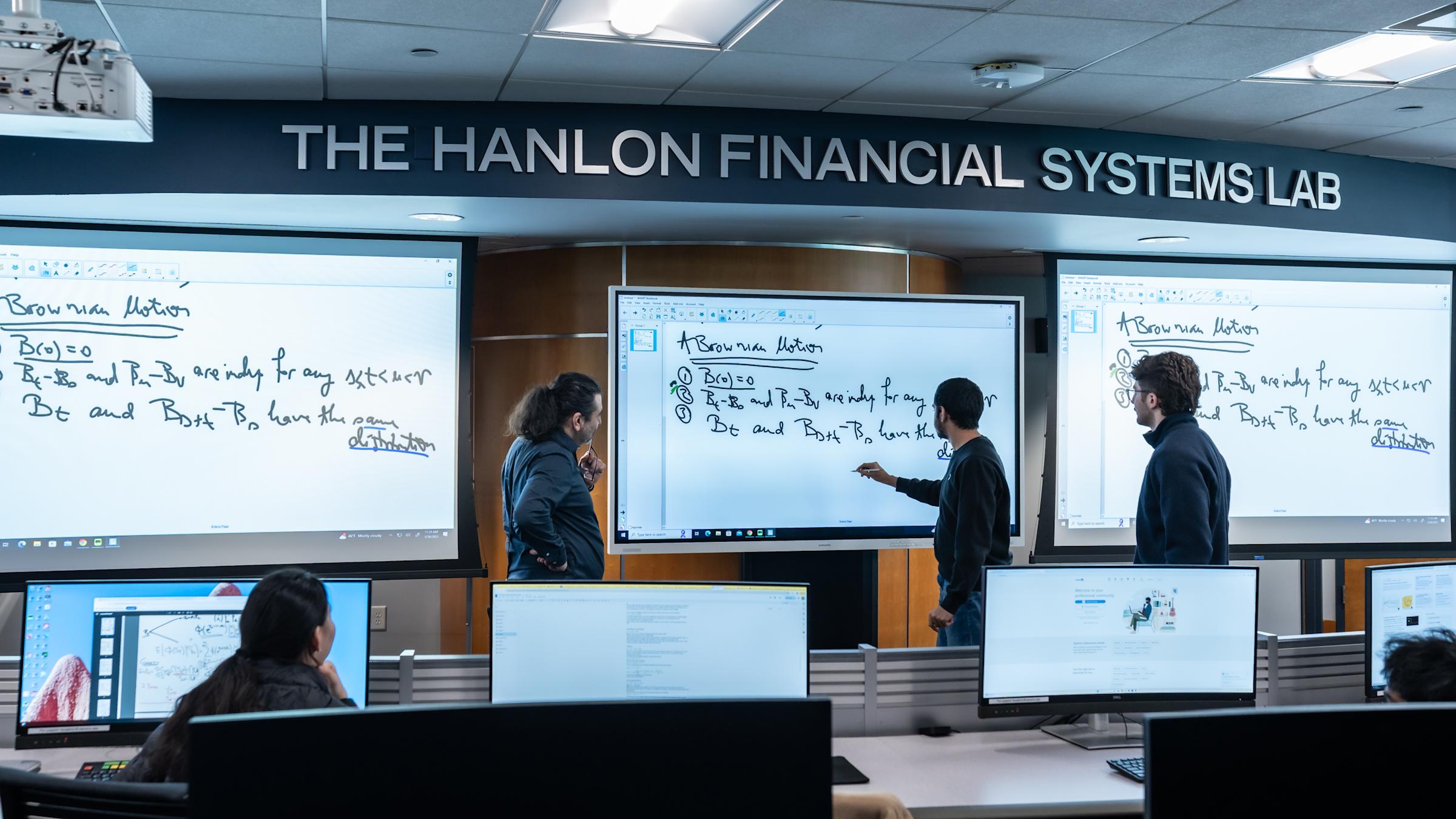
The Stevens School of Business Hanlon Financial Systems Center is full of state-of-the-art Bloomberg Terminals, so it should not come as a surprise that the students who utilize them every day were so successful in the 2025 Bloomberg Global Trading Competition.
Stevens placed two teams in the top 10% of competitors worldwide, including the Capital Crushers, which placed 160th out of 2,732 teams. The team consisted of five graduate students in the school’s Financial Engineering Master’s Program: Gabriela Angelkoska (captain), Hao Cai, Malea McMurray, Claudia Young and Heyuan Zhuang.
The annual Bloomberg Global Trading Competition is the only university investment competition conducted solely within the Bloomberg Terminal. It challenges teams of three to five students to manage a virtual $1 million portfolio with strict rules, including long-only positions, no leverage and no single stock exceeding 20% of total investments. Teams could choose from more than 10,000 stocks in the Bloomberg World Large, Medium and Small-Cap Index.
"This was my first trading challenge, and it was a great learning experience," Claudia said. "I got to see market moves in real time, translated a simple strategy into actual orders and learned about the workflow inside the Bloomberg Terminal."
The Strategy
The Capital Crushers developed a comprehensive, data-driven approach that leveraged many of the lessons they learned at Stevens.
"The team conducted research across platforms, including Bloomberg, Yahoo Finance and Seeking Alpha to identify quantitatively strong stock candidates," explained Dan Pirjol, SSB Industry Professor and the team’s advisor. "To expand their global exposure, they used the Bloomberg Terminal to filter based on one-month price change, market cap, ROE and debt-to-equity, which helped them identify high-potential stocks in Asia."
Their winning positions included strategic investments in AI and high-quality healthcare stocks, which provided steady returns. The team also maintained a gold position during risk-off days, demonstrating sophisticated portfolio management.
The effective strategy helped counter the challenge of a compact trading window.
“The most challenging aspect of this competition was the five-week window,” Malea said. “It aligned with some newer mid-frequency trading techniques that we were not the most familiar with and had to learn as we went. Three of the five of us work full-time, and finding enough hours in the day was challenging because this competition does require a lot of research and planning.”
"That is exactly what made it a challenge,” agreed Claudia. “It forced us to step out of our comfort zones, manage competing priorities and become more disciplined. Growth often comes from being uncomfortable, and this experience reminded me that pushing through those moments is how we become better students, professionals and collaborators."
The Stevens Advantage
The team built its success on a foundation of rigorous coursework and hands-on training, hallmarks of the Stevens experience.
"Several courses helped build the foundation I relied on throughout the competition," Young explained. "At Stevens, Pricing and Hedging and Portfolio Theory and Applications gave me the quantitative tools and risk-management frameworks needed to evaluate opportunities and understand the behavior of financial instruments."
The theories and technology learned in the Pricing and Hedging course were a common theme.
"I believe the most beneficial class at Stevens to prepare for this class is Pricing and Hedging,” Malea echoed. “It gives insights into portfolio diversification, why balance is important, research into markets, how to use the Bloomberg Terminals and hedging techniques."
"I felt like it really showed us how valuable the coursework here is at Stevens in preparing us for the next chapter of our lives,” she continued. “I know a lot of us in the group want to pursue more quantitative finance roles.”
Gabriela had the added benefit of completing her B.S. in Business and Technology with a concentration in finance and computer science at Stevens.
"This challenge is an excellent opportunity for students to become more comfortable navigating the Bloomberg Terminal and applying classroom concepts in a live market setting,” she said. “Having taken Introduction to Financial Tools & Technology during my undergraduate studies at Stevens, along with the analytical tools I've developed in my master's coursework, the experience really gave me confidence in my ability to interpret market signals and translate them into practical trading decisions."
Lessons Learned
Reflecting on their experience, the team offered sage advice to Stevens students considering similar competitions.
"Prepare early," Claudia said. "Do your research, ask questions, ask many questions and don't hesitate to consult your professors or advisors. Most importantly, be ready to invest the necessary time."
Malea stressed the importance of taking the leap and participating in these opportunities to challenge themselves because the results can sometimes lead to important discoveries about how they view themselves.
"I would encourage students to participate regardless of their knowledge in finance or how prepared they think they are,” she said. “I wasn't expecting to do so well in this competition, but I'm really glad we pushed ourselves to participate. I always considered myself more of a mathematics and statistics person, but now I am starting to see myself as someone with some quantitative skills who truly has an interest in markets."
Perhaps most importantly, the experience demonstrated that, with the proper preparation, strong fundamentals and the collaborative spirit that defines the program, Stevens financial engineering students can excel on the global stage.