Stevens Data Science Program Graduate Takes First Place at Global Competition
Organizations are at a tipping point — shifting AI initiatives from pilot to real-world deployment — but data governance and security pose challenges. Organizations need secure, governed AI systems that help protect their data, reduce long-term costs and lower the risk of breaches.
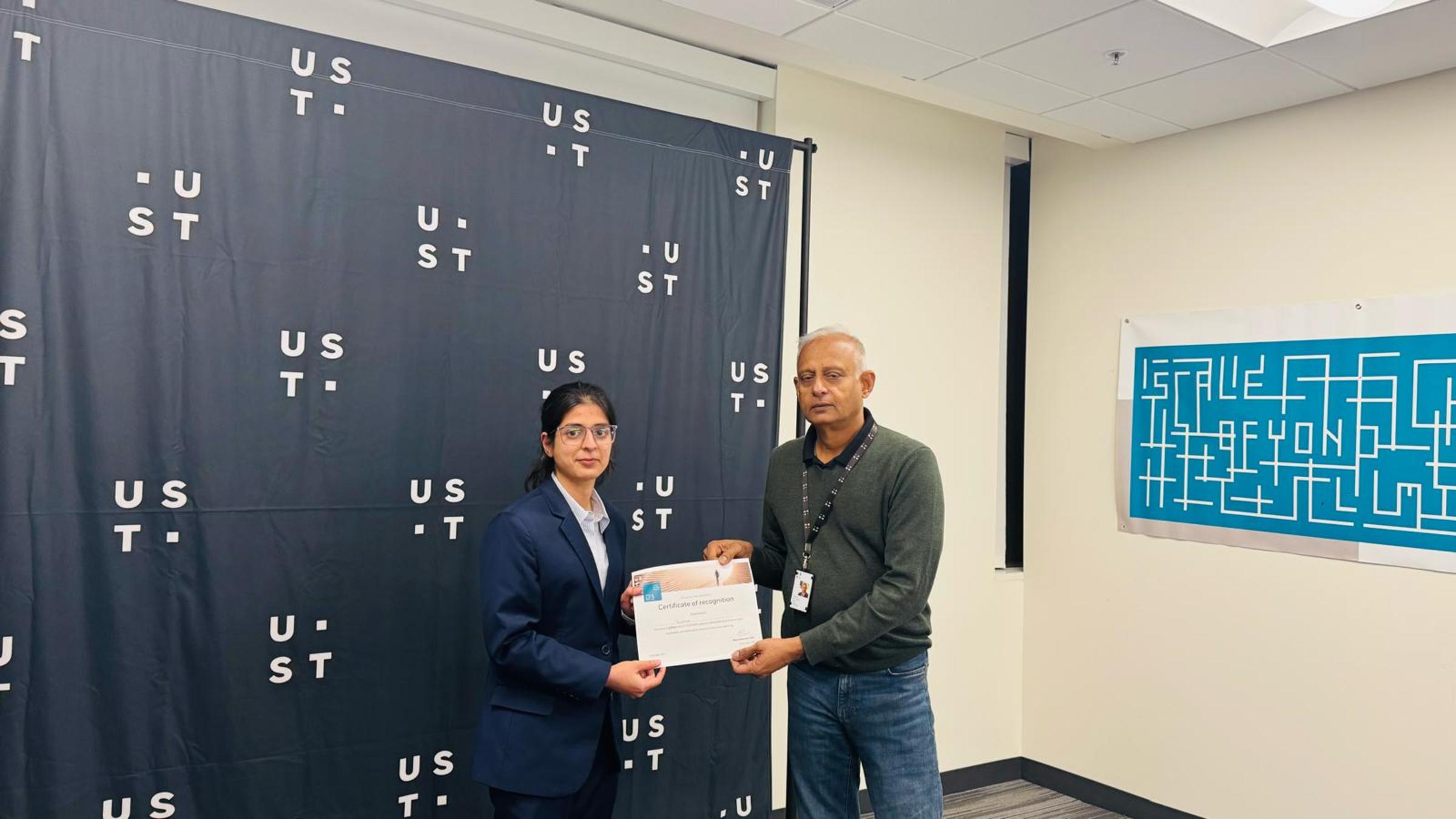
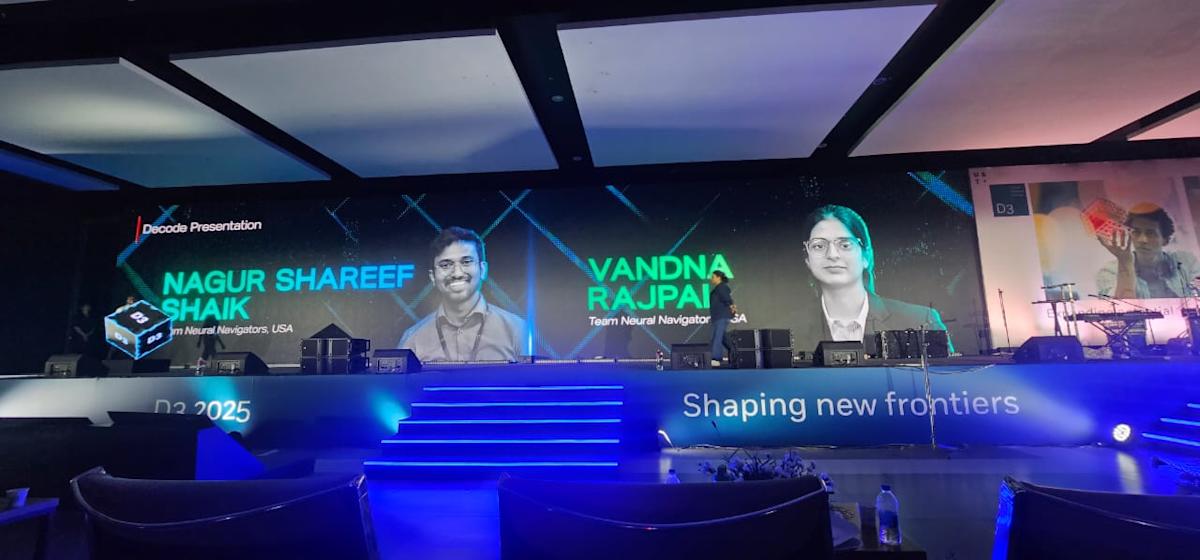
Vandna Rajpal ’25, a graduate of Stevens’ Master of Data Science program, saw these trends firsthand and co-developed a solution that won first place at the D3CODE 2025 Global Hackathon, a major event hosted by UST that challenges students to solve real-world problems.
The team, Neural Navigators, who included Rajpal and Nagur Shareef Shaik, Ph.D., from Georgia State University, designed PRISM (Predicting and Reporting Insights with Scalable Models), an AI-powered data intelligence solution, with a simple concept in spirit: “Organizations should be able to ask questions of their internal knowledge without pushing private content onto the public internet, and without mixing information across users, teams or databases.”
Rajpal considers winning the competition a deeply meaningful milestone. “Being an international student, coming from Pakistan, representing my country and representing my college on a global stage — it’s obviously a moment of being proud of yourself,” Rajpal said.
AI with governance: What enterprises are asking for now
Organizations are swimming in data, according to Rajpal, but they often struggle to safely and effectively use most of it. AI is fast and can help them address the challenge, but it can also pose risks.
“Sensitive data can leak, results can be hard to audit, and teams can struggle to explain why an AI system produced a given output,” said Rajpal.
AI with governance, by contrast, focuses on control, auditability and protection. Rajpal explains that organizations can deploy models that generate answers, summaries or insights by sending prompts and content through public tools. Another option is to use loosely controlled pipelines.
“Organizations can use AI while maintaining clear boundaries over what data is accessed, how it’s stored and who sees what,” explained Rajpal.
While data drives progress, much of it remains untapped. “Organizations often don’t even know what’s happening inside their own information environments,” she noted.
With these challenges in mind, PRISM aims to address barriers such as inconsistent insights, a major hurdle that can lead to inaccurate decisions and missed opportunities. PRISM aims to also help solve other pain points that repeatedly slow teams trying to operationalize AI and analytics, including time-consuming dev-to-prod work and redundant builds, all impacting ROI, responsiveness, costs and complexity.
“Rather than treating these issues as separate, PRISM packages them into a single approach focused on speed, usability, and governance,” said Rajpal.
Core capabilities, transparency differentiated PRISM
Thousands of students from around the world participated in the D3CODE 2025 Global Hackathon. Although many presentations addressed problems in novel ways, PRISM distinguished itself by the way it was structured around core capabilities such as data insights and predictive modeling.
A key feature of PRISM is the RAG (retrieval-augmented generation) Factory, a secure, governance-focused system, enables organizations to query private, internal documents without exposing data to the public internet. This approach enhances a model’s ability to generate accurate and contextually relevant output by retrieving pertinent information from a controlled knowledge base and using that context to inform responses.
It wasn't just AI capability, but also strong governance that helped distinguish PRISM. Rajpal explained that PRISM, designed with secure, isolated databases that prevent data from being mixed, allows for incremental updates to keep information current and enables semantic search across private documents.
Transparency is central to AI governance, and Rajpal notes that the team carried that value into the presentation itself, choosing honesty over exaggeration. “By pitching only what we could fully explain and defend, we built trust with the judges,” Rajpal explained.
Beyond winning, it’s about the thrill of competition
Rajpal describes herself as strongly “output-driven,” motivated by building systems where inputs visibly produce results. “Unless I just click something, trigger something, and I don’t see it on the other side of the story, it just doesn’t give me peace,” she said.
The mindset of build, test and refine until it works carried into the pace and pressure of the hackathon environment, which was reinforced by Stevens’ market-aligned electives in big data, augmented intelligence and generative AI.
Rajpal entered the competition without expecting to win, initially viewing it as a learning opportunity. “Honestly speaking, we did not expect this to come. It was very unreal,” she said. “I went silent both times. The first time, I was just processing. The second time, I couldn’t process it. But some wins are just personal, and this is one of them.”
The team presented live in California for the regional round, and Rajpal described the intensity of presenting and fielding questions live.
“I could hear my heartbeat, and my brain was asking, ‘What next question are they going to ask, and how are we going to tackle it?’” she said.
Winning against thousands of well-prepared teams boosted Rajpal’s confidence beyond technical execution, reinforcing a professional belief in focused effort and self-critique.
But for Rajpal, it’s not about winning.
“Winning or not winning will not justify my effort. I justify my effort by being my own critic,” she said.
For Stevens students who consider hackathons and high-stakes competitions, Rajpal emphasizes the importance of choosing the right teammates and valuing effort and learning over winning alone. She also advises them to avoid over-polished pitches for underbuilt ideas.
“Build products or pitch products that you’re fully aware of,” she said.
Learn more about academic programs and research in the Department of Mathematical Sciences: