Putting Money Where the Mouths Are
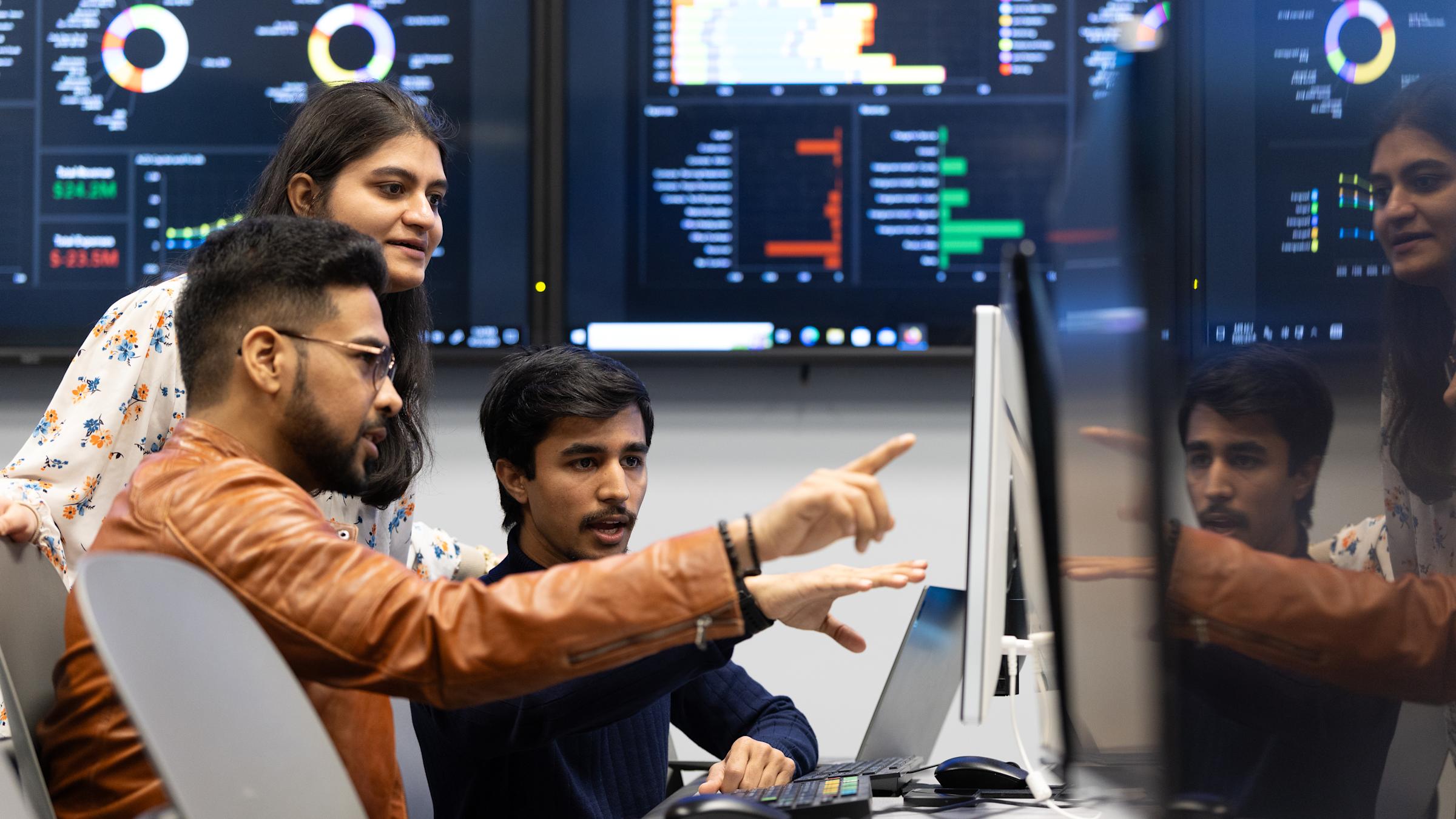
For a local dental practice, maximizing their revenue and ensuring efficient patient relations was like pulling teeth, but after a group of Stevens students in the Practicum and Analytics course finished their work, it was nothing but smiles all around.
The fact the project even happened is a testament to the Stevens School of Business emphasis on industry collaboration and experiential learning. Sandeep Sacheti, the Industry Chair of SSB’s Business Analytics and Artificial Intelligence Advisory Board and co-founder of Editlingo Solutions, proposed the idea of a student-led analysis to Sujata Varshneya, the CEO and founder of Simplified Medical Solutions, a small business that helps healthcare providers run their day-to-day operations. After agreeing to participate, the idea went to Anand Rai, the course’s professor with industry experience as a principal engineer and AI product lead.
“I noticed a major gap between what students learn in class and what companies expect when they hire an analyst or AI practitioner,” Rai said. “Many students were doing artificial case studies that didn’t reflect real business complexity, and I wanted to change that. Real-world projects help students navigate ambiguity, build confidence and problem-solving skills, engage with CEOs and founders and develop industry-ready portfolios. The transformation I see in students after these experiences motivates me to make experiential learning a core part of my curriculum.”
The idea of using motivated students to focus on something their staff did not have the time or resources to tackle was enticing to Varshneya.
“Sandeep came to me and said he and a Stevens professor were looking for a real-life problem,” she said. “We started talking about how we see problems in a practice and know the pain points, but because we are so busy solving day-to-day problems, we don’t have the time to think about solutions. He said if we created a project, Stevens students would help us with a real-life problem, and that's how this wonderful idea came up.”
Starting From Scratch
The students had to start with only the basic information, with no data or specific direction. At first, all they knew was a dental practice needs help improving business and bringing patients back.
This approach forced students to think strategically and ask fundamental questions about how dental practices operate before diving into analytics. The class divided into two teams, each approaching the challenge from different angles. One focused on scheduling optimization, while another tackled retention strategies.
For Judy Labossiere, an associate scientist in the Sample Management department at Pfizer, the ambiguity was initially daunting.
"The difficult part of analyzing the data, at first, was the lack of context," said Labossiere, who is finishing her business intelligence and analytics master’s this semester. "For instance, we saw columns with names like 'earnings' but weren't sure if the earnings were payments from the insurance or the patient. If I'm honest, the most difficult part of analyzing the data was asking the right questions when we got a chance to speak with the subject matter experts or the CEO."
Mani Somuveerappan, a director at Pfizer completing his third master's degree, had a similar reaction. Despite receiving two and a half years of patient data from Simplified Medical Solutions, the team found themselves needing to understand not just the numbers, but the business context behind them.
"We could understand some of their patient demographics and the type of treatments that patients come for," Somuveerappan said. "It was an awesome experience to try to understand the business just from the couple of Excel spreadsheets they gave us. Once we were able to get some decent understanding of the data, we were then able to start analyzing it to provide recommendations for increasing revenue.”

Delivering Innovation
Students went far beyond standard analytics deliverables, building working prototypes of AI-powered solutions.
"Students didn't stick to basic dashboards,” Rai said. “They proposed AI agents, forecasting models, patient retention strategies, workflow automation and AI-based patient communication tools. They went beyond the dataset, calling clinics and learning real workflows. Their ownership of the problem exceeded expectations."
One team developed a proof-of-concept AI agent for self-service appointment scheduling, and another team analyzed demographics to recommend targeted promotions by age group and shifting the marketing focus from restorative to preventive procedures.
"We noticed that a lot of revenue came from restorative procedures and suggested they invest more in pushing patients toward preventive procedures,” Labossiere said.
Abhijit Ghosh viewed the dental practice's scheduling as a complex optimization challenge with a humanitarian goal. Ghosh has a proven track record at J.P. Morgan, Morgan Stanley and other Wall Street firms and currently applies his deep technical background to advance the mission of the Fire Department of New York.”
“With this project, I brought the same obsession with excellence that I do to the FDNY and Wall Street,” he said. “This initiative is the culmination of my journey, bridging the gap between elite financial technology and essential public service. By focusing on operational efficiency, the team aimed to keep the clinical chair occupied for a full eight-hour shift. This ensures that services, ranging from routine preventive care to complex restorative procedures, are always available to the community. We can offer patient-centered outreach in defined age groups for teeth cleaning or root canals. We found that could achieve a lot in a short time frame and with an economical approach.”
The results of their collaboration included integrity-based targeting which uses AI to identify specific demographics that be neglecting necessary care. They also aimed at reducing barriers to care, focusing on reducing patient weight times and making timely treatment more accessible, as well as using AI agents as a tool for “professional responsibility” and “thoughtful scheduling,” ensuring that patients time was medically justified and dedicated to improving the patient’s well-being.
The team’s model was designed to accommodate a diverse clinical workflow. By analyzing demographics and treatment histories, the system optimizes scheduling for a wide range of services, ensuring the clinical chair remains occupied with high-value care such as restorative procedures, preventative care, and elective and aesthetic services.
The Real-World Difference
Working with an actual CEO and real company data fundamentally changed the students' approach.
"If it was an internal project, we could have taken a shortcut to just finish and check the box," Somuveerappan said. "In real-world problem solving, we understood how our contribution can truly help their business grow. When you talk about increasing revenue for a dental practice, that benefits the institute, the people working there and the patient care they provide."
Students gained understanding of real-world constraints often absent from textbook problems such as budget limitations, data privacy concerns and implementation challenges.
“The students really got into it and were very methodical,” Varshneya, the CEO, said. “They could think about a lot of solutions, and everybody was very interactive. Everybody asked questions about how we work and understanding the problem. It was just not, ‘Hey, it's just a problem. It's just a class, and we just need to pass.’ No, they were trying to find an answer. They were trying their level best to get to a solution for me.”
Blending Different Skill Sets
Beyond technical skills like Python programming and dashboard creation, students developed crucial “power” skills that will give them an advantage as they progress in their careers.
"Although half of this project was technical, creating dashboards and cleaning data, it was also about our ability to communicate, ask the right questions and collaborate with stakeholders," Labossiere said. "Being able to use business language and produce something technical but simple enough for CEOs to understand was great practice."
Rai structures his course around the balance of theory with hands-on applications.
"Theory gives foundation, hands-on learning gives confidence," Rai explained. "Each assignment builds on the previous learning, including problem framing, data exploration, modeling, insights and executive storytelling. By the end, students have a fully structured, near-industry-ready project."
"Beyond helping students secure jobs, the biggest impact is a shift in how they think," he continued. "They adopt an entrepreneurial mindset, looking at the world as data problems waiting to be solved."
For Labossiere, the project helped crystallize her career goals.
"This experience has given me confidence to show up to CEO meetings and have conversations using data for informed decisions," she said. "My goal now is to be a consultant helping companies use their data to not just make profit but create better consumer experiences."
A Win-Win Model
The collaboration represents a repeatable experiential learning model that benefits everyone involved. Companies get fresh perspectives on problems they might not have the resources to otherwise deal with, while students gain portfolio-ready experience.
"If every project gave students opportunity to tackle real-world problems, even on smaller scale, it's immensely beneficial," Somuveerappan said. "You can't get this experience from mocked-up data or made-up projects."
For Rai, student transformation measures success.
"They became confident problem solvers and innovators,” he said. “Their mindset completely changed. That's what we need, people thinking beyond coding or data science. We need product engineers, not just data scientists."