Stevens Students Apply Artificial Intelligence To Solve Real-World Healthcare Problem
Malcolm Gladwell’s Outliers popularized the idea that it takes 10,000 hours of practice to become an expert. Six Stevens Institute of Technology students only needed 48.
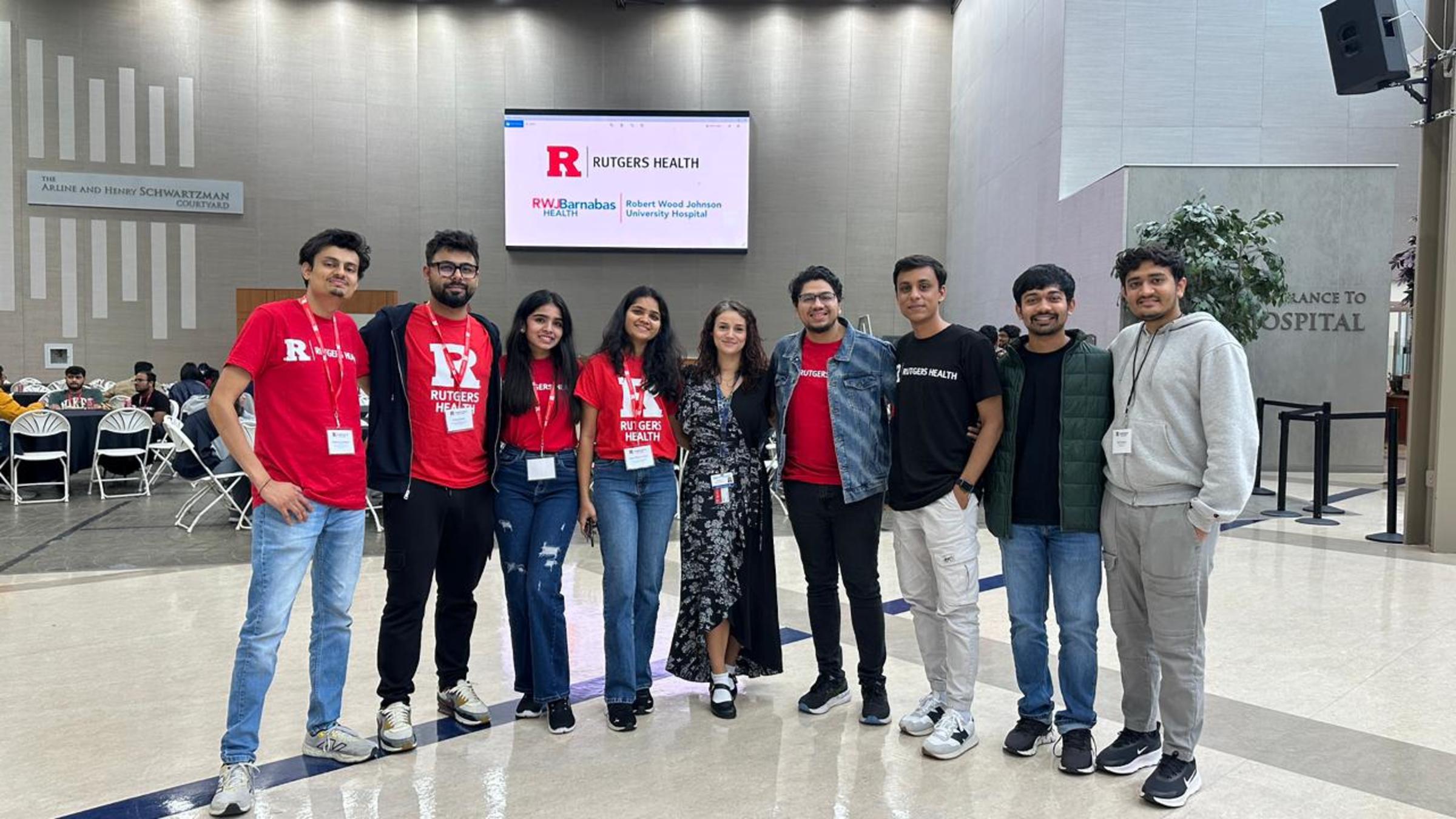
When the team signed up for the Rutgers Health Hackathon, they had never built an iOS application before, but two days later they emerged as champions after creating an AI-powered platform that could revolutionize how hospitalists access critical information.
The winning application, developed for the "Hospitalist Companionship" challenge on the “App Building on Spezi track” addressed a pressing issue for doctors caring for inpatients — how to navigate through numerous policies, workflows and procedures to answer seemingly simple questions like who to consult, how to order testing and where to find the latest treatment protocols.
"They need to go through a lot of policies, and they don't often have that information at hand," explained Shubham Jain, a second-year Applied Artificial Intelligence master's student from India. "So we created an iOS application where doctors were able to ask any question via text or via voice, and they are able to get all those answers from the whole sea of documents very quickly."
The core requirements of apps build for the competition included an AI-powered document search, a secure, internal document repository, a Spezi-driven mobile interface, dynamic updates based on monthly hospitalist meeting notes and an optional billing/coding assistant module.

What made this team unique was their ability to bridge the gap between technology, business and medicine. The competition brought together students from the Stevens School of Business, the Charles V. Schaefer, Jr. School of Engineering and Science, medical professionals from Rutgers, creating a collaborative environment where a real-world problem could be solved to the satisfaction of all the stakeholders.
"I felt like there was a marriage between the medical professionals and technical experts,” said Chetna Mangal Kuthe, a first-year SSB Information Systems master's student. "The doctors explained what they needed and what we should do for this application so that it would help hospitals to solve the real-world problems."
The Stevens students, which also included Applied Artificial Intelligence students Vedant Khatri and Hena Kharway, and computer science major Dhyan Patel, invited a Robert Wood Johnson University Hospital resident to join their team during the networking period before the competition clock began.
"She played a crucial role,” Jain said. "She knew the pain points the doctors were having, and we were able to answer them in our app."
The team of nine, six from Stevens studying Applied AI, Computer Science and Information Systems, and three from Rutgers, quickly organized themselves around their respective strengths. Some members focused on the iOS application using the Stanford-developed SPEZI framework, which is specifically designed for healthcare compliance. Others worked on the backend architecture and training the AI on hospital policies.
The result of their work was an application that could deliver answers in less than a second while also maintaining strict HIPAA compliance.
“Doctors have a lot of responsibility on their shoulders,” said Siddharth Upadhyay, a Stevens computer science student. “While it is obvious that the patient they are treating is a huge part of this responsibility, the reputation of the hospital and compliance is also a sizable portion. Our solution helps both new and seasoned doctors take a load off their mind and help focus on their patients. We have the AI trained on all the hospital policies and even certain treatment methodologies specific to the hospital. All the doctor needs to do is open the app and ask a question. The AI then finds the relevant information based on the training material and provides the answer and the relevant document if there’s a need to verify.”
While the challenge was extremely technical, making it user-friendly was also an important factor. Chetna drew on her business school education.
“I worked on the clinical workflow because in my business education I’ve learned about process and digital innovation,” she said. “I know how to learn what customers want, so I tried to use that knowledge in this competition.”
After two straight days of intense work on the Rutgers campus, the team began to see the light at the end of the tunnel.
“The most rewarding part came at the end of day two, nearing the end of competition,” Siddharth said. “After a lot of brainstorming and sleepless nights, it was amazing to see that our app performed the way it should. The answers the AI provided were clear, concise and professional. The response was quick. The app worked smooth without crashes. It just worked, and that was the most rewarding part.”
Chetna was participating her first hackathon and was not sure what to expect when the winners were announced. "We were sitting and I was not expecting that we would win," she recalled. "I was very happy in that moment.
The project didn’t end with the hackathon, and there are potential opportunities for the app.
"Rutgers has given us the opportunity to work with them and develop this app," Jain revealed. "The email chain is still going on."
For the students, the experience reinforced important lessons about collaboration, time management and the power of combining different perspectives.
"It is very important that students from any major participate in hackathons," Upadhyay advised. "These competitions give you a chance to apply what you have learned and show you how real-world solutions come to life, how to collaborate, manage time and make new connections in the process."