Stevens School Of Business Professor Hits Research Milestone
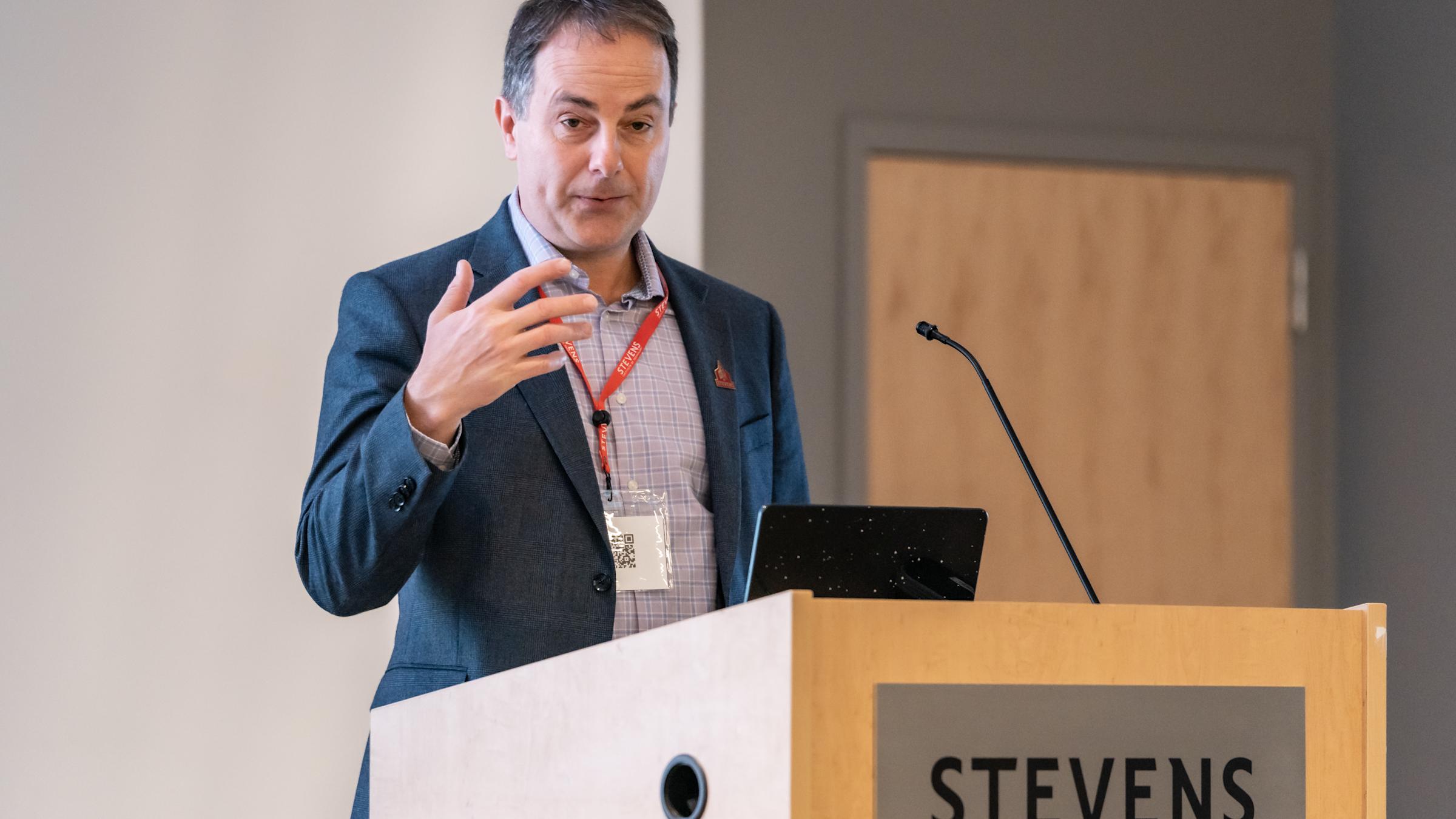
Given the usual pace at which academic research goes from submission to journal publication, Stevens School of Business professor Douglas Cumming should be roughly 125 years old. But then again, there is nothing “usual” about the Steven Shulman '62 Endowed Chair for Digital Innovation’s publishing success.
Cumming and his co-authors will have their article “Banking system stability: a global analysis of cybercrime laws” published in an upcoming edition of the Journal of International Business Studies. For Cumming, it will be the 50th article in a Financial Times 50 (FT50) journal.
The FT50 is the gold standard of business research, ranking the 50 most prestigious business journals worldwide.
“We look at cybersecurity laws around the world, using a large international data set with dozens and dozens of countries and over several years,” he explained. “We examined the introduction of cybercrime laws as well as things about stringency, particular types of laws and enforcement and then developed indices based on these legal differences around the world. It allows for a nice statistical identification to see if it matters to bank stability. If there are problems in the banking system, it could work out badly for the economy as a whole, so we looked at that to see if it matters at all for the stability of the banking system. We found that it does and goes through certain elements of legal differences across countries that are particularly helpful.”
Given his pace, it comes as little surprise that Cumming’s 51st FT50 publication has already been accepted just a couple of months later. The article, “How disruptive is financial technology?” will appear in the April 2026 issue of Research Policy. The study examines whether fintech disrupts the banking sector and if traditional banks must start paying more to keep their customers’ money.
Examination of the large data set over the dozens of years of Cumming’s career leads to the conclusion that he is one of the most productive and prolific economic researchers in the world. According to Google Scholar, his work was cited nearly 4,700 times in 2025, almost 19,000 times since 2021 and more than 37,000 times since 2004.
He is a Highly Ranked ScholarTM by ScholarGPS®, and is one of “the most productive authors (by number of publications) whose works demonstrate exceptional impact (citations) and outstanding quality (h-index). These scholars hold a ScholarGPS®Rank within the top 0.05% in any given Field, Discipline, or Specialty.”
On the ScholarGPS® lists, Cumming ranks No. 5 in Equity (finance), No. 7 in Equity (economics), No. 12 in Finance, No. 33 in Investment and No. 60 in Business and Management.
He is listed 113th in the nation and 154th in the World on Research.com’s list of Best Economics and Finance Scientists 2025/2026.
In 2022, he was listed among the world’s top 92 highly cited researchers in the business and economics category based on citations in the Web of Science, according to Clarivate, a London-based analytics company. That year, fewer than 7,000 researchers, or about 0.1%, earned that distinction.
His work, which includes more than 250 total journal articles and 23 academic books, has been featured and reviewed by renowned media outlets, including The New York Times, The New Yorker, the Chicago Tribune, the Wall Street Journal and The Economist.
In addition to authoring some of the most recognized work in the study of entrepreneurial finance, angel investors, venture capital, private equity, private debt, hedge funds, mutual funds, financial market misconduct, fraud, entrepreneurship, international business and securities regulation, he is the Founding Managing Editor-in-Chief of theReview of Corporate Finance. Cumming is also the current Managing Editor-in-Chief of the Journal of Alternative Investments. He has previously served as Managing Editor-in-Chief of the British Journal of Management (2020–2022) and the Journal of Corporate Finance (2018–2020).
Not bad for someone who began their academic career as a law student in his native Canada.
“I have been lucky on several fronts,” Cumming said. “I started my first academic job in 1999, and when I first started out, I found it very hard to publish. I made some mistakes, and sometimes when you're younger, you get the ‘assistant professor treatment.’ They have papers submitted by more well-known people, so it's easy to get brushed off. Back in my earlier days in the early 2000s, I wondered if I had chosen the right job. I thought that maybe I should go into industry, something like a job at the central bank or some other place. I started as a law student, so maybe I should have become a lawyer. I had a lot of heartaches, if you will, but I guess eventually found my rhythm.”

With the amount of research, analysis, writing and editing necessary to reach his FT50 milestone, it’s easy to assume that flow and cadence sounded like the clacking of a keyboard while Cumming was hunkered down in his office. In fact, he credits much of his success to the relationships he’s built while traveling and to applying his expertise across disciplines.
“I have had very good experiences with my co-authors,” he said. “They have worked out well and been great partnerships. I did several sole-authored papers when I first started out, and some of them got into the FT50 journals, but more recently, I have been doing co-authored projects because it's fun and you can really get some good things going together. Over the years, I've maintained good relationships with folks and had a lot of fun meeting new people. I've been pretty lucky to travel around and meet people. I happened to be in Melbourne at the Royal Melbourne Institute of Technology, where I met my co-authors on this project. We've done several projects together, and we're still doing other things together.”
That spirit of collaboration led to his most important partnership, developing a paper with his now-wife, Sofia Johan, an associate professor at Florida Atlantic University's College of Business.
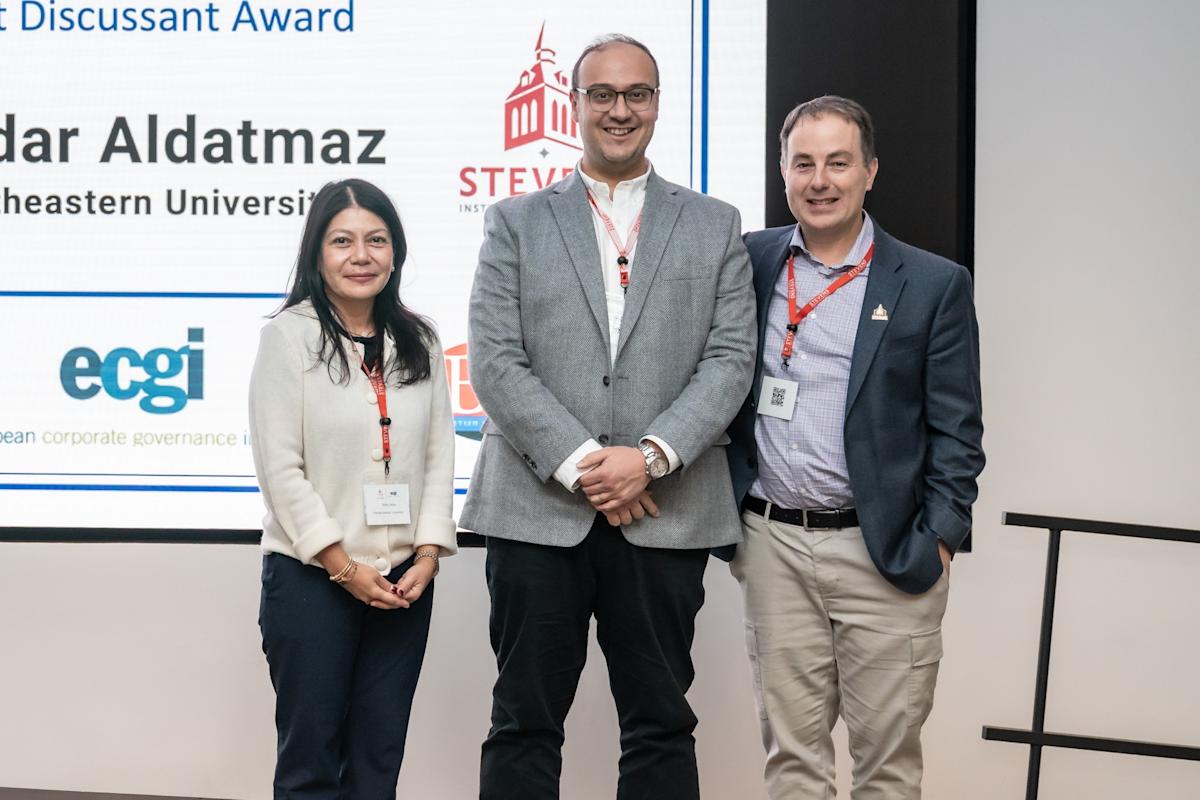 “The first few years, I thought I was going to write papers on venture capital because I like the topic. It's fun, it's applied, it has issues of government policy, legal things and international differences,” Cumming said. “I guess I'd written at least 100 plus papers on venture capital. It’s how I met my spouse. She used to be legal counsel for a venture capital fund, then decided to return to school to get her Ph.D. That's how we met and got to working on projects together. I wanted to chat with her because I knew she had data, and I’d do anything for a data set, right? I like to joke about this, but I made a very good decision to marry one of my co-authors and get her to do all the work.”
Cumming’s work isn’t just for academics to read and debate. His examinations have had real-world effects. He spent years studying how regions around the world become innovation hubs, including tax subsidies, state-run venture funds, innovation grants and technology parks. In some cases, his research convinced governments to enact legislation or to eliminate harmful programs entirely. Cumming was somewhat surprised by that outcome because, as he puts it, “no politician ever gets credit for taking something away.”
“When I was a student, my advisors in the business and economics departments would sometimes joke that the worst thing in the world is to be ignored,” he said. “As they say, love me, hate me, just don't ignore me. To write a paper that nobody is going to read is terrible. Of course, you're hoping for academic citations, but you're really also hoping that when you leave the world, it's maybe a little bit better than when you came in. Over the years, we’ve had some success with things that we do influencing policy. On this latest project, I've already had people reach out to me and ask about their country and if we could redo the study, focusing in-depth on their country.”
Industry practices and government regulation aren’t the only two areas Cumming’s research has a tangible effect. For example, in his equity valuation course, he is able to cover crowdfunding because he and his wife literally wrote the book on the subject. He brings live data, real examples and the same analytical frameworks he uses in his research to show students that the decisions entrepreneurs make have measurable, real-world consequences.
“We wanted to have resources for students to use and to understand what they should do and maybe even encourage them to be entrepreneurs,” he said. “It’s much easier to start out as an entrepreneur in your 20s than it is to switch when you're 50. Not that that doesn't happen, but it's a trickier issue. In our class, we raise some fun questions with them. Very often, students will have seen a TV show like Shark Tank or some other thing where there's a pitch.”
“On the crowdfunding side, it's been fun because it’s a very popular topic, and it’s easy to sell the material to the students,” he continued. “You can use very fun examples and go right on to the web pages to look at the crowdfunding platforms, see the types of entrepreneurial projects that are put up there, and then, convey to the students that the design of a campaign can significantly affect the outcomes.”
Using his research in a classroom at Stevens was on Cumming’s mind since he visited Hoboken for the first time during a conference. When he received the offer from Stevens, he didn’t have to deliberate long. An avid cyclist who rides his bike to work every day, he took a spin around his living room to celebrate.
Stevens, he says, offers the rare combination of a research environment with real institutional support, a culture where ideas get pressure-tested by colleagues, and a dean who encourages faculty to collaborate and push their work into the world. Add in a student body shaped by the school’s focus on innovation and technology, and the result is a community that feeds both his research and his teaching.
"This type of environment doesn't exist everywhere," he says. "I feel like I am one of the luckiest guys in the world to be here. I felt like I won the lottery when I got to come here. Being in such an inspiring place makes me keep wanting to work as hard as ever to get those next 50.”
