Stevens Students Move to the Top of the PANYNJ College Challenge with an Innovative Tunnel Patrol Robot
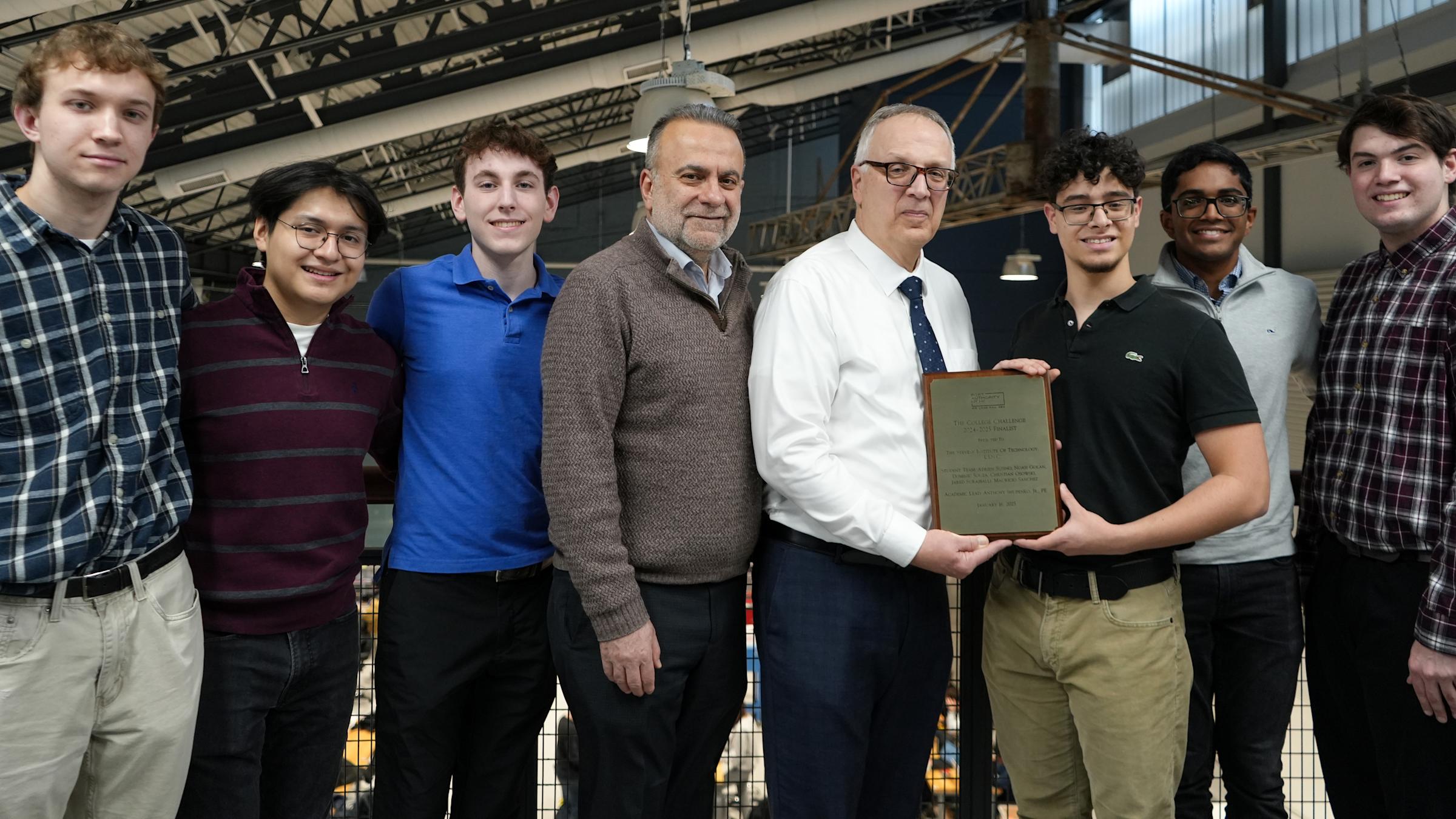
The catwalks throughout the iconic Lincoln Tunnel have been abandoned for a couple of decades, but they may soon be humming with the sounds of a new kind of traffic: robot patrols created by six engineering students from Stevens Institute of Technology.
The team was one of only two selected to advance to the final phase of The Port Authority of New York and New Jersey (PANYNJ) College Challenge: Vehicular Tunnel Catwalk Robotics.
The competition sought designs for an autonomous robot to patrol the catwalks of the Lincoln Tunnel, which runs 1.5 miles under the Hudson River between New Jersey and New York, as well as other crossings. Repurposing these unused spaces with robotic technology would allow PANYNJ to detect fires, floods, accidents and other hazards in real time, improving safety and response in emergency situations.
"The challenge felt right up our alley," said Noah Golan, Class of 2027, who is majoring in Mechanical Engineering. Golan and his teammates are all in their first or second year at Stevens.
"We come from robotics, 3D design and tech-savvy backgrounds, with immense interest in mechanical systems," Golan said. "This project was the perfect outlet to test our skills, challenge our capabilities and learn from our mistakes. Nothing teaches an engineer quite like being thrown into the depths of an involved project like this!"
The students recruited Anthony Shupenko, teaching associate professor in the Department of Civil, Environmental and Ocean Engineering, at Stevens, as their mentor and sought guidance from Brendan Englot, professor in the Department of Mechanical Engineering and Director of the Stevens Institute for Artificial Intelligence, during the project’s early stages.
Engineering a high-tech solution for tunnel safety

The team dedicated the Fall 2024 semester to designing a robotic solution tailored to the tunnel’s unique environment. Complex and evolving design hurdles ranged from ensuring the robot could maneuver at high speeds in the catwalks’ tight spaces and pass through a central monitoring booth, to developing a compact yet powerful motor system.
Undeterred, the students designed a cutting-edge robotic platform featuring tank-like steering; advanced detection of fire, water and other hazards; accident recognition technology; two-way communication; a highly efficient battery; and industry-leading safety systems using state-of-the-art sensors and cameras.
"This robot has immense potential beyond the scope of the competition," Golan said. "It could one day be adapted for real-world applications in other high-risk infrastructure environments."
The team’s innovative design earned it a spot in the prototype phase with a $10,000 grant to execute the plan during the Spring 2025 semester. They are using off-the-shelf items in unique configurations, and working in the Stevens MakerCenter machine shop to custom-make components such as the chassis.
This summer, they are also invited to complete prestigious summer internships with PANYNJ.
The light at the end of the tunnel
For the students, the project has been an invaluable learning experience.
"This is an exceptional group," Shupenko said. "Competing against teams with more coursework and experience, they’ve demonstrated outstanding perseverance and ingenuity. Advancing to the prototype phase is a testament to their hard work. They honed skills they may not even have known they had! Their ability to manage additional design restrictions with on-target redesigns will serve them well, as design challenges occur regularly in an engineer’s career."
Their dedication and adaptability have not only impressed the PANYNJ and their Stevens mentors, but also reinforced their confidence in their own skills and potential.
"While we may not have as much coursework under our belts as some of the other teams, we made up for it with research and teamwork," Golan said. "Stevens has given us a remarkable foundation through rigorous coursework and hands-on work with student organizations. Everything we’ve learned — from mechanical design to circuit work to programming — will be applicable in our careers. It is truly an honor to have been accepted as finalists in this competition, and we cannot wait to see where it takes us."
Learn more about academic programs and research in the Department of Mechanical Engineering:
