
The Art of the Possible
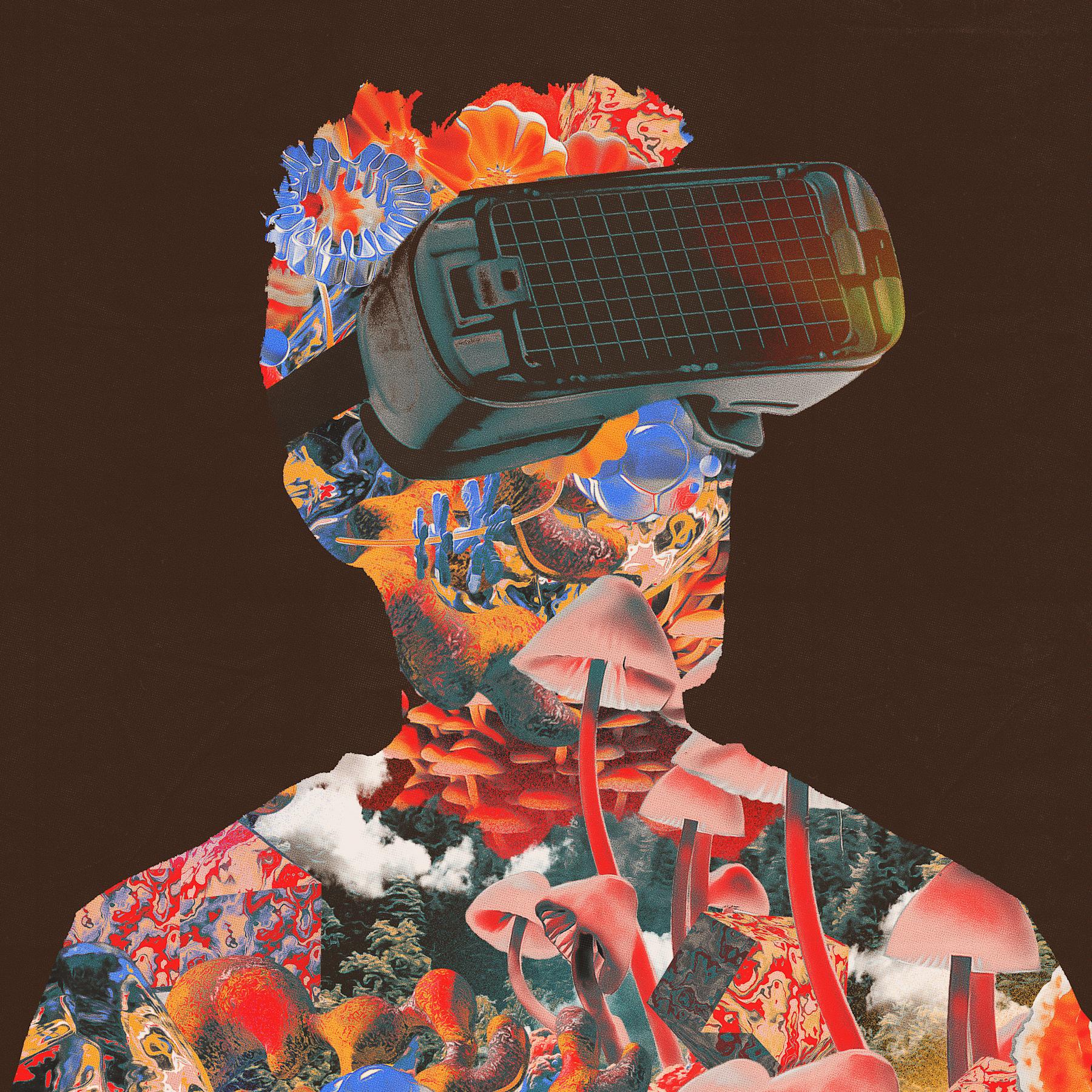
A network of mycelium grows all around as multi-colored, mushroom-like creatures dance. Soothing voices read earth-conscious love poems as psychedelic textures morph into soil, then mountains. This is Jonah King’s “Honey Fungus,” a sci-fi virtual reality installation inspired by the fungal reproductive cycle. “You go through a world, and it’s interactive, so you can touch things and engage with them,” he explains.
A professor of interactive digital media in Stevens’ School of Humanities, Arts and Social Sciences (HASS), King created the work with a little help from artificial intelligence — using a GAN, or Generative Adversarial Network, to be precise.
He trained the GAN using images of an avant-garde Japanese dance style called butoh and images of mushrooms to create those dancing figures. The poems were created by training GPT-1, an early large language model, on all of the Smithsonian botanical field research, combined with thousands of pages of open-source love stories. (Large language models, like ChatGPT, are trained on large amounts of text to generate human-sounding text.)
The piece premiered at South by Southwest, the annual creative cultural festival in Austin, Texas, in 2025 and has since toured more than 20 international venues.
“I’m actually amazed at the life it has had because it’s so strange,” King says.
HASS, with its B.A. programs in music and technology and visual arts and technology, draws innovative thinkers like King who are teaching students to harness their creativity in a technologically fast-moving world. Both programs are preparing students for careers as sound engineers, music producers, graphic designers, filmmakers and game designers.
Now, as AI is emerging as the latest tool in the creative toolbox, Stevens faculty members and students are wrestling with its implications, scrutinizing the tools and exploring the creative possibilities as the technology develops at warp speed.
“AI is here, love it or loathe it. It’s just a big steamroller,” King says. “So it has become part of the responsibility for educators in this space to really show students how it works.”
A World of Possibilities
AI has endless applications in the arts, seemingly limited only by the imagination of the human using it.
In filmmaking, AI tools can add a moving train in the background of a shot, change the shirt of an actor and add rain to a scene. “Some of those shots might be $50,000 to $100,000 per shot [to film],” says Christopher Manzione, who leads the moving image concentration offered within the B.A. in visual arts and technology. “You can now do those on your own in maybe a half hour or an hour.”
In game design and 3D animation, AI tools can automate animation, create worlds within games and program character movement and behavior. In music, AI tools can produce accompanying instrumental parts to a piece of music, suggest post-production effects and create songs based on text prompts. In visual art and photography, the editing and effects are endless.
And these are some of the more elementary AI tools available today. In a way, they democratize the arts, allowing just about anyone with a phone or computer to create in ways previously unimaginable or unattainable.
What it all means is anyone’s guess. Will AI displace artists? Are these tools adjunctive to the artistic process, or do they take the process over? Do humans remain central to the future of art?
The answers to these questions are complex and ever-evolving. At Stevens, faculty members engage with AI in their own work, looking at AI models with a critical, analytical eye, and teach students how to engage in this space in a meaningful way. Stevens also fosters collaboration between departments and their students — engineering and business professors work alongside those from HASS, for example, and conduct research at the Stevens Institute for Artificial Intelligence.
“We’ve carved out our own niche by finding people who are working at the intersection of various kinds of art and technology, having them bring their research practice and creative practice here, and also bring that into the classroom,” says HASS Dean Kelland Thomas.
Teaching the Tools
HASS faculty members advocate for AI literacy, teaching students about the history of AI, how the tools work and showing them how to manipulate open-source models (tools that can be modified) rather than simply relying on closed-source models from major tech companies. This allows students to become developers and programmers rather than just users.
“I see AI systems not as things that are handed to us that we use. I see them more as systems that we have the opportunity to build and can make decisions about,” says Teresa Nakra, director of the music and technology bachelor’s degree program.
Nakra has been interested in the intersection of music and technology and AI for decades. In the 1990s, as a graduate student at MIT, her office was near that of the late Marvin Minsky, a mathematician and computer scientist known as the “father of artificial intelligence.” The two would often discuss AI and music.
In her own work, Nakra designed a wearable device for orchestral conductors and software that captured their gestures. Using that information, she created a museum exhibit, “You’re the Conductor,” in which people could conduct a recording of the Boston Pops using an infrared baton. Larger gestures would mean the orchestra played louder. Faster conducting meant a faster tempo.
In a course she taught last fall, AI and Machine Learning in Music, Nakra tried to demystify AI for her students. She had a Spotify engineer explain how the company’s algorithm works to provide its users music recommendations. She showed her students tools that can generate music based on a few adjectives, then open-source tools where they can “get under the hood” and change parameters and algorithms.
Among the tools were Google Magenta, which can be fed a melody or chord progression and come up with variations, and Wekinator, which allows users to build interactive systems based on human actions and gestures.
Key to Nakra’s message to students: “The responsibility lies with us to figure out what level of support and assistance we want AI to provide,” she says. “I’m firmly in the camp of not wanting AI to take over our creative gifts, but rather to potentially support us.”
That resonated with Yehoshua Auerbach ’27. His final project for Nakra’s AI and Machine Learning in Music course involved using ChatGPT to turn Edgar Allan Poe’s “The Tell-Tale Heart” into a series of chord progressions that could be turned into a score using a creative coding tool called Max. But the resulting composition, Auerbach found, turned out to be too happy sounding for the dark, gloomy Poe story.
Auerbach’s experience, in many ways, exemplifies the current state of AI in the arts. While these tools are capable of amazing feats, they need “a lot of finessing, fine-tuning and human input that is guided by our ingenuity and our problem-solving,” as he puts it. And, perhaps most importantly, any resonant piece of art needs to be created via real human emotion.
As King says: “The artifacts of culture that have genuinely moved you, it’s usually because you see a part of yourself, that maybe you had trouble articulating, being perceived and reflected back to you. AI, as it stands, for all the metaphysical attributes we’re ascribing to it, it’s just large-scale data aggregation.”
Nakra says that while her class received positive feedback from students, she, like her faculty colleagues, has experienced a number of students skeptical of AI who wanted to use the tools very little, even after engaging with them. Still, she thinks it’s important for them to be knowledgeable in this space, as AI will continue to impact the arts.
“We should ensure students aren’t just users of these systems; they really need the developer skillset,” Nakra says. “It’s critically important for students to learn how machine learning systems work, implement them and modify them and test them on real data.”

Manzione agrees. “I think it would be a disservice to our students … if we didn’t fully embrace this and understand what we’re doing, because they need to come out of their schooling with a really good grasp on all these tools,” he says.
For Auerbach, his experience using AI has helped shape his intended career path. For his senior thesis, he is designing an immersive sound installation where the soundscape a person hears through wireless headphones changes as they move through the physical landscape. While Auerbach originally planned to work in recording studios, he has become more interested in installation work, multimedia projects and sound design. And, if used with purpose, he believes AI can serve his creative vision rather than be a means to cut corners.
“It’s not, ‘Oh, let me use this to make my life easier,’” he says. “It’s more, ‘This tool creates an effect and creates a dynamic that serves art in a way that other tools would not.’”
Looking to the Future
It’s easy to panic over AI and cast it as this boogeyman coming to take jobs and supplant artists, computer programmers and content creators. AI certainly does have the potential to drastically change multiple disciplines and industries, and while there are major issues to contend with — labor, ethical, environmental, global — Stevens faculty members in HASS say the conversation demands nuance.
“I have a suspicion that a lot of the people who are really critical of AI image and video generation haven’t spent a lot of time trying to make something with them, because it doesn’t do what you want it to — almost ever,” King says. “There’s skill in creating an AI work as an artist. It’s not the shortcut it’s being made out to be.”
For artists, the tools feel more like collaborators, Manzione says, that can be incorporated into a larger artistic vision. He thinks artists could be ideal users of these tools. In film, for example, “there’s a whole handmade quality to it” — creators have to build out a visual language, characters, voices and a story.
“You have to know what to ask for, you have to have the language to ask for it, then — once you get the thing back — you have to do something with it,” he says. “It’s not an endpoint.”
As AI technology continually advances, HASS faculty members plan to continue to teach students to engage with AI in a holistic manner to prepare them for a world in which AI is part of their creative workflows.
“You’re going to need to understand how to use these technologies while critiquing them at the same time,” Thomas says. “From that perspective, new approaches and new relationships to these technologies will emerge.”
King believes students will have to be nimble as AI may displace certain kinds of execution contract work — such as specific types of animation or illustration.
He says artists instead need to look at themselves as creative directors with a plethora of tools to execute their ideas. “You create a world, you build your visions, and then people are hiring you because they like your voice, they like the textures of your work and the things you stand for,” he says. “Artists are these interdisciplinary entities who pull from all sorts of places and are hopefully useful in a cultural sphere as a cultural producer.”
Each professor goes back to the same truth ultimately — that art communicates the condition of being human, and only humans can do that.
“There is a sacred dynamic to creative expression that helps us feel better, feel less alone; expresses our innermost thoughts and feelings; and provides a therapeutic mode of engagement that allows us to work out our innermost thoughts,” says Nakra.
“It’s one of the most important things that helps us get through life. And so to that extent, I can appreciate why artists and musicians might want to preserve that, for good reason. But, can that experience be enhanced by a nonhuman sentient entity that supports that without taking it over? I’m open to that idea.”
– Marc Shapiro
Meeting of the Minds
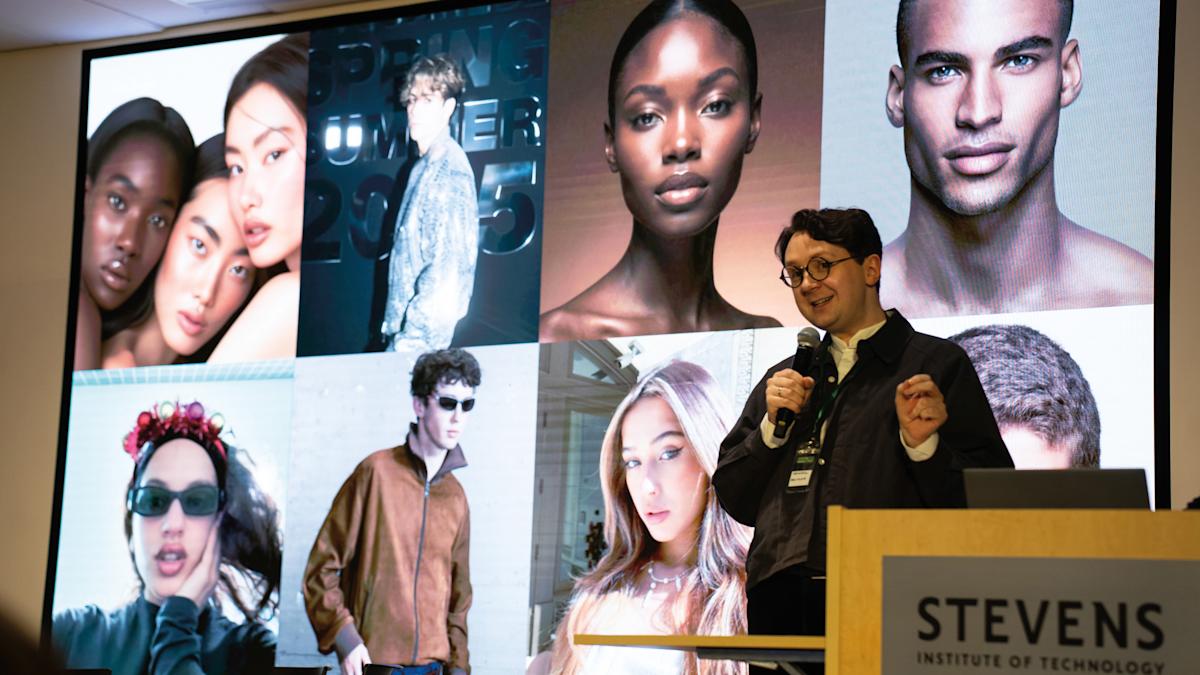
In October 2025, professors Jonah King and Christopher Manzione held a symposium at Stevens that brought together artists, technologists and philosophers to showcase their AI work and discuss the implications of this new technology. “Synthetic Narratives: AI/XR + The Future of Storytelling” featured AI-driven interactive and immersive artwork and generative AI films. The symposium also included panel discussions on AI filmmaking and immersive media, post-photography and the challenges of truth and trust in AI.
“The conversations between different fields — immersive media, AI image, video and audio generation, even film or game design — had been happening independently of each other,” Manzione says. “We wanted to make one large event where we could pollinate it with different people from different backgrounds and see what happens when they all come together and start talking about what they’re doing, what they’re thinking about and their predictions for the future.”
King likens the conversation to talking about “the internet” — which encompasses any number of things, from social media to video streaming to file downloads. AI is similarly a world unto itself, with a huge gulf between tools from large corporations and open-source tools, and an endless number of varied uses for these tools.
“Synthetic Narratives,” for its part, showcased the possibilities of AI, but wrestled with its ethical implications. King hopes the next symposium, to be held at Stevens in February, can feature a panel about AI infrastructure and environmental concerns, including the energy required to power data centers.
“Is there a way to think about building infrastructure that also supports neutral or green energy? I think in the big picture we have to think about those things urgently,” he says. “Then locally for artists, I think it’s important to not dismiss anybody’s concerns [about] scraping people’s data without their consent and repurposing it.”
King and Manzione held a satellite event in May 2026 as part of the Delaware Valley Arts Alliance Future/Think symposia series and plan to hold several more in the future.
The spirit of the symposium is in line with what HASS Dean Kelland Thomas hopes students and faculty are discussing — distinguishing between the hype from entrepreneurs and companies profiting from AI versus what AI tools can really do.
“Artists are good at taking critical perspectives on that,” Thomas says. “Querying and questioning the technology — I think that’s an important role that artists have at Stevens.”