Associate Professor Ying Wang’s $1.19M DARPA Award Could Help Make AI More Energy Efficient
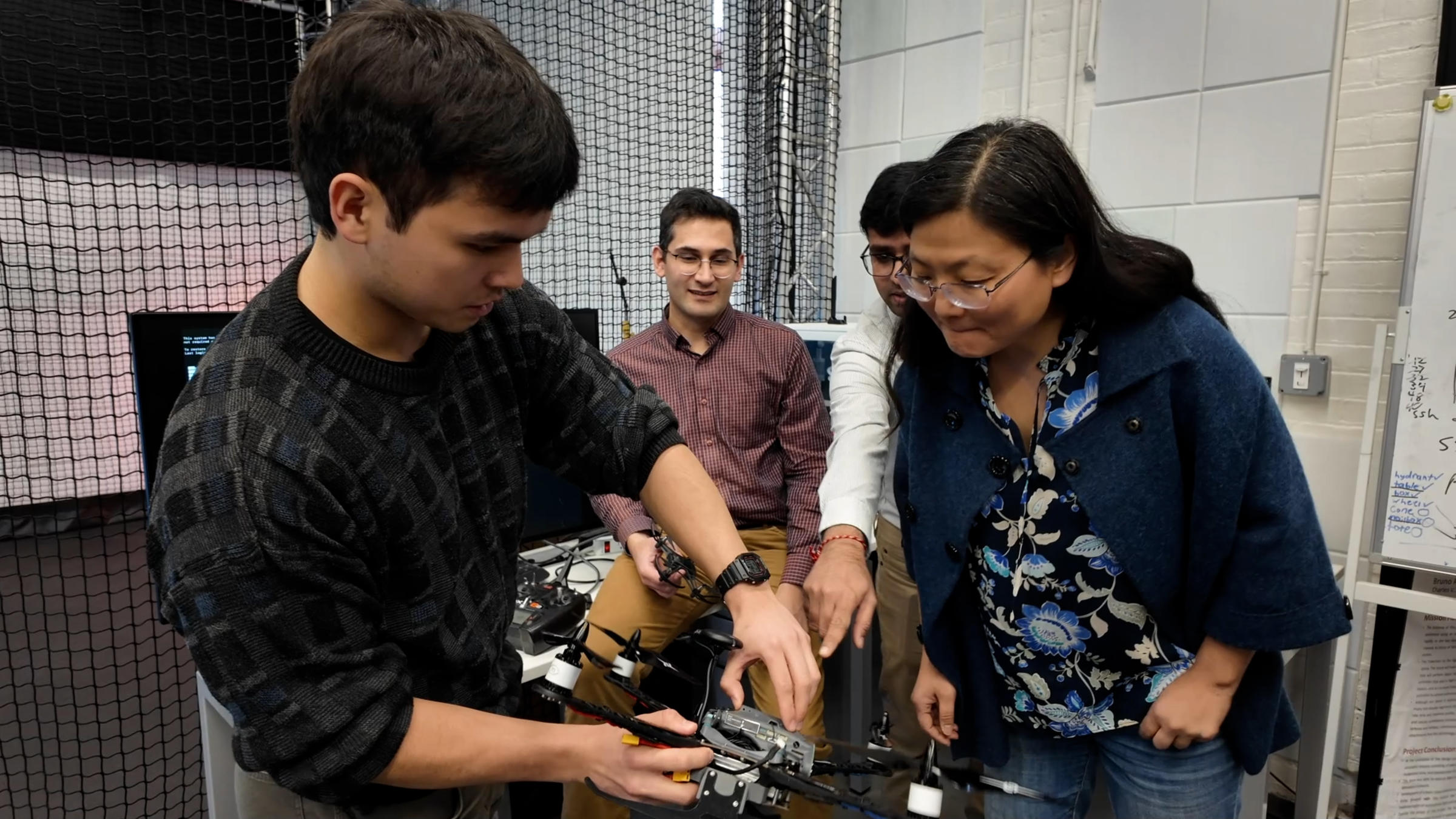
In conversations about AI, people often wonder about its energy appetite, and sprawling, noisy, power-hungry data centers usually come into view.
For Ying Wang, associate professor in the Department of Systems Engineering at Stevens Institute of Technology, there is another question worth asking: what if AI accounted for its own power consumption from the moment it was designed, rather than measuring it once the system was already running?
With a recent $1.19 million award from DARPA for her project, “Formal Energy Semantics for Machine Learning (ES-ML): A UAV-Based Framework for Predictive Modeling and Energy-Aware Optimization,” Wang is working on developing what she calls energy-aware machine learning.
“People always ask, if you type 'hello, how are you' on ChatGPT, how much energy equivalent is being burned in the background,” Wang said. While that is a real concern, she noted, her research focuses on devices at the edge, specifically drones and robotics that rely on battery life to operate.
Picture a drone flying a mission. On board, a machine learning model watches for obstacles and monitors the aircraft's health. Every prediction it makes draws from the same battery that keeps the drone in the air. If the AI uses more energy than expected, the drone may have less power available to complete its mission.
Wang explained that unlike large data centers, edge devices operate with limited energy in constantly changing environments. “Every AI computation draws from the same battery that powers the mission,” she said.
The consequences can be significant during a mission. If AI uses more energy than expected, less energy remains to complete the task. The goal of the project is to make energy predictable so AI systems can achieve the best mission performance within the available energy budget.
Energy as a first-class citizen
Energy should be considered alongside accuracy when designing AI systems, according to Wang. “Understanding the energy cost of AI is just as important as understanding its accuracy,” she said.
Instead of building a powerful AI and then asking how much energy it uses, the approach asks how to build something powerful that is energy-aware by design, she explained.
“The key is enabling energy prediction at decision time,” Wang said. “If we know the expected energy cost of an AI decision, we can make better decisions to maximize mission performance within the available energy budget.”
Grounded in physics
Instead of measuring energy use after the fact and modeling it from data, Wang’s team develops physics-grounded methods, which means starting from the physical behavior of the hardware itself: the current, voltage, and thermodynamics behind every computation.
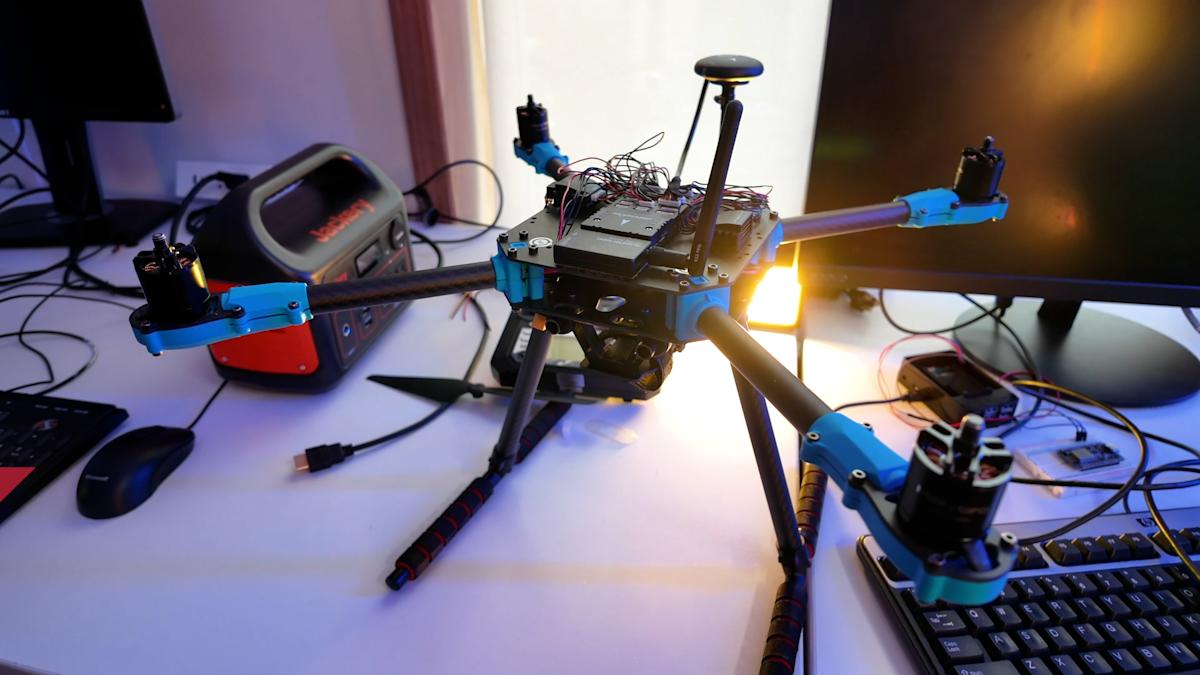 “That complexity becomes apparent when AI moves from controlled testing to real-world deployment, Wang explained. In an edge system such as a drone, energy consumption depends not only on the AI model itself but also on the surrounding system and mission conditions.
“The same AI model can have very different energy behavior depending on what else the platform is doing,” Wang said. “Sensing, communication, flight dynamics, and changing operating conditions all contribute to the system's overall energy consumption." Wang pointed to other potential applications: a medical sensor worn for months, a satellite that doesn't have to be brought back to swap a battery, a delivery drone routing through a city, each continuing to operate or failing by how well its energy can be predicted.
From industry to the lab
Stevens leads the project, with collaborators at Virginia Tech and Fordham University, and the work runs through the Mobile AI Cybersecurity Computing (MACC) Laboratory, which Wang operates within the Department of Systems Engineering. Her lab studies the assurance of autonomous cyber-physical systems, where software interacts closely with the physical world in applications such as transportation, energy, and defense. In 2025, she received a U.S. Army Research Office Early Career award for work on autonomous systems that can check and recover their own safety and security in real time.
Wang’s entry into research originated in industry. After completing her Ph.D., she spent several years at Apple and Verizon, and that experience shaped her view of research.
“Everyone is excited about what AI can do,” Wang said. “But AI ultimately operates in the physical world, where energy, hardware, and the environment impose real constraints. This project connects machine learning with those physical constraints so AI can make decisions that are both intelligent and physically achievable.”
Wang noted that the research results will be open source to benefit the community.
Student contribution and collaboration at every level
Wang's lab currently has eight Ph.D. students. In the past three years, it has also worked with three senior design teams each year, and plans to add one or two more this year to work alongside the graduate researchers. The lab also brought on two high school students as summer interns at the project’s start.
The project team will host a workshop, bringing together researchers to advance the field while providing students with early opportunities to connect with industry partners and government agencies.
As for Wang's own big objective, developing energy-aware machine learning, she noted: “AI has advanced remarkably,” she said. “Our goal is to make AI more aware of its energy footprint so it can make better decisions within real-world physical constraints.”
Learn more about academic programs and research in the Department of Systems Engineering: