Taking Real Advantage Of Artificial Intelligence Opportunities
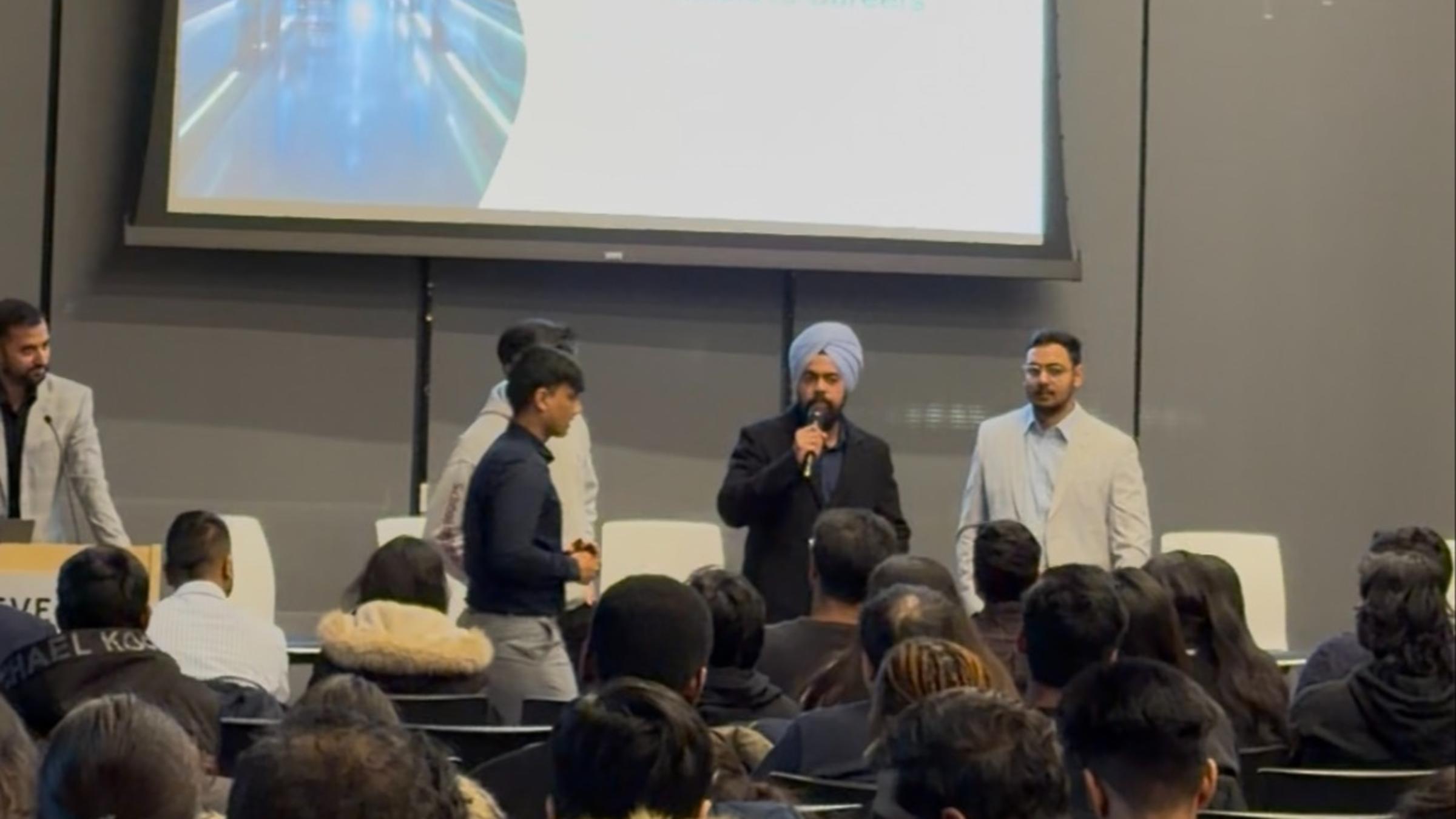
Business Analytics and Artificial Intelligence master’s student Naman Singh has nothing but compliments for the way Stevens complements his goals and ambitions.
Since arriving from India in the fall of 2025, Naman has been able to work hands-on with AI, settle comfortably into a new culture and grow into a leadership role as the president of the Stevens Business Intelligence and Analytics (BIA) Club.
“It's exceeded my expectations,” he said. “The main thing is that Stevens focuses on both academics and the holistic development of the student. As students, we are so involved outside the classroom because there are multiple events happening all semester. GSL (Graduate Student Life) hosts different cultural events, and the School of Business has different academic and alumni events. We actually don’t miss our hometowns because we are busy and engaged. I never expected that I would be involved in so many things.”
Naman’s first priority in pursuing a place to continue his studies was adding AI to his knowledge base built as a computer science undergraduate student and professional experience working with startups as a business analyst and product manager.
“While working in these roles, I was interested in learning more about analytics and artificial intelligence stuff,” Naman recalled. “I remember back in 2022 when ChatGPT was just released and buzzing around. I was interested in how these things are working on the back end, so I started researching AI and how machine learning algorithms actually work. At that time, I decided that I wanted to pursue my master’s in business analytics and artificial intelligence. The main reason I chose Stevens was because very few schools in the U.S. offered the perfect mixture of business and technology. Stevens offered business analytics as well as the technical, artificial intelligence part.”

Comfortable with what he was going to study, Naman’s next adjustment was how he was going to study. Stevens’ focus on real-world business challenges can be a big change to students used to learning only through textbooks and theories.
“The curriculum is industry-focused, which is really good because we are not studying anything not relevant to the industry,” he said. “The skill set that is needed in the industry is included in the course curriculum. Coming from India, I was not really well-versed with the practical culture. That initially challenged me because in every course, we have a project. That initially felt a bit overwhelming. The professors are helpful because they understand that people are coming from different cultures and backgrounds.”
One professor helped define that adjustment. In his Multivariate Data Analytics course taught by Somayeh Moazeni, Naman found himself struggling with unfamiliar skills. He scheduled multiple meetings with Professor Moazeni and supplemented those sessions with online lessons to fill the gaps. The extra guidance and hard work paid off.
“The professor guided me through all the skills we discussed in class that had to be implemented in the project,” Naman said. “To my surprise, that project was really appreciated by the professor in front of the class.”
That confidence in the classroom gave Naman room to grow outside of it. In his second semester, Naman has gone from an active volunteer to president of the BIA Club, a role he took on with a sense of purpose. He sees the club as a direct line between students and the industry connections they need most. The BIA Club hosts alumni networking nights, industry panel events and hackathons, bringing working professionals from major companies into conversations with current students.
The outreach has been well-received. Naman estimates that roughly 80 percent of the Stevens alumni he contacts respond positively, eager to stay connected to the community and help current students navigate a landscape they once faced themselves. The reception has inspired him to expand the club’s programming even further, with plans to add bootcamps targeting specific skills that students are missing but the industry demands.
“We need industry connections and the alumni network so that students can actually talk to people and get meaningful insights about what is going on in the industry,” Naman said. “For example, if I’m interested in a data analyst role, I can talk to an alum and seek guidance on what skill set is actually needed for the interviews. Towards the end of our events, we build in time for students to talk to them, get their LinkedIn, etc., so in the future, if there’s an opening in their company, they could reach out.”
In-person networking is still invaluable, but it wouldn’t be a Stevens story without integrating technology and the human side. Naman is assisting his mentor, Professor Edward Stohr, the co-creator of the business analytics and artificial intelligence program, in building a large-language model-based career explorer tool for students.
“When you’re deciding which industry you would like to go into, you can generate a list of companies you should be interested in and the skills you need,” Naman explained.
It is another version of the support Naman himself received when he arrived. Now on the other side of that transition, he is paying it forward.
“The advice I would give to people interested in studying AI is to be curious,” Naman said. “Everything can’t be taught in classrooms. Everything can’t be taught by professors. You have to be curious. You have to ask questions. You have to do research on your own. You can get guidance, but actually it starts from you.”