A Chip Off the Old Blockchain

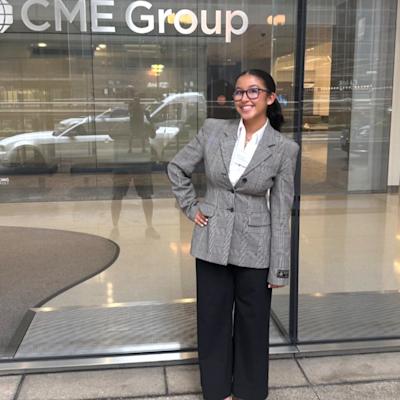
With a view of the high finance capital of the world, Hao Fu is working to put Hoboken in the middle of decentralized finance.
The Stevens financial engineering Ph.D. student is part of the “DeFi” research team led by professors Zach Feinstein and Ionut Florescu. Decentralized finance emerged in 2009, with the introduction of Bitcoin and blockchain technology. The concept is built on the idea of a financial system that is free from central authorities, governed instead by transparent, consensus-based networks.
“If you want to buy an ETF (exchange-traded fund) like the S&P 500, you normally pay annual management fees,” Hao explained. “But for the blockchain version we can use code to automatically manage the ETF. That's one line of research we are exploring. The traditional ETF has a firm that actively maintains their portfolio to matching some benchmark. On blockchain, there are no middlemen. It's just a one code running to automatically match the buyer and seller. That's why it cuts a lot of the transaction costs. You don't need to pay anyone to maintain that portfolio.”
Lowering transaction costs and in turn, the barrier to entry, isn’t the only way DeFi can help democratize investing. It also addresses privacy and timing concerns that can keep people out of the market.
“Some people focus on their privacy,” he said, “You don't need to have a Social Security number to use blockchain. You don't have a lot of requirements or limitations to buy the stocks. In the U.S., foreigners have to pay for an international money wire. It can cost $100 and take five days for every simple transaction, but on blockchain, you just need maybe a couple of cents, and it’s done almost immediately.”
Hao began his professional career as a Fundamental Analyst at Ganen Invest Corporation in his native China, where he spent nearly two years studying China's sugar market and translating his findings into price forecasts for futures. He then transitioned into quantitative research at Will Invest Corp, spending three years designing CTA strategies and building a testing platform to refine his models before deploying them in live trading.
“Before I came to America, I had been working on the trading strategy using auto automatic trading platform,” he said. “I realized that there was a lack of theoretical work behind it, which was the motivation for me go come abroad to study.”
Before arriving on the banks of the Hudson, Hao spent time in the desert. He originally enrolled in the Ph.D. program at the University of Arizona, studying statistics. He quickly realized he was looking for a more finance-focused program and quickly discovered Stevens. He arrived in Hoboken in 2024 to begin work. As part of Stevens’ program, he completed his master’s degree in 2025.
“After I started the program at Arizona, I realized the main focus was on biostatistics, and that’s not what I wanted,” he said. “About two months after I got there, I started to apply other places. Stevens is very strong academically in combining finance and technology, which is exactly what I wanted.”

In addition to the program’s curriculum, the teaching methods and hands-on opportunities have made Hao’s experience at Stevens “outstanding.” In his first semester, he participated in the Stevens High Frequency Trading Competition, which opened his eyes to the wide range of possibilities available to him.
“I really spent a lot of time working on the competition,” he recalled. “We created our team and had to refine our strategies. It’s really competitive, and it pushed me to improve our strategies. That was the first technical project I dealt with. We didn’t win, but that was a meaningful experience. It's a bridge that led me to the real research. The professors here, emphasize hands-on experience. After the competition, I talked to the professors, and they had me join their research work.”
He quickly found that the faculty’s knowledge and expertise wasn’t solely forged in the classroom. Their deep roots in the finance industry shaped how they taught, blending theory with the practical realities of how work gets done on trading floors and investment firms.
"The professors here don't just read lecture notes," he said. "They combine their knowledge with their experience. It's not just from a newspaper or a video, it's personal experience. That's an advantage of having those industry professors."
That industry mindset extends to how Stevens embraces technology in the classroom. Rather than treating AI tools with skepticism, Hao said the program encourages students to integrate them into their research and coursework. That approach that has accelerated his own work in decentralized finance.
"Students are encouraged to use current modern technologies," he said. "How do we use AI to incorporate trading? How do we use AI to learn? Sometimes, in other universities, they don't like it. They think it's not a good way to learn. But at Stevens, we love technology, and our professors encourage us to learn through AI the correct way."
The combination of faculty who have lived what they teach, a curriculum that leans into emerging tools and research opportunities that put theory into practice has him excited for what lies ahead.
“Nowadays, we need a lot of space to explore knowledge, and Stevens gives us that freedom,” he said. “We can really pursue what we want. This point in my career is where it’s important to work and do some self-learning, especially now with AI technologies. Here, we have the capacity to learn whatever we want, and have the time and space to be quiet, calm and to do the research.”