Stevens Students are Mapping the Future of AI Data Centers
As artificial intelligence reshapes how people conduct business and even their personal lives, the physical infrastructure that powers it is also expanding at a breathtaking pace. Major technology companies such as Amazon, Google, Meta and Microsoft have already invested roughly $282 billion in building physical data center locations to meet the unprecedented and still-growing demand.
But not every location is ideal for these energy-intensive facilities, and many siting decisions are being made without an educated view of long-term impacts.
A team of graduate students from the Department of Electrical and Computer Engineering at Stevens Institute of Technology took up the challenge of better informing those key decisions. Using machine learning, they developed a systematic, data-driven approach to help identify the most responsible and effective locations for AI data center construction.
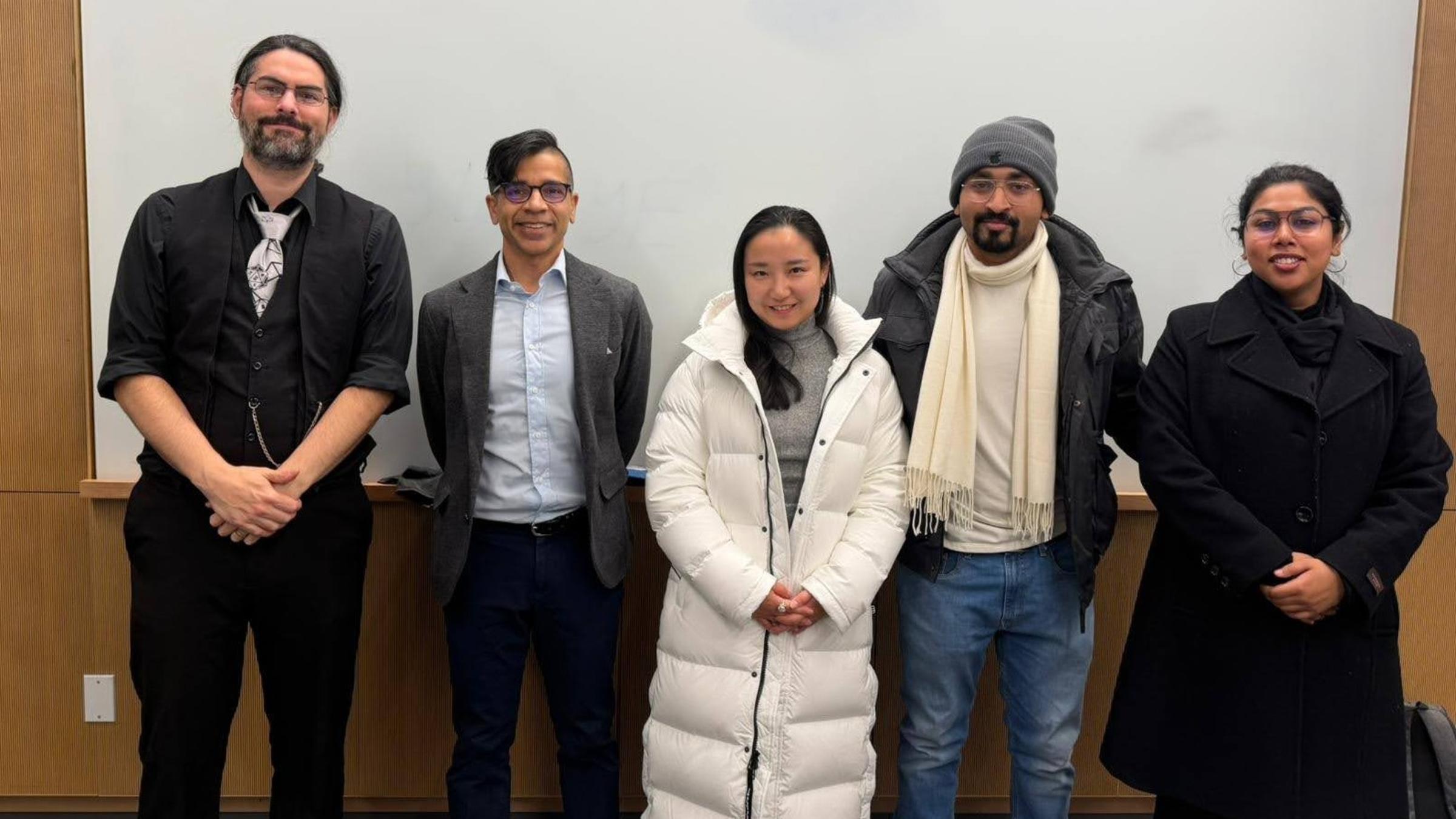
The team included applied artificial intelligence master’s students Shivam Raj ’27, Titir Talukder ’27 and Xirui Yu ’26, as well as Atif Qadir, a real estate developer enrolled in Stevens’ Applied Machine Learning course. Advised by lecturer Joseph Helsing, they created a machine learning model that evaluates the suitability of every U.S. Census tract — more than 85,000 — for AI data center development.
Why data center location matters
AI data centers can consume at least three times more energy than traditional facilities. Their rapid growth is already straining power grids, inflating energy costs, and creating environmental and community concerns.
“AI infrastructure is expanding faster than almost any other asset class,” said Qadir. “Today’s siting decisions will shape energy and technology systems for decades. But they’re often being made through intuition or by which region can approve permits the fastest.”
Through research and conversations with experts in real estate, construction, energy planning and regulation, the students found that incomplete data, market familiarity or timing pressures often drive site decisions. They decided to add performance-based factors to the process of finding the most suitable U.S. regions for data centers.
“This approach replaces intuition with evidence,” Qadir noted, “helping planners, utilities and technology companies make informed, resilient, and sustainable infrastructure decisions as AI continues to expand.”
Their machine-learning model learns development patterns directly from data without human labeling. It analyzes national datasets related to power infrastructure, network connectivity, environmental risk and policy conditions. Then it compares each Census tract to locations where data centers already exist, giving each site a score from 0 to 100 to show how closely it aligns with successful data center locations.
The model shows that the best-performing sites tend to be close to high-voltage power transmission facilities and major internet exchange points, suggesting that these should be top criteria for decision-making. It’s a reality-based finding with real-world implications.

“I appreciated seeing how machine learning can be applied to a real, large-scale infrastructure problem,” said Yu. “It strengthened my technical skills and showed how data-driven insights can guide decisions with real societal impact.”
The team presented its findings at the Stevens DuckAI Symposium in December 2025, and plans to pursue publication and work incorporating real-time electricity pricing and grid expansion scenarios.
“AI is becoming indispensable across industries, from healthcare and finance to everyday technologies and the growth of AI depends on its robust infrastructure,” Talukder said. “Understanding how and where data centers should be located helps support this expanding AI ecosystem while promoting sustainable, data-driven decision-making.”
Learn more about academic programs and research in the Department of Electrical and Computer Engineering: