Stevens Student-Led AI Innovation Takes Center Stage at iCNS AI Engineering and Science Symposium
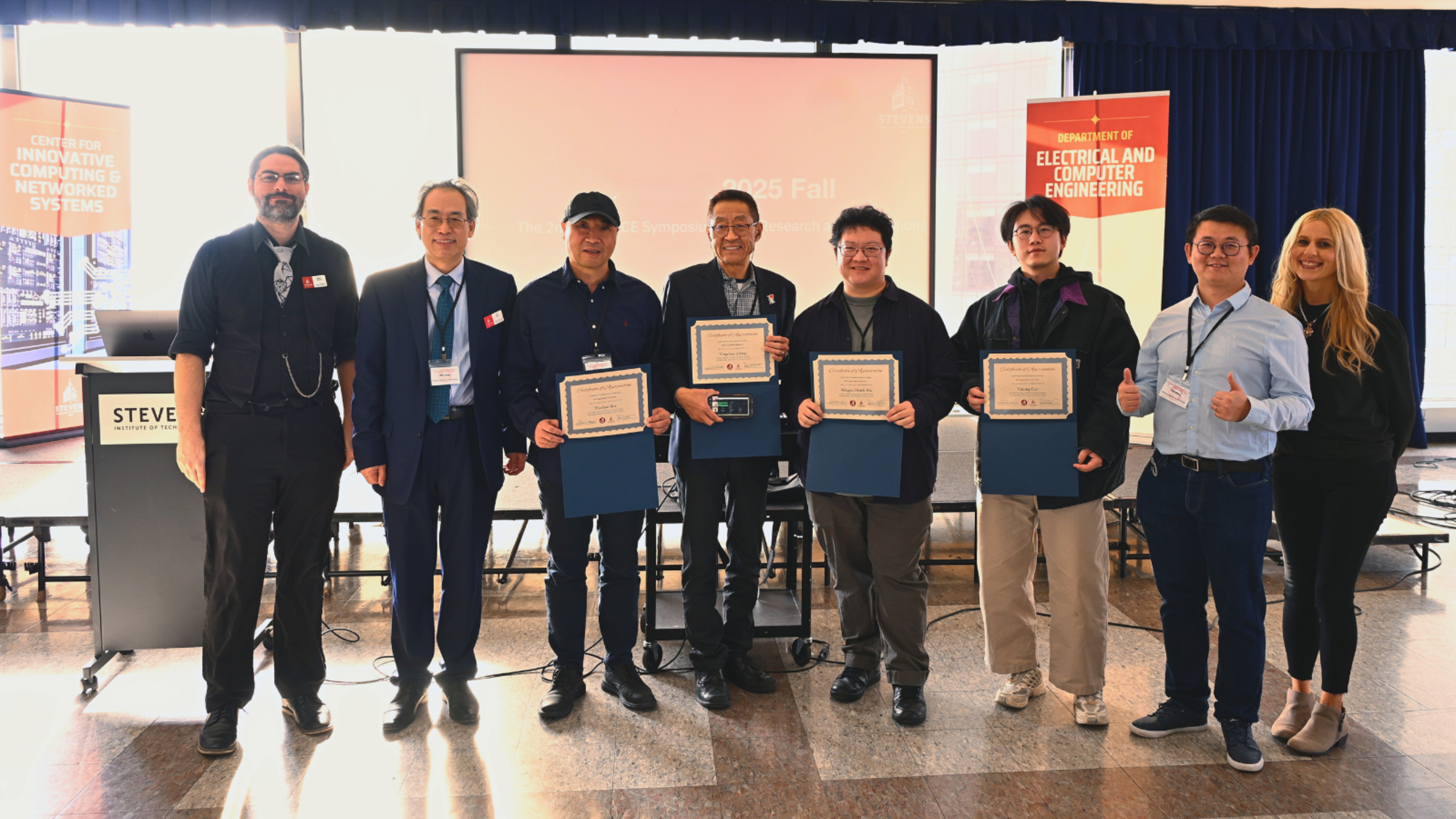
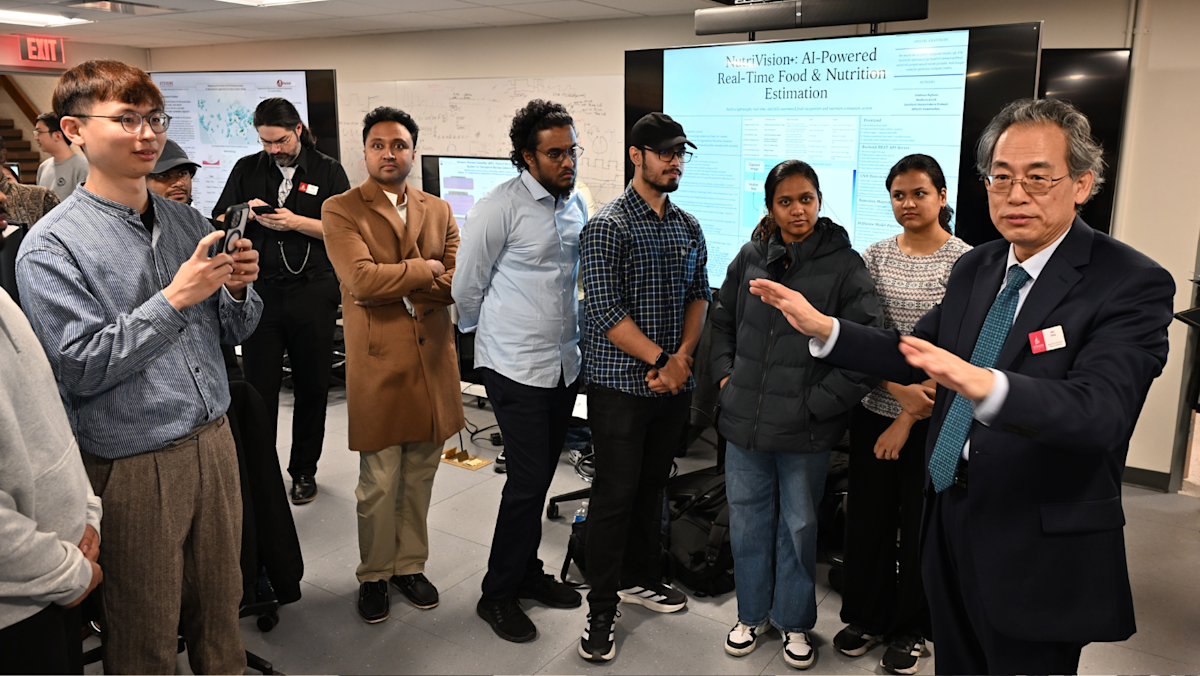 Stevens Institute of Technology continued to advance its leadership in applied artificial intelligence research and education with the latest iCNS (Center for Innovative Computing and Networked Systems) AI Engineering and Science Symposium (formerly known as DuckAI), held this past fall.
Hosted by the Department of Electrical and Computer Engineering, the event brought together faculty, students and industry experts to explore AI’s future — and how Stevens is helping advance this transformative technology.
Alongside keynote talks, students presented posters and demonstrations highlighting innovative AI projects they developed during the Fall 2025 semester.
Connecting classroom theory with professional practice
Earlier in 2025, the inaugural event showcased foundational research and solutions in healthcare AI, fairness and bias and reinforcement learning. This program’s student projects built on that groundwork, reflecting more specialized and emerging domains. Posters focused on efficient large language models (LLMs), LLM safety and trustworthiness and advanced system optimization.
“This shift highlights a rapid maturity in our students' work,” said Min Song, professor and chair of the Department of Electrical and Computer Engineering. “It’s exciting to see them moving from general application bias and standard model training to optimizing and securing the cutting-edge architecture of LLMs.”
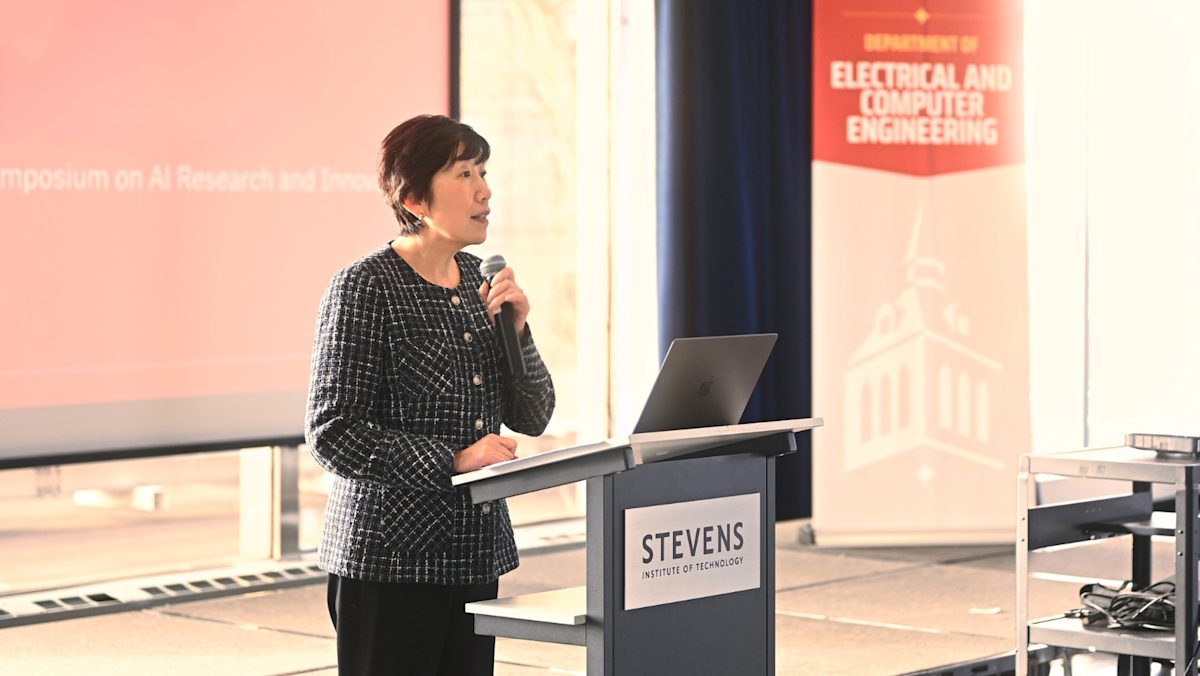 Industry speakers reinforced those themes through real-world applications. Tianhao Wu and Yingchao Zhang, co-founders of life sciences technology company opAIda, discussed strategies for unlocking business value through open-source AI. Mingyu Derek Ma, senior machine learning scientist at Prescient Design (Genentech), shared how LLMs are being adapted to provide expert-level intelligence in areas such as drug discovery and clinical health. Yulong Cao, NVIDIA research scientist, examined how testing frameworks, simulation and foundation models can support safe, human-aligned autonomous driving systems.
The iCNS AI Engineering and Science Symposium also provided students with a platform for professional communication and networking, challenging them to clearly articulate complex ideas to peers and industry leaders.
“The event facilitated organic networking that went beyond standard Q&A,” Song noted, “with students actively engaging speakers on technical challenges and potential career paths, sparking ideas for future research directions.”
After 34 student teams participated in the poster and demo session, an Elite Posters awards session recognized the leaders of three projects for delivering technical depth, real-world relevance and alignment with cutting-edge AI themes:
 First place: LLM-Powered Agentic Systems and Applications by Yupeng Cao, Ph.D. candidate, exploring AI agents capable of planning, reasoning and executing tasks beyond traditional chatbot behavior.
 Second place: DEMI: A Reinforcement Learning Agent that Embodies Collective Intelligence to Minimize Attrition by Drishti Parekh, Eden Charles and Meetkumar Gajera, addressing workforce and user retention through reinforcement learning.
Third place: Trustworthy Models and Data by Sabbir Ujjal, focusing on ensuring AI systems are reliable, secure and free from bias.
“It was an impressive and thought-provoking experience that left a lasting impression,” said Dr. Lin Lin, a member of the Department of Electrical and Computer Engineering's External Advisory Board. “From the keynote presentations to the hands-on design project demonstrations, the iCNS AI Engineering and Science Symposium offered a comprehensive and optimistic view of artificial intelligence and its role in shaping the future.”
Learn more about academic programs and research in the Department of Electrical and Computer Engineering: