How Physics Research at Stevens Led to an Enrico Fermi Fellowship
Time is not the same everywhere. A clock placed higher above the Earth, where gravity is slightly weaker, ticks a little faster than one sitting lower down. Modern atomic clocks are sensitive enough to detect the difference across a height of just a few millimeters.
Stevens physics Ph.D. student Christos Karapoulitidis, a recipient of the Enrico Fermi Fellowship, a highly competitive and globally recognized award given to only a small percentage of applicants worldwide, is interested in knowing what happens to the passage of time when the clock itself is placed in two heights at once, a state physicists call a quantum superposition.
“Does such a clock experience one definite passage of time, or a quantum combination of different proper times?,” he asked.
Answering that question is an ambitious endeavor, one that requires both theory and experimentation.
Merging the theoretical with experimentation
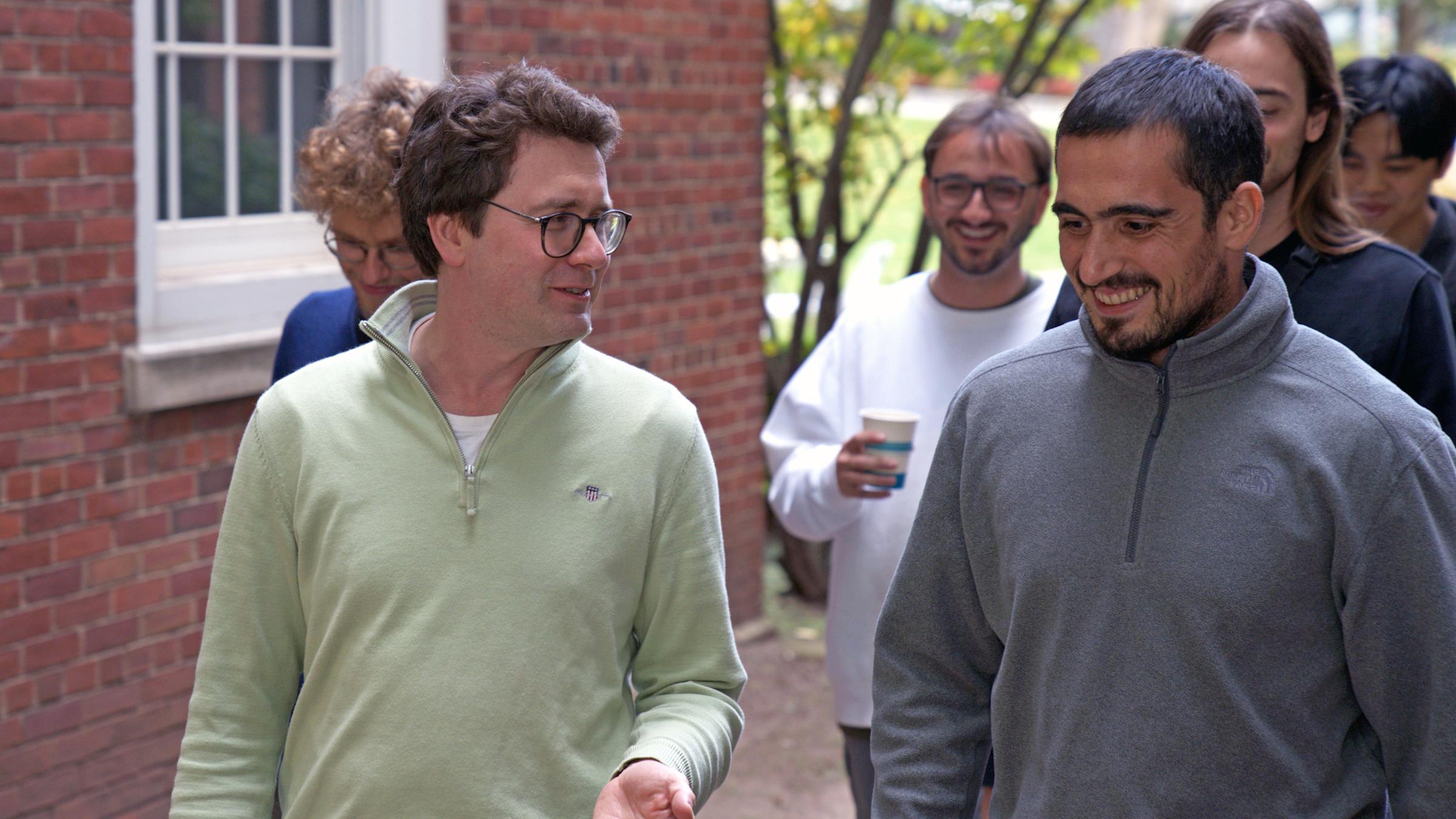
“When Christos Karapoulitidis arrived at Stevens, he came with a top education from the University of Heidelberg and a thorough grounding in the kind of fundamental physics most departments have taught for decades,” said his advisor, Professor Igor Pikovski, the Geoffrey S. Inman ’51 Assistant Professor of Physics at Stevens, adding, “He is a good student, and he’s clearly motivated.”
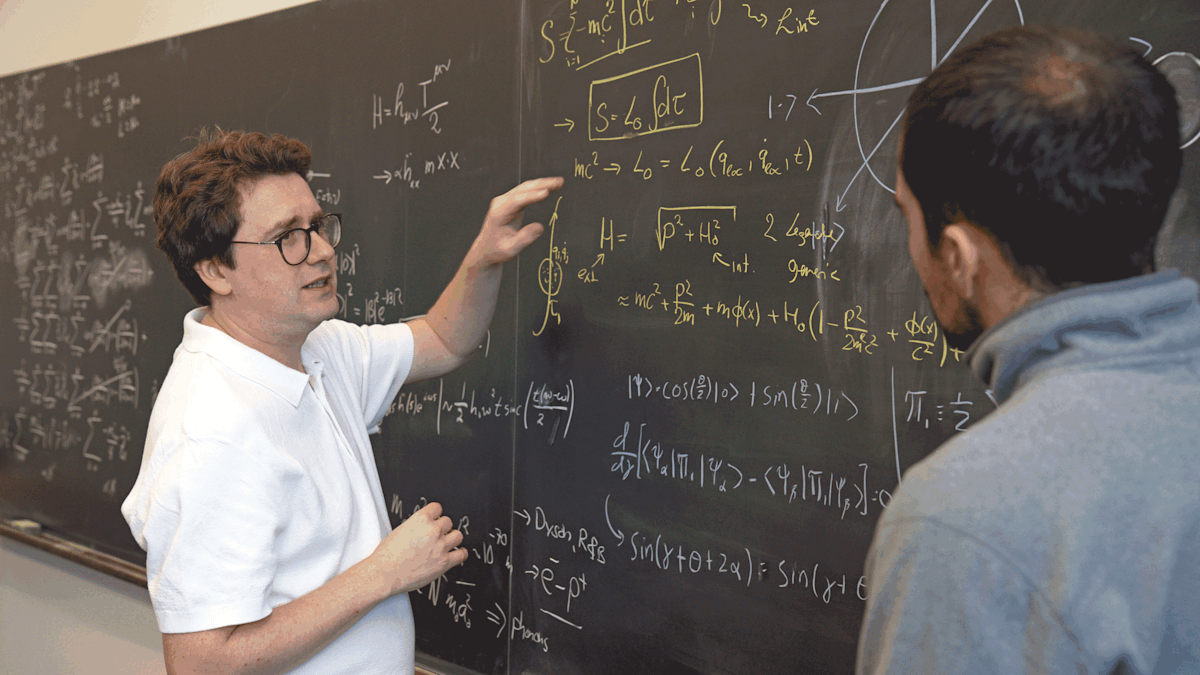 But Karapoulitidis was looking for something a bit more ambitious: studying nature at its deepest.
Karapoulitidis wanted to work on questions that sit at the border between quantum mechanics and gravity, and the partnership he’s part of spreads his research across two institutions: Stevens and UC Berkeley.
“Here at Stevens, the theoretical side of the project asks how these clocks behave under the influence of gravity,” he said. “The experimental side at Berkeley focuses on using state-of-the-art optical lattice clocks, where atoms can be controlled with exceptional precision.” An optical lattice clock, among the most precise timekeepers ever built, uses laser light to hold ultra-cold atoms in a rigid lattice and measure the passage of time.
The Enrico Fermi Fellowship gives a theory student the rare chance to learn experiment firsthand and shape his research into practice, according to Pikovski.
“The fellowship is notable because it really is focusing on something very special in fundamental physics, this interplay between experiment and theory, which has not been at the forefront of modern physics for a long time in terms of fundamental physics,” Pikovski said.
“The conceptual challenge is to find signatures that truly probe this interplay between gravity and quantum mechanics,” said Karapoulitidis. The catch is that any such effect also must be something a real instrument can actually pick up, using the optical lattice clocks available now or in the near future.
“We know the results a little bit. But for now, the work is still a roadmap,” Pikovski said. “We haven't published this direction yet, but we know how to do it, and so that's the exciting part.”
Laying the groundwork for a new era in fundamental physics
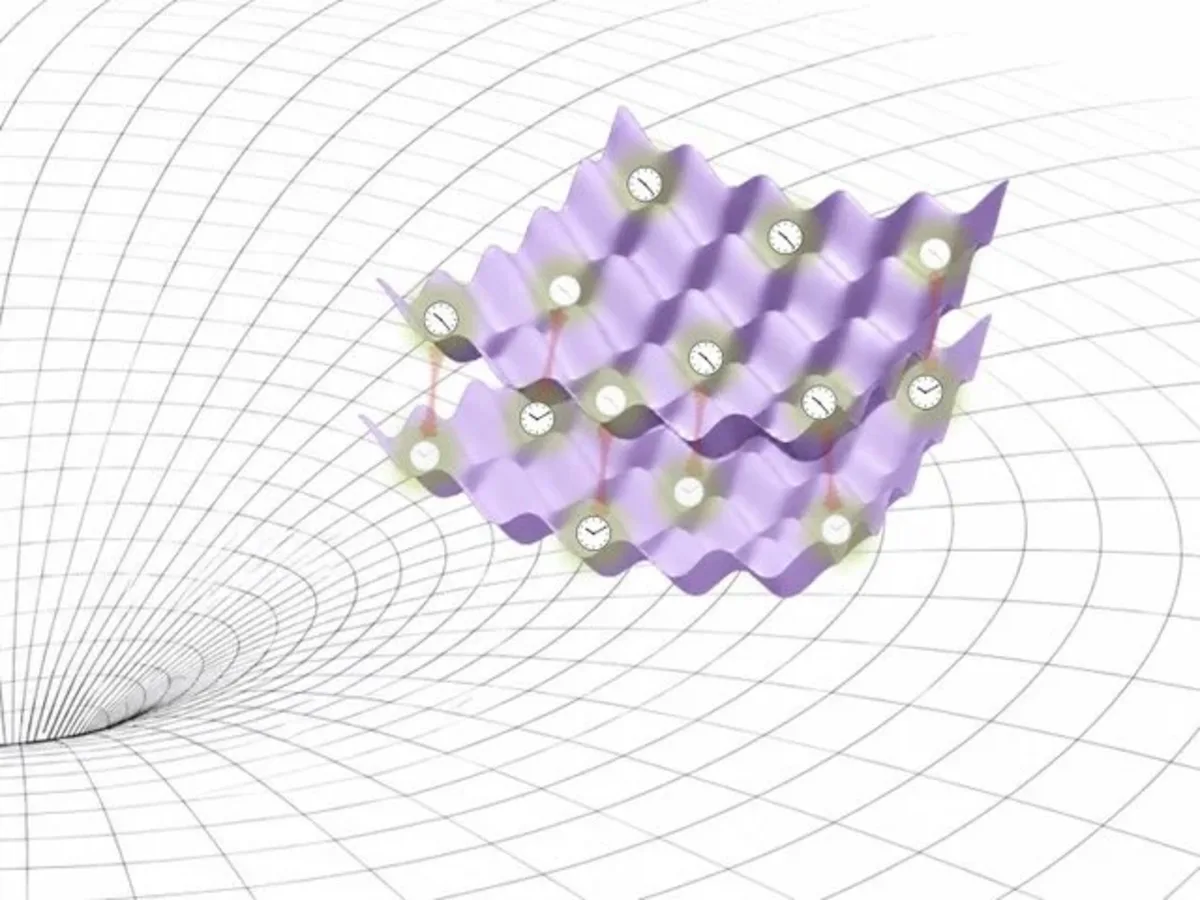 One of the first things Pikovski asked Karapoulitidis to do was study one of the professor's earlier papers, from 2011. It introduced an idea Karapoulitidis calls beautiful: that a clock could be placed in a quantum superposition, traveling more than one path at once, and would then experience more than one flow of time at once.
“For me that was the moment when actually this direction of research really clicked,” he said. “Professor Pikovski asked me if we can take this idea seriously as an experimental goal and find a way to make it accessible with modern atomic clocks,” he said.
The transition from this beautiful idea to a concrete experimental direction was the moment when the project really clicked for him, and Stevens has provided the essential environment to develop this research, according to Karapoulitidis.
“We have close mentorship and strong intellectual support, and we have a group focused precisely on this interface between quantum mechanics and gravity,” he said.
The broader goal of the project is to demonstrate that meaningful experimental progress can be made and help establish experimental quantum gravity as a new field, explained Pikovski.
“I would name it something like experimental quantum gravity, where it really is possible to ask and answer meaningful questions that before were confined to pure math or even philosophy, but in an experimentally relevant regime,” he said.
A place for curiosity and big questions
“Professor Pikovski always encourages to ask fundamental questions, even when they sound ambitious or unusual at first,” Karapoulitidis said. “I learned that progress often comes from taking such questions seriously, in a sense, and then working carefully to turn them into precise and testable problems,” said Karapoulitidis.
Pikovski, winner of the Keck Award earlier this year for a project focused on a different research direction, detecting gravitons, notes what Karapoulitidis is working on is complementary, and one of the aims is to make Stevens a prime destination for where this research is heading.
“It used to be niche and now really kind of, I think, the most promising for maybe the next decade or two of where fundamental physics will go," said Pikovski.
Both Karapoulitidis and Pikovski emphasized how Stevens offers a setting for curious students with big questions.
“Stevens is extremely inclusive of students in research. We work with high school students and many undergraduates. It's extremely accessible research. That's true across the entire Center for Quantum Science and Engineering, where students can really have an impact from basically day one when they join Stevens,” said Pikovski.
“We focus on the fundamental research and fundamental questions of nature, and the main ingredient to do this kind of research is curiosity,” said Karapoulitidis. “For a prospective student, if they’re really interested to study nature at the deepest levels, in a fundamental level, then our group is the go-to place to do that.”
Learn more about academic programs and research in the Department of Physics: