
Torch Bearers: Math as Miracle
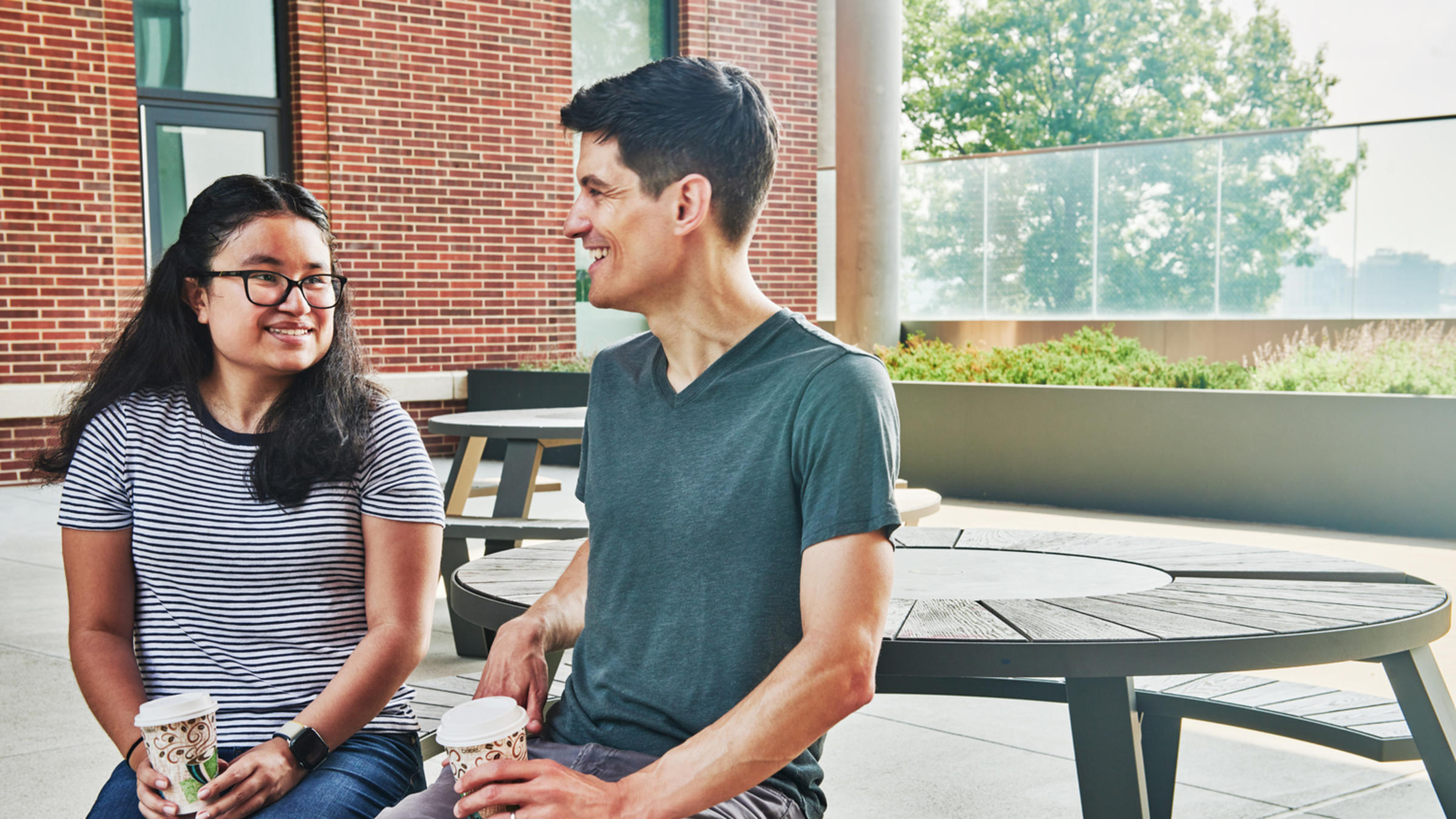
Professor Jan Cannizzo’s unabashed love of math springs naturally into his everyday conversation, as he quotes history’s great mathematicians. One of his favorites, paraphrasing Galileo: “Mathematics is the language in which the universe is written.”
The award-winning professor — who earned bachelor’s and master’s degrees in mathematics from Stevens in 2007 and a Ph.D. in mathematics from the University of Ottawa — has spent his career as a math educator and innovator. He’s the perennial coordinator of the Stevens Math Circle Initiative, an enrichment program for elementary and middle school students aimed at inspiring and nurturing a love for math, and has helped to organize the Stevens Mathematical Olympiad competition for local schoolchildren.
In his class, you might see a brief lecture, then students working in groups, with Cannizzo roaming the room, speaking with students and answering questions. You may see students tackling a calculus problem, with polling software immediately telling him who’s getting it and who needs more time. (See sidebar below on a new AI tutoring tool for calculus homework developed by Cannizzo.)
“I try to carry across in what I’m teaching my own love of mathematics,” Cannizzo says. “It feels like a small miracle that every human being has a capacity to do mathematics.”
His student Katherine Fuentes ’26 was a standout, and not just because she was among the First in Class of her Stevens graduating class, with a perfect 4.0. This fall, she joined Binghamton University to pursue a Ph.D. in mathematics, with plans to become a university professor.
But her academic journey was far from certain.
Growing up in West New York, New Jersey, Fuentes was a math whiz and a popular tutor. “I would help them, and it would always feel really nice,” she says.
She was the first in her family to attend college; most of her family had not completed high school, having fled El Salvador during the country’s 12-year civil war. She and her mom lived with her aunt and uncle; her family offered steadfast support and faith in her. But she faced tough classes, college tuition bills, and the future seemed uncertain. College felt like traveling through a tunnel, she explains. “My entire time I was at Stevens, my question was always, ‘What am I going to do next?’”
The ADAPT Scholars program at Stevens — funded by the National Science Foundation — offered scholarships and mentors to talented first-generation college students like Fuentes. Cannizzo became her mentor.
He was always ready to help, she says. They discussed difficulties with classes, courses she should take and the road ahead. In Cannizzo, Fuentes also saw the type of teacher she wanted to be; she thrived as a teaching assistant this past year. She plans to mentor other first-generation college students.
Cannizzo describes Fuentes as “a great student” who opened his eyes to the struggles and resilience of first-gen college students.
“Going forward,” he says, “she’ll be a great instructor. I am so proud of her.”
– Beth Kissinger