Stevens Team Sets Its Sights on a Revolutionary Approach to Extend the Life of the Hubble Space Telescope
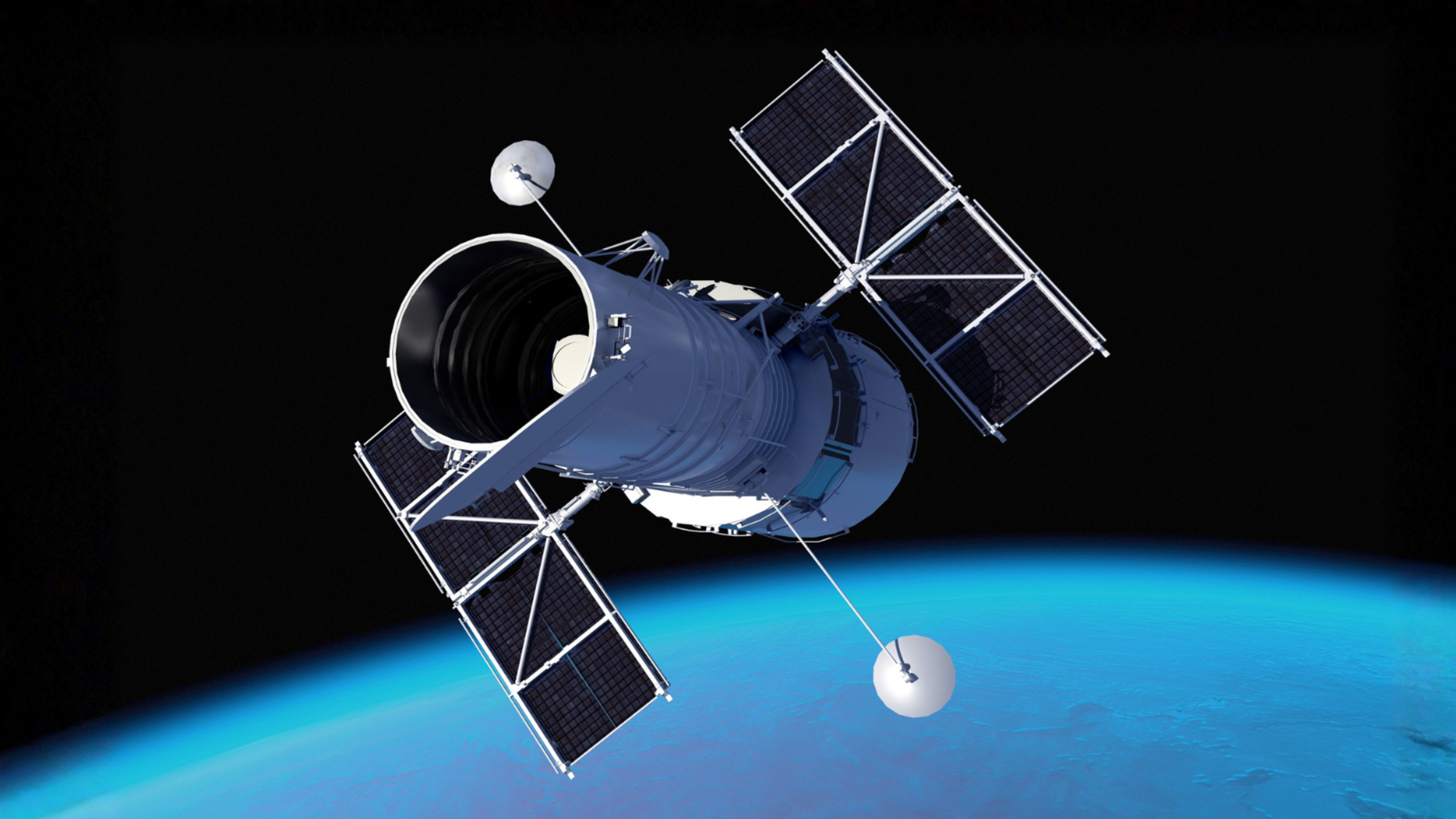
For more than three decades, NASA’s Hubble Space Telescope has been exploring the universe, delivering images and data that inform and inspire both professional and amateur astronomers. The iconic observatory has captured photos of distant galaxies, revealed new insights into black holes and dark energy and enabled countless scientific discoveries.
 Today, however, one of the telescope’s most persistent challenges is far less dramatic: the gradual aging of its gyroscopes, which allow Hubble to sense its motion and point precisely toward distant cosmic targets. Although Hubble originally used three of its six gyroscopes, just two are currently functional — and only one is in use.
Rather than accepting this situation as the mission’s inevitable conclusion, a research team on two coasts began asking, “What if Hubble could be given a second life?”
Roshanak Nilchiani, associate professor in the Department of Systems Engineering; Rashika Sugganahalli Natesh Babu, a second-year Ph.D. candidate in Systems Engineering; David Barnhart, professor of astronautical engineering at the University of Southern California, and Barnhart’s research group colleagues took on the challenge of finding a cost-effective, non-intrusive, simple solution to keep Hubble operational.
Their solution proposes using nanosatellites that would restore the telescope’s ability to measure its motion in space. Their work was recently published in Aerospace America, the flagship magazine of the American Institute of Aeronautics and Astronautics.
Putting a new spin on solving the gyroscope problem
Astronauts on service missions have already opened Hubble and swapped out degrading gyroscopes multiple times, which was effective but cost hundreds of millions of dollars.
 Now, with the retirement of the space shuttle, even that option is no longer viable.
Software workarounds and sensor reconfigurations have helped, but issues remain. So while the optics and other instruments are still performing well, the ongoing gyroscope issues could potentially limit or even end Hubble’s storied career.
“Hubble is an elegant engineering system that has already far exceeded its original design life,” said Nilchiani. “But systems like this often face degradation in a single critical subsystem that can threaten the entire mission. That raises a deeper question: what truly defines the lifetime of an engineered system?”
For the team, the answer was not necessarily the failure of a component. Instead of immediately pursuing conventional fixes, the researchers stepped back to reconsider the problem.
“Sometimes it is the failure of our imagination to adapt and extend it,” Nilchiani said. “When the solution space remains open long enough, unusually elegant ideas sometimes emerge.”
The team’s unusual idea emerged as a ring of small gyroscopes acting as a smart exoskeleton docked around the telescope, augmenting but never touching its internal architecture.
“My role was to take the seed of an idea, an external gyroscope augmentation for Hubble, and develop it into a systems-engineered concept,” said Sugganahalli Natesh Babu, whose research focuses on spacecraft complexity, obsolescence and strategies for extending the operational life of space systems. “That meant looking carefully at questions such as how many nanosatellites might be needed, how they could safely rendezvous with Hubble and how their sensing data could interface with the telescope’s existing control system without intrusive changes.”
Working with Nilchiani, Barnhart and USC collaborators, she conducted feasibility studies, architectural trade analyses and preliminary cost assessments that helped shape the concept into a proposal that could realistically support a future mission.
For Sugganahalli Natesh Babu, the project connects with her broader interest in space sustainability. In 2025, she was selected as part of the AIAA ASCENDANTS cohort, an international program recognizing emerging leaders in aerospace. There, she explored ideas for rejuvenating aging satellites.
“That experience anchored my thinking around giving space systems a second life,” she said. “Hubble still has immense scientific value. The question is whether a single aging subsystem should define the end of such a mission.”
It’s a question plaguing many aerospace and similarly complicated infrastructure systems.
“Hubble provides a powerful and symbolic case study,” Nilchiani said. “The broader challenge is how we intelligently extend the life of complex systems instead of defaulting to replacement.”
The collaboration among faculty and students has been one of the project’s most rewarding aspects.
“Together we worked to meaningfully influence how we think about stewardship of critical space infrastructure,” Nilchiani said. “When students work on missions like Hubble, they develop not only technical skills, but also a systems-level appreciation for sustainability, equity of access and long‑term thinking. That mindset is exactly what the next generation of aerospace leaders will need.”
For Sugganahalli Natesh Babu, the project has reinforced both her research direction and her career goals. “I want to work at the interface of research and mission design,” she said, “where systems engineering decisions directly shape how sustainable and adaptable our space infrastructure becomes.”
As Hubble continues its orbit, the Stevens-led research offers a compelling vision for how imagination, systems thinking and student-driven innovation could help keep this pioneering scientific instrument exploring the universe for years to come.
“The best reward,” Nilchiani said, “would be knowing that 10 years from now, Hubble is still moving across our sky every 95 minutes, still producing groundbreaking science because we chose to extend its life.”
Learn more about academic programs and research in the Department of Systems Engineering: