Stevens Researchers Discover Ways to Boost Performance in Hydrogen Fuel Cell Membranes with Big Implications for Improving this Clean Energy Tech’s Performance
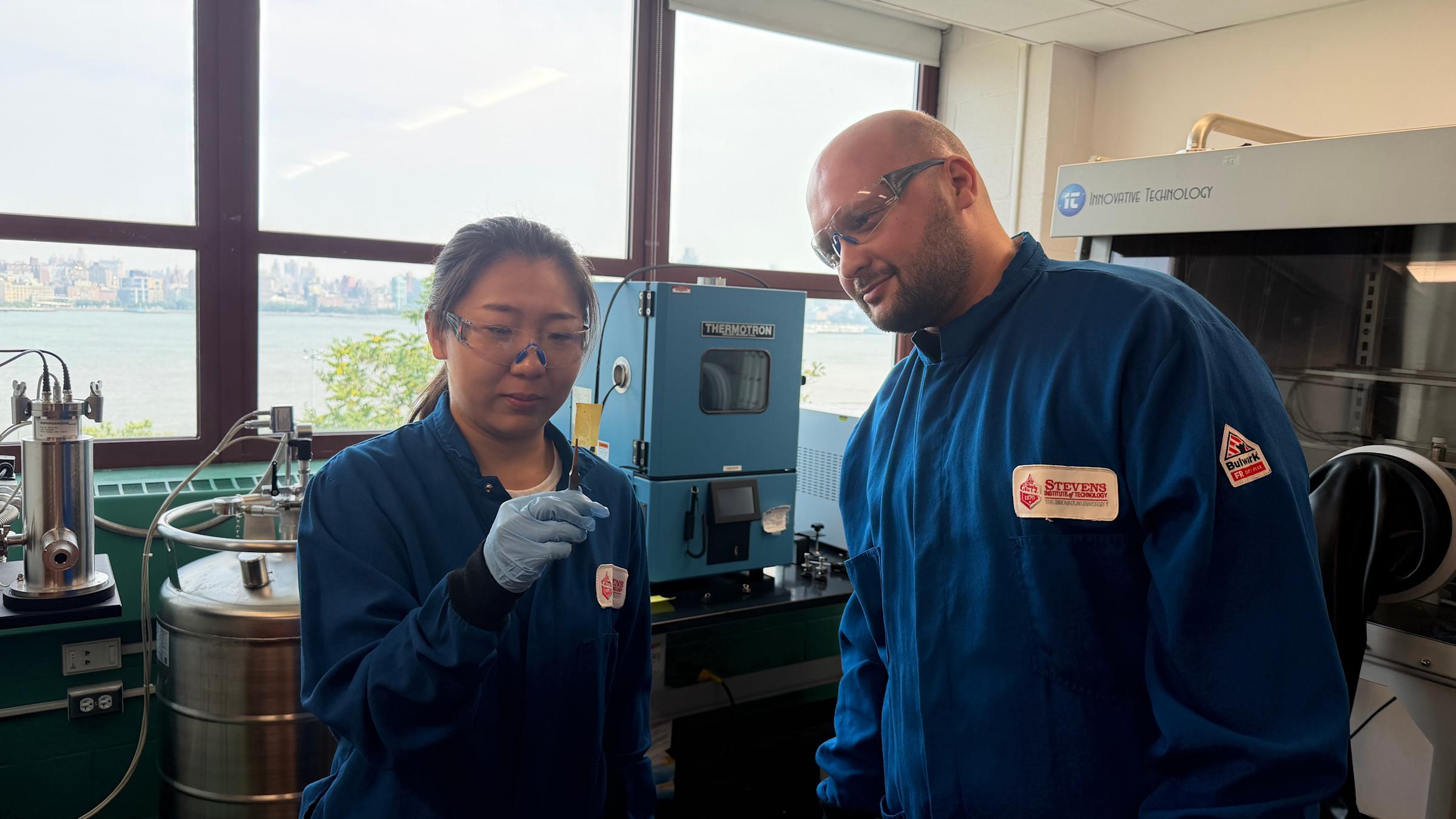
HOBOKEN, NJ, Sept 9, 2026 — Hydrogen fuel cells are a promising clean-energy technology with the potential to reduce pollution and greenhouse gas emissions with adoption. As they generate electricity, the only byproduct of their reactions is water. However, improving their performance depends on developing better materials that can more efficiently transport ions. In a recent study, Stevens researchers collaborated with academics from other institutions to test several novel polymer materials and determine which characteristics improve performance.
A fuel cell consists of three primary parts: an anode (negative electrode), a cathode (positive electrode), and an ion-conducting membrane in the middle. The energy in a form of electrical current is generated as ions flow through the membrane between the electrodes, and hydrogen and oxygen gas react to form water, according to Assistant Professor Benjamin Paren who studies fuel cells at Stevens Institute of Technology’s Department of Chemical Engineering and Materials Science.
Existing fuel cells technologies rely primarily on proton exchange membranes, which require expensive catalysts to keep the chemical reactions going. “Proton exchange membrane fuel cells use platinum group metals,” explains Paren. “Those are rare elements. They are expensive. They can be environmentally harmful to get, and so there are a lot of economic disadvantages to that.”
An alternative is using anion exchange membranes, where the reactions that occur at the electrodes can be enabled with more commonly available and less expensive catalysts, such as iron- or nickel-based catalysts. A drawback is that anion exchange membranes are not as efficient as the proton exchange membranes for transporting ions. “The anion exchange membranes are attractive from a sustainability point of view,” Paren explains. “But the performance has not quite reached the level of what we get from proton exchange membrane fuel cells.” To improve the performance, one must better understand the structure of polymers that membranes are made from — and optimize their structure.
To make progress towards better anion exchange membranes, Paren worked with a multi-institution team led by Professor of Chemistry Chulsung Bae at Rensselaer Polytechnic Institute, who is an expert at synthesizing such polymer membranes. Bae’s lab supplied existing and newly synthesized polymers so that Paren’s team could analyze their structures.
The membrane performance depends on how quickly the ions move through it, which is influenced by the membrane’s polymer structure. The more rigid polymers can often limit performance while the more flexible ones adjust and create more uniform channels through which the ions flow faster. “The idea is that a polymer that's more flexible can rearrange itself to form channels more easily,” says Paren.
But his team was up for a surprise. When they measured the performance of various polymers, scientists discovered some that wasn’t always the case. Some polymers with fairly rigid molecular backbones — not the most flexible ones as scientists had expected — created the most well-defined channels once they were submerged in water. The polymers with the most organized water-filled channels allowed ions to travel quickly and efficiently through the material.
“What we found is that some of the polymers that were actually more rigid while dry formed better channels when hydrated with water,” Paren explains. “So the water itself may allow the ions to arrange in a more favorable way.”
The team published their findings in the journal of Macromolecules. Their discovery shows that a material's performance can change dramatically under real operating conditions and highlights the importance of evaluating membranes in their hydrated, working state rather than only when they are dry.
Hydrogen fuel cells offer a big advantage from the clean energy perspective. Energy derived from solar or wind power, can be used to produce hydrogen through a device called an electrolyzer, which splits water molecules into hydrogen and oxygen. The resulting hydrogen can then be stored in specialized tanks until it's needed and later converted back into electricity by fuel cell, explains Paren. Electrolyzers also rely on efficient membranes, so Paren’s work is important for both types of technologies. “Essentially, what we are doing is creating a pathway to more affordable and sustainable energy,” Paren says.
About Stevens Institute of Technology
Stevens is a premier, private research university situated in Hoboken, New Jersey. Since our founding in 1870, technological innovation has been the hallmark of Stevens’ education and research. Within the university’s four schools, more than 8,000 undergraduate and graduate students collaborate closely with faculty in an interdisciplinary, student-centric, entrepreneurial environment. Academic and research programs spanning business, computing, engineering, the arts and other disciplines actively advance the frontiers of science and leverage technology to confront our most pressing global challenges. The university continues to be consistently ranked among the nation’s leaders in career services, post-graduation salaries of alumni and return on tuition investment.
Stevens Media Contact
Lina Zeldovich
Manager of Media Relations
Division of University Advancement
201-216-5123
[email protected]