Stevens School of Business leadership development and organizational behavior professor publishes new research on how top executive traits may be associated with a company’s behavior
You don’t have to be a fan of Coldplay to understand that a CEO’s actions can have a significant impact on the company they lead.
In one of the more public examples, WeWork’s dramatic fall became the subject of documentaries and a case study in how a CEO’s personal traits can shape corporate destiny. Contrast that with the former Unilever CEO, whom the New York Times called “one of the most prominent voices in the corporate world calling for changes to the status quo, encouraging big companies to reduce emissions, embrace renewable energy, improve conditions for workers and produce healthier products.”
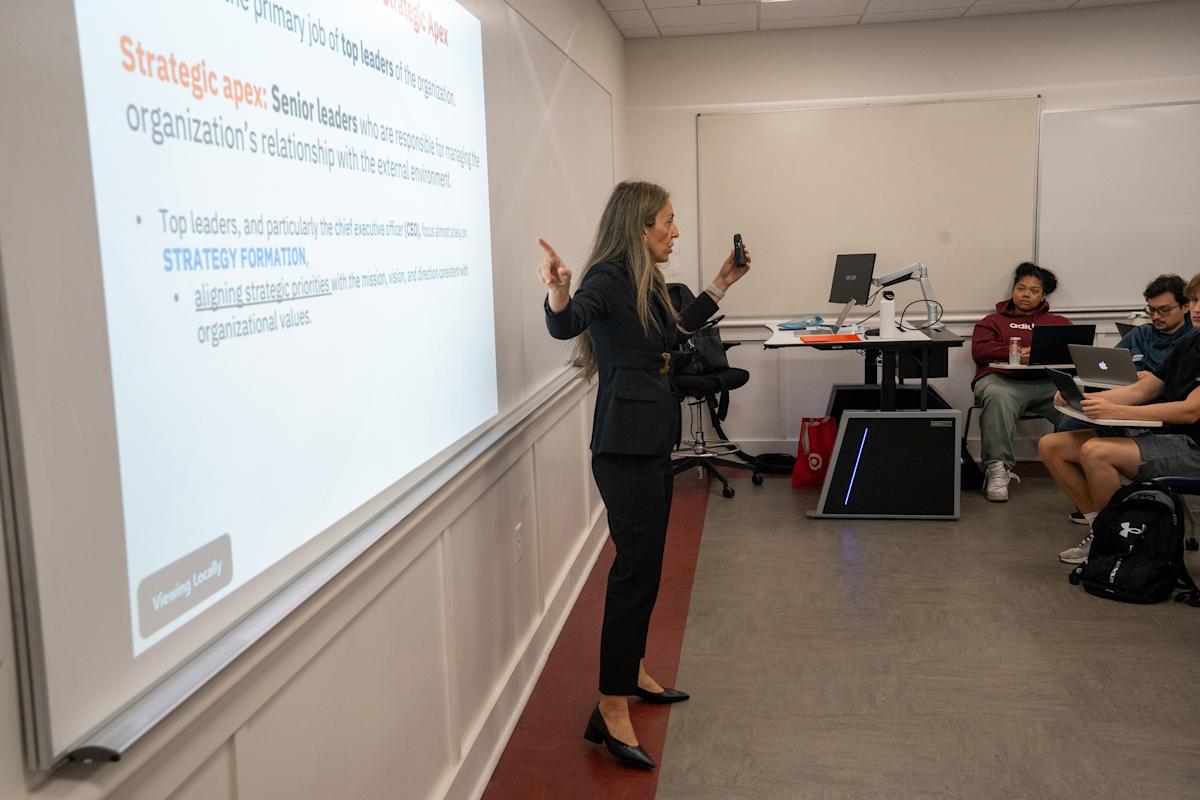
These stories highlight why business scholars, like Stevens School of Business professor Sibel Ozgen Novelli, are examining how the characteristics of top executives can influence whether a company leans toward corporate social responsibility or irresponsibility. Ozgen and her co-authors address this question in their article, “CEO Characteristics and Corporate Social Responsibility and Irresponsibility: Mirrored or Distinct Correlates?,” which was recently published in Corporate Governance: An International Review.
“In leadership research, we talk about how leader characteristics affect different outcomes,” she explained. “Most of the time, they look at this question related to whether certain attributes of CEOs affect firm performance, but recently, there has been a shift. Now they are asking different questions, whether the characteristics of CEOs affect firms’ corporate social responsibility or irresponsibility.”

Drawing on 420 primary studies encompassing 425 independent samples, this research examines the relationship between CEO traits and both Corporate Social Responsibility (CSR) activities, such as environmental initiatives and community engagement, and Corporate Social Irresponsibility (CSI), which refers to behaviors that may harm stakeholders or society.
“We wanted to see whether CEO attributes relate to corporate social responsibility and irresponsibility in the same way or different ways,” Ozgen explained. “Why is this an interesting question? Suppose you think that a CEO attribute relates to one characteristic positively. In that case, we might presume that it is going to be negatively related to irresponsibility, but that might not be the case.”
The article breaks characteristics down into three categories: cognitive aspects, such as education level and experience, non-cognitive aspects that include values, leadership styles, minority status and personality, and relationships.
“The initial inspiration was that we want to understand why the firms behave the way they do, and if the characteristics, values and leadership styles of the people who are at the top of these organizations might factor into their decision making, which can ultimately impact firm outcomes,” she explained. “While we understand this in the context of CSR and CSI, we were curious whether CEO characteristics relate to these outcomes in a similar way or different ways. From a research standpoint, this was interesting because this literature does not tend to talk to each other.”
“There are scholars and researchers looking at CEO characteristics in relation to social responsibility, and there is another line of research looking at CEOs and corporate irresponsibility. However, there is a lack of communication between these two streams of research.”
The research found that most CEO traits have a clear connection to the social responsibility of their companies, but the link to irresponsible behavior is less straightforward. The only three that showed a symmetrical relationship, positively affecting CSR and negatively affecting CSI, were gender, political connections and political views.
 But not all traits work this way. A CEO’s tenure tends to decrease both good and bad social activities, while narcissistic CEOs are likely to go big in both directions, increasing their firm’s CSR and CSI. The study also found that the business environment and cultural context may play a role in shaping how these CEO traits actually play out in the real world and “further demonstrating that CSR and CSI are not simply two ends of a ‘corporate social performance’ continuum.”
The implications for business practices are significant, offering a framework for executive succession planning and CEO selection. Rather than assuming that avoiding "certain" CEO characteristics will automatically lead to good social outcomes, boards should consider how different traits might influence both responsible and irresponsible behaviors, requiring a more nuanced understanding of how CEO characteristics interact with institutional context.
“One of the interesting findings that we are providing to the literature, and why this is relevant for companies to consider, is that when companies are selecting executives and CEOs, they need to ask what characteristics they are going to pay attention to,” Ozgen said. “They need to be mindful of the company's positioning with respect to corporate social responsibility and irresponsibility.”