Bachelor's Degree in Economics
Technology, analytics and globalization continue to define the changing course of economics.

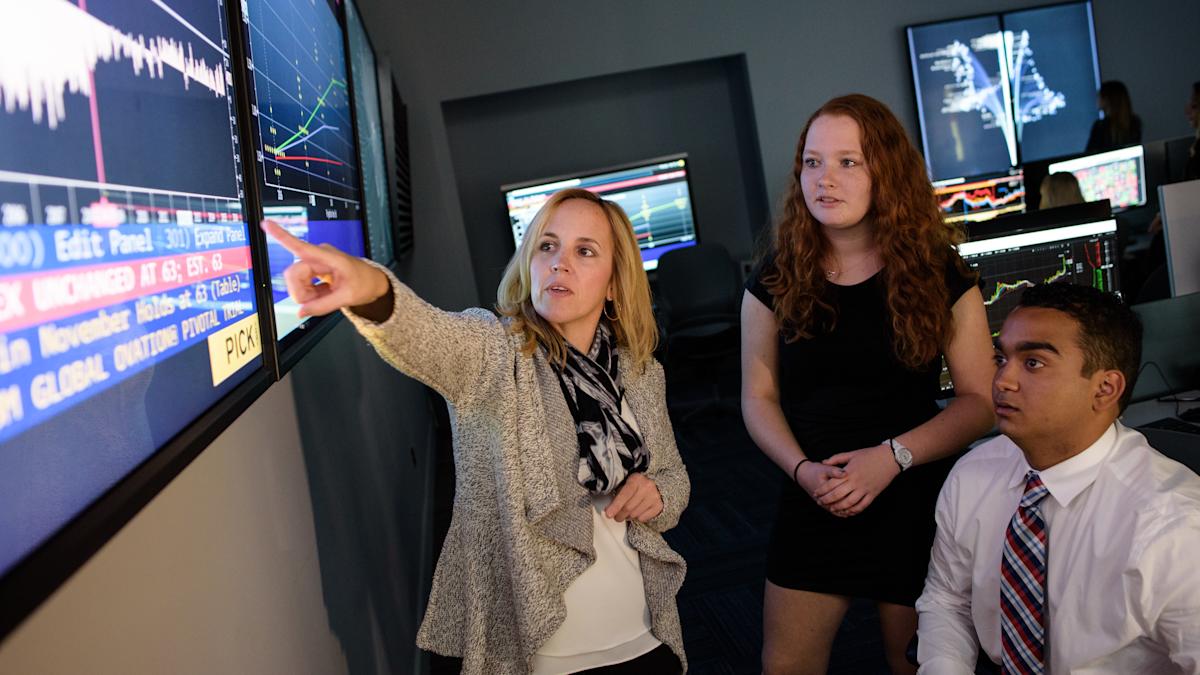
Stevens' leadership in these areas gives you a head start in the real world, both on internships and on the job or in graduate school. You'll gain an extra edge at Stevens, where coursework is aligned to the rigorous guidelines set by the American Economic Association in logical problem solving, data analysis, and compelling speech and writing. Furthermore, you'll enjoy plenty of opportunities to travel abroad, to see firsthand how business practices in other countries impact economics, both at home and far away.
Students complete the Economics major prepared to leverage their understanding of the global economics picture and data analysis techniques to excel in economics, banking or finance.
The economics curriculum emphasizes both technology and exposure to international aspects of economics, including an optional study abroad component. Students develop an international perspective and an appreciation for the technology that makes predictive modeling possible.
Economics Core
The major coursework puts a premium on data analysis, logical problem solving, and excellent speaking and writing skills — all areas identified by the American Economic Association as critical to student success in this industry.
BT 343 Intermediate Macroeconomic Theory
BT 344 Intermediate Microeconomic Theory
BT 436 Game Theory
BT 440 Money, Banking and Financial Institutions
QF 200 Financial Econometrics
FIN 105 AI Applications in Finance, Economics, and Finance Engineering and Accounting (FEFA) [1 credit lab]
Choose 1 elective course
BT 360 Financial Time Series
BT 450 Global Business Seminar
ECON 401 The Future of Work in the Age of AI
MGT 451 Computational Models of Thought and Behavior
QF 202 Financial Time Series
Business Core
In addition to your core of major-specific courses, you'll complete a suite of courses to provide you with an understanding and appreciation for the business fundamentals, including entrepreneurship, operations, business law, information systems, international business, accounting, finance, marketing and management. These courses will help you develop critical thinking and presentation skills, and encourage you to apply your learning to solve complex business problems.
ACC 200 Financial Accounting
ACC 215 Managerial Accounting
MGT 100 Principles of Management
ECON 242 Economics
BT 105 AI Applications in Information Systems and Analytics
BT 221 Statistics
BT 223 Applied Models and Simulation
MGT 290 Business Career Seminar
FIN 321 Corporate Finance
MGT 330 Social Psychology & Organizational Behavior
MKT 350 Marketing
MGT 413 Business Law
ISE 350 Logistics and Supply Chain Management
MIS 110 Intro to Scientific Computing, or CS 115 Intro to Computer Science
MIS 201 Fundamentals of Information Systems with Excel Lab
MGT 300 Business Communication
Two information systems courses
Two technology courses
Practice Core
The practice core at Stevens is where you’ll apply the skills you’ve learned in real business simulations, culminating in the Stevens Innovation Expo. For your expo project, you'll work in teams to either pursue a startup business concept of your creation, or work with executives at a New York-area business on a real-world consulting project. It’s one of the strongest examples of learning by doing — a value emphasized by Stevens and the School of Business — and provides instant credibility for your resume.
MGT 301 Strategy
MGT 372 Entrepreneurship
MGT 411 Senior Design I
MGT 412 Senior Design II
SUCCESS Core
Required:
PRV 101 First Year Experience
Frontiers of Technology
Choose 3 elective courses:
PRV 201 AI and Machine Learning
PRV 202 Data Science and Analytics
PRV 203 Biotechnology
PRV 204 Sustainability
PRV 205 Quantum Technology
Arts and Science Core
The arts and sciences core is a distinguishing feature of a Stevens education, and will help you hone talents such as written and oral communication and teamwork, while gaining a broader perspective on the world around you through courses in literature, political science, history and the social sciences.
HASS 103 Freshman Writing
HASS 105 CAL Colloquium
MA 110 Linear Algebra for Business and Liberal Arts
MA 111 Calculus I for Business and Liberal Arts
Two Humanities courses – one upper-level course and one lower-level course
Enhance Your Degree
The School of Business offers a variety of business minors designed to help you further diversify your studies. Please note, as a business student, you cannot receive a minor in the same field as your concentration or major.
Frequently Asked Questions (FAQs)
Can you describe the Economics major in one sentence?
The Economics undergraduate major combines economic theory with technology, quantitative analysis and data-driven decision-making to prepare students to understand and solve complex business and economic problems.
What type of coursework is incorporated into the Economics program?
Economics students study microeconomics, macroeconomics, statistics, applied modeling, finance, information systems and data analysis, along with the broader business curriculum. The program emphasizes logical problem-solving, quantitative analysis and effective written and oral communication and is aligned with guidelines established by the American Economic Association.
Are there student organizations Economics students can get involved in?
Economics students can participate in the Finance, Investment Banking and Advisory Society, Stevens Consulting Club, Stevens Women in Business, Phi Beta Lambda and other business and economics-related organizations.
How many internships or research opportunities do Economics students typically secure?
Economics students have strong opportunities to gain professional experience throughout their undergraduate years. 94% of business students complete at least one paid internship before graduation, and 53% complete two paid experiences, with opportunities in accounting, auditing, financial analysis, taxation, consulting, and related business fields.
Students can also participate in faculty-led research, working directly with professors on projects involving accounting, financial data, analytics, and artificial intelligence.
Together, these experiences allow students to apply classroom knowledge to real-world business challenges while developing the technical, analytical, and professional skills employers value.
How can I finish my bachelor’s degree in three years and use the fourth year to earn a master’s degree?
Stevens has developed a three-year bachelor’s degree plan for eligible students who enter with 24 or more college credits earned through AP and dual-enrollment coursework in high school.
With careful academic planning and by applying eligible incoming credits toward degree requirements, students may be able to complete their undergraduate degree in three years and use their fourth year to pursue a master’s degree, creating the opportunity to earn both a bachelor’s and master’s degree in just four years.
What are the outcomes of Economics graduates?
92% of Economics graduates achieved their desired outcome within six months of graduation, with an average starting salary of $84,100 for the Class of 2025.
Graduates are prepared for analytical careers in financial services, consulting, economic analysis, business intelligence, government and technology, as well as graduate study in economics, finance, analytics, law and related fields.
Where are Economics graduates employed?
The combination of economics, business and analytics prepares Economics students for employment across banking, financial services, consulting, technology, government and research organizations, particularly in the New York metropolitan area.
Examples of employers include: Barclays, Deloitte, Sapura Energy and JP Morgan.