When Wireless Networks Falter, Drones Can Provide Backup Connectivity, According to Stevens Researchers
Hoboken, NJ., March 24, 2026 — Researchers at Stevens Institute of Technology have developed a drone-based system designed to provide temporary wireless coverage during network outages or periods of high demand. The system, named AURA-GreeN, deploys a coordinated swarm of aerial vehicles that function as mobile cell towers, intelligently managing spectrum allocation, data routing and energy use in real time. As networks face increasing strain from rising demand, bandwidth may suffer, resulting in slow connections and possible disruptions.
“That will be felt particularly hard in big cities with large populations and fewer spaces to add more cell phone towers,” says Associate Professor Ying Wang who studies wireless communications at Stevens Department of Systems Engineering. “In busy cities — especially during things like traffic management, disasters or search-and-rescue — we need fast, reliable wireless communication,” she adds. But regular cell towers don’t always provide strong coverage everywhere and networks can get overloaded or damaged.
Wang’s solution to the problem is using a swarm of drones, which can serve as temporary cell phone towers during an outage or a slow network performance episode. “Instead of fixed towers, the aerial vehicles move and act as distributed radio units,” she explains. Think of them as pop-up cell phone network or a network-on-demand.
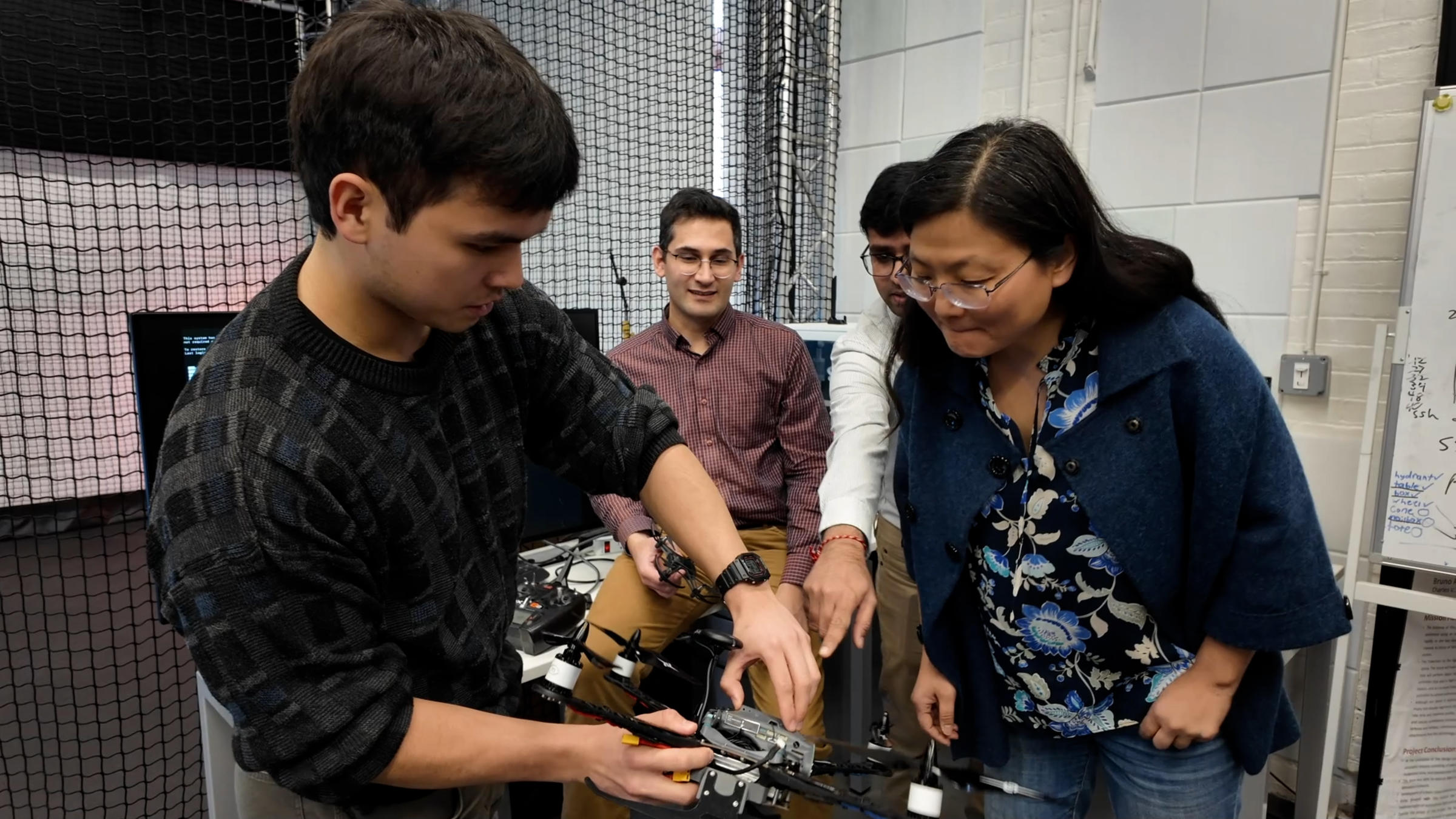
Working together with Stevens PhD candidate, Ishan Aryendu, Wang designed a network of such flying cell phone towers that can be quickly deployed when ad-hoc connectivity is needed. Named AURA-GreeN, for Aerial Utility-driven Route Adaptation for Green cooperative Network, the system operates as a small application, called an xApp, within a smart network controller that runs on the modern Open-RAN framework, which provides the mobile network architecture.
The system continuously monitors real-time network conditions — such as signal quality, interference and traffic load — and uses that information to make intelligent decisions. Specifically, it determines which aerial vehicles should transmit data, how to divide and allocate the available wireless spectrum, how to route the data through the network and how to operate within overall power limits. “The system decides where they should go and how to use the wireless spectrum, so data gets from source to destination quickly and reliably,” explains Wang.

At the same time, AURA-GreeN carefully balances multiple goals: keeping communication delays low, using spectrum efficiently, maintaining reliable service and ensuring energy-efficient operation. “It keeps the ‘age of information’ low, meaning the data you see is always very fresh and closely reflects what is happening right now,” says Aryendu. “We saw that there was a significant improvement in the age of information, about 460 percent.”
Wang and Aryendu outlined their idea in a recent study, published in the IEEE Transactions on Vehicular Technology in February 2026.
These flying cell phone towers can also be deployed during concerts and other big social events, which often strain mobile networks, says Aryendu. “During the Super Bowl, there was a bunch of drones equipped with cameras flying all over the place, capturing video footage from the event. All those drones could serve a double purpose by providing connectivity to the users inside the stadium without overwhelming the existing communication infrastructure. This makes our idea even more feasible, because we are not using extra energy to fly the drones; we are piggybacking on drones that already provide the coverage of the event.”
Although the main goal of the AURA-GreeN system is to improve coverage, reliability and data freshness in dynamic urban aerial scenarios or during natural disasters, the concept challenges the traditional view of the communication infrastructure, Wang notes. “The majority of the day-to-day communication infrastructure was built on the ground, which is normal and expected, because the majority of the human activities take place on the ground. In the future that doesn’t have to be the case. We can deploy these flying networks using drones and other flying vehicles like air taxis.”
About Stevens Institute of Technology
Stevens is a premier, private research university situated in Hoboken, New Jersey. Since our founding in 1870, technological innovation has been the hallmark of Stevens’ education and research. Within the university’s three schools and one college, more than 8,000 undergraduate and graduate students collaborate closely with faculty in an interdisciplinary, student-centric, entrepreneurial environment. Academic and research programs spanning business, computing, engineering, the arts and other disciplines actively advance the frontiers of science and leverage technology to confront our most pressing global challenges. The university continues to be consistently ranked among the nation’s leaders in career services, post-graduation salaries of alumni and return on tuition investment.
Stevens Media Contact
Lina Zeldovich
Manager of Media Relations
Division of University Advancement
201-216-5123
[email protected]