By A Student, For Students
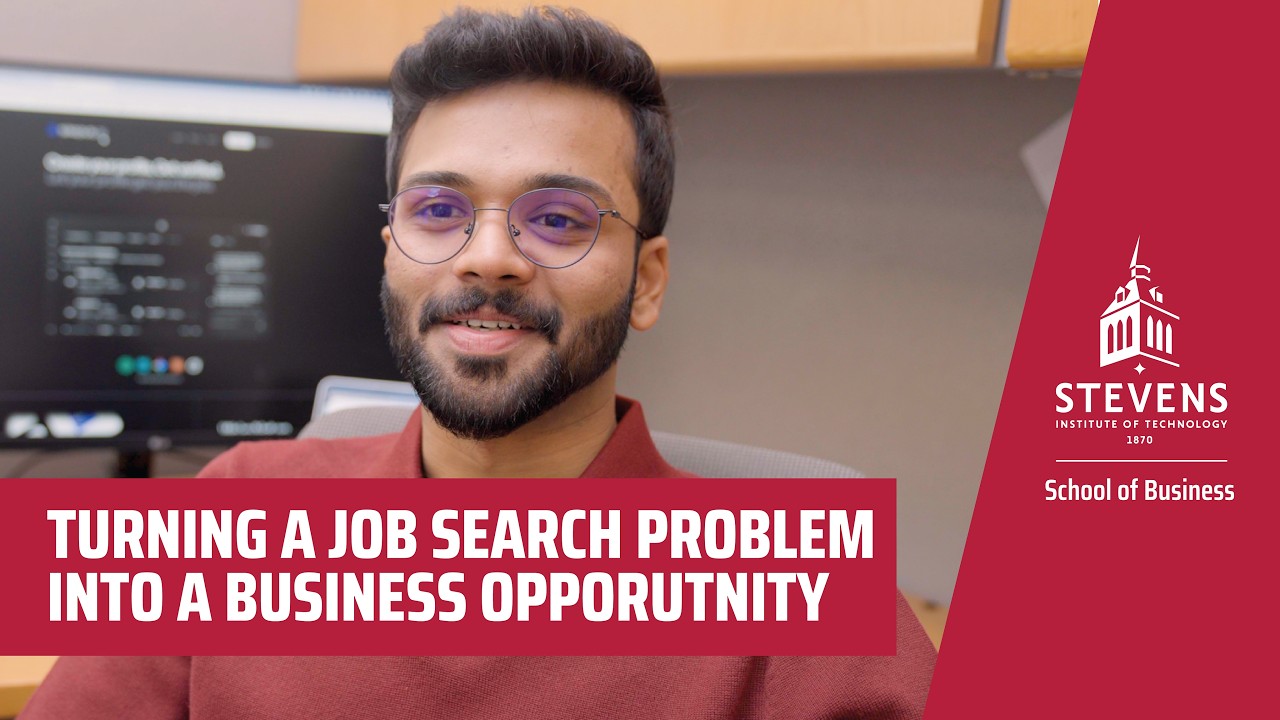
When Omkar Mahale struggled to hear opportunity knocking, he decided to build a new door.
When he arrived from India to begin the Financial Technology and Analytics master’s program at the Stevens School of Business, the advice he heard most often was that it is never too early to start looking for internships and jobs. He tried every search method he could find, compared notes with classmates and gathered advice from anyone willing to offer it.
“When I came to the U.S., a lot of people told me to start applying for internships and jobs,” he said. “I tried a lot of platforms, but it was all a mess.”
Omkar’s initial clean-up effort was a small prototype of a job search engine that he shared with his friends and classmates. Within 24 hours, he realized that he tapped into a universal concern.
“I got a crazy response,” he recalled. “I had about 70 responses in 24 hours, so I thought, ‘Let's build something out of it.’ And then we started building Skopus.”
Skopus AI is an AI-native hiring platform built for a job market where AI-written resumes and one-click mass applications make it hard for candidates to stand out, and even harder for recruiters to trust what they see. Skopus works both sides of that issue, pointing job seekers to the roles with the strongest real demand and giving recruiters a pool of verified talent they can hire from directly.
“We are a platform where users can actually apply for jobs, and recruiters can scout new and better candidates,” Omkar explained. “Think of it as a two-way ecosystem. We are creating a whole new verification layer for HR tech, because AI has made trust a real issue in the market right now.”
Skopus is entering a crowded market, but Omkar believes his viewpoint provides an edge. He is a student building a product for students, solving a problem he is still living through.
“The founders and developers of those companies are not students,” he said. “I know which problems arrive at which stage, because I have faced them firsthand and worked out how to solve them.”
His experience as a job seeker has made him skeptical of features that sound impressive but don’t solve the real problem. Many platforms promote AI agents that submit hundreds of applications a day on a user’s behalf, but by his count, roughly two-thirds of employers’ Workday portals won’t accept applications submitted by an agent.
Instead of helping users apply everywhere, Skopus helps them apply where their talents stand out. The platform pulls openings directly from the 10 largest applicant tracking systems every day, drawing on a growing registry of 2,500 companies. Its “Alpha” job board — a finance term that means returns above market average — then counts which roles have the most openings over a rolling 14-day window, filtering out stale and “ghost” postings, and highlights the three most in-demand roles in a user’s field.
“Think of it as finding alpha in the job market,” Omkar said. “We look at which companies are desperate to fill which roles.”
Helping job seekers find the right fit is the business-to-consumer side of Skopus. The business-to-business side, Skopus Verify, is the company’s core intellectual property, and when it launches later this year, it will flip the usual hiring model. Instead of candidates chasing openings, the right openings find them.
Candidates build a profile around the roles they want, and Skopus checks it against what those roles actually demand, reviewing their work, projects and certifications and asking the kinds of screening questions recruiters typically ask. Those who pass are verified and placed in a talent pool that recruiters and HR teams can search and manage, alongside the hiring software they already use. Every decision a recruiter makes, from viewing a profile to passing on it, shows up on the candidate’s end, so no one is left ghosted.
“Every candidate is verified, not just another applicant,” Omkar said. “Recruiters hire on trust, not on volume.”
Since that first prototype, Omkar has assembled a seven-person team around him — six of them Stevens students or alumni — incorporated the company, secured investor funding and earned a spot in Harvard Business School’s Foundry program.
“We are one of the only startups from Stevens to be selected, and we are very proud of that,” he said. “We are representing Stevens alongside other top universities, and we want to make an impact there. Right now, we are focused on bringing more users on board, and our next target is applying to accelerator programs. We are also building a distribution channel with universities so students can access Skopus directly through their school’s career portal.”
In early 2025, Omkar began approaching investors, focused less on how many he could reach than on how strong a product he could show them.
The approach paid off in March, when he connected with Michael McGuire, a lecturer in entrepreneurial studies at Columbia Business School. McGuire liked what he saw but wanted to test the team.
“He gave me a few tasks to complete within a set time, just to see whether I was serious and how fast I could build and ship,” Omkar said. “He was pretty impressed.”
McGuire became the company’s first investor and helped guide the incorporation, completed in October 2025. The team has been building Skopus ever since. After a beta launch last summer, Omkar resisted the urge to rush toward commercialization. Following advice to make sure the product fit the market first, the team has kept its focus on research, design and rounds of user feedback.
Omkar’s success is even more impressive for someone who never planned to start a business.
“I was always curious about how a business works, how money flows, how to build something from scratch,” he said. “But I was never interested in actually building one. The problem I faced affected my life so much that I had to make a decision: either wait for someone else to solve it or start building it myself.”
That curiosity about how money moves is what brought Omkar to Hoboken. Before Stevens, he worked as a performance analyst intern before being promoted to product manager at an asset management firm in India. A friend introduced him to Stevens in 2022, and its location just across the river from Manhattan appealed to someone who had already lived and worked in a fast-paced city full of corporate headquarters and wanted to see how finance works at its center.
The Financial Technology and Analytics master’s program sealed the decision. Other universities offered similar degrees, but none offered the balance he wanted.
“I was always drawn to technology. I didn’t want to go into core finance,” he said. “I wanted the perfect blend of finance and analytics.”
Once on campus, he found the faculty just as accessible as New York City. He spent last summer as a fellow on Professor Dragos Bozdog’s research team.
“Getting a mentor is pretty easy over here,” he said. “You just have to email a professor.”
Omkar’s entrepreneurial achievements can be traced back to what he has learned in the classroom at Stevens. He earned his undergraduate degree in mechatronics engineering from Terna Engineering College and arrived at Stevens with no background in AI or coding. A prompt engineering course gave him the foundation to start building Skopus.
“That was one of the core subjects that taught me exactly how to use AI, how to build agents, how to streamline a process and how to automate,” he said. “I would recommend that course to everyone.”
The lesson he values most, however, is not technical. Across his courses, professors stressed understanding the problem before trying to solve it.
“Read the assignment, learn it, test it,” Omkar said. “Once you understand the scenario and the structure, then you implement. That’s when I realized research matters more than development.”
He estimates about 60 percent of the past 12 months of work on Skopus has been dedicated to research, design and rethinking.
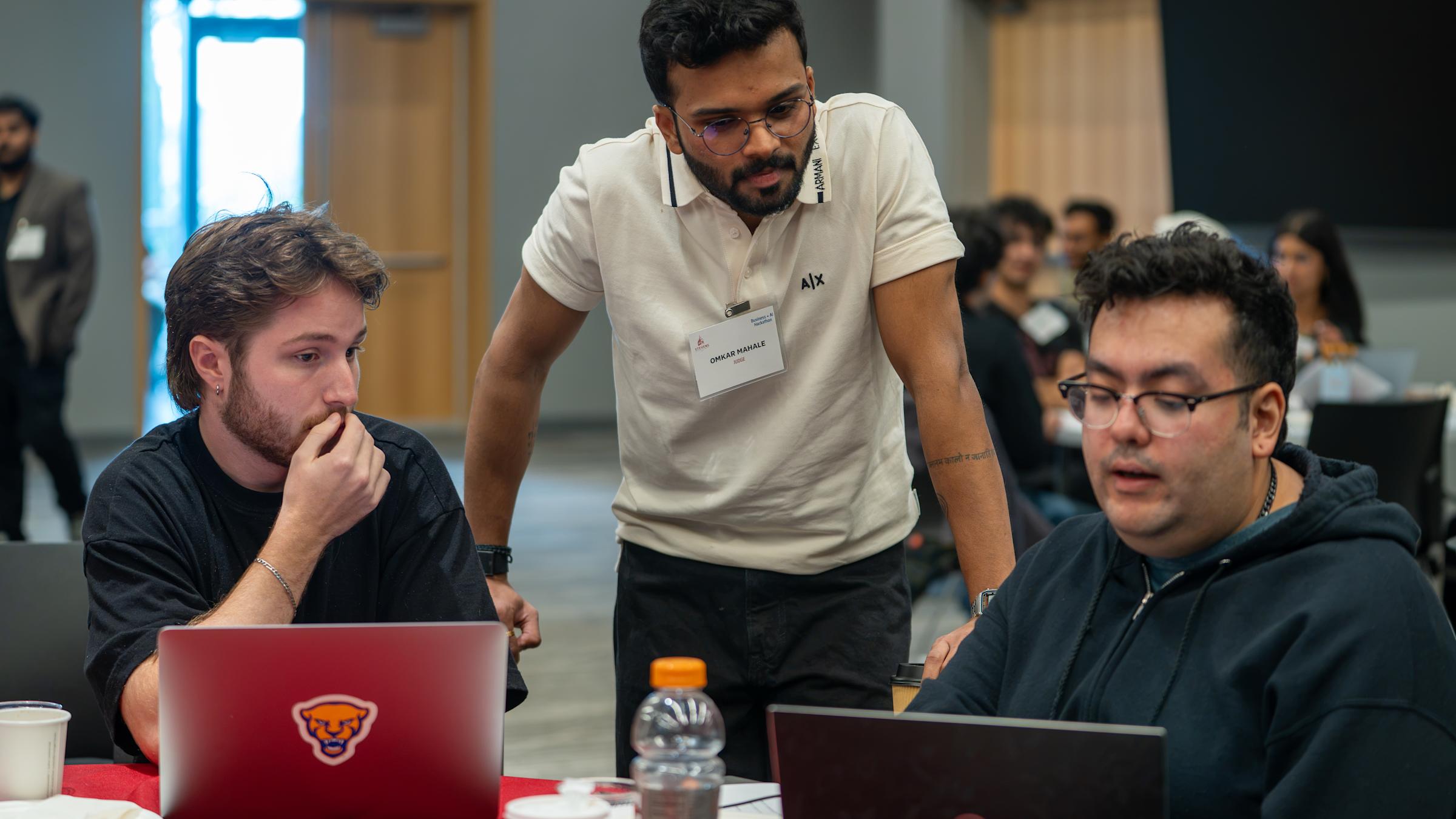
Some of that research happened at Stevens events. At a product management hackathon on campus, he approached one of the judges, a product manager from JPMorgan Chase, and asked for feedback on Skopus. She agreed, and their coffee chat stretched into a productive two-hour conversation. Until that interaction, Omkar had seen the hiring process only from the applicant’s side.
“That conversation was really insightful because I got the recruiter’s point of view,” he said. “That’s when I realized this is a two-sided problem.”
Balancing coursework, an on-campus job, a growing team and the basics of daily life has made time management his biggest challenge. To make sure he stays on track, Omkar leans on advice from his mother.
“My mom once told me, ‘Whenever you are confused, do one thing every morning,’” he recalled. “Think about the product and everything around it, and count how many times you say yes and how many times you say no. If there are more yeses, you are good for the day. If there are more no’s, you have to rebuild. That became my morning ritual.”
The early results suggest the yeses are winning. Two beta users, one at a university in San Diego and one in Chicago, have already landed an internship and a full-time job through the platform.
“I want users to text me, mail me or reach out to me, telling me, ‘Hey, I got a job using Skopus,’” he said.
This fall, Omkar attended another hackathon at Stevens, but in a different role. When a friend suggested they compete in the Stevens School of Business Business+AI Hackathon, he noticed an option on the event website to become a sponsor. Skopus joined a sponsor list that included Google Cloud, ElevenLabs and Chubb.
“We are at stage one, but our name was up there with companies people know,” Omkar said. “Their technology is creating real impact in society, and we hope Skopus will one day do the same. That was what I kept thinking about that day. It is a milestone, but it is just the beginning.”