Stevens School Of Business Professor Brings Premier Corporate Finance And Governance Conference To Hoboken
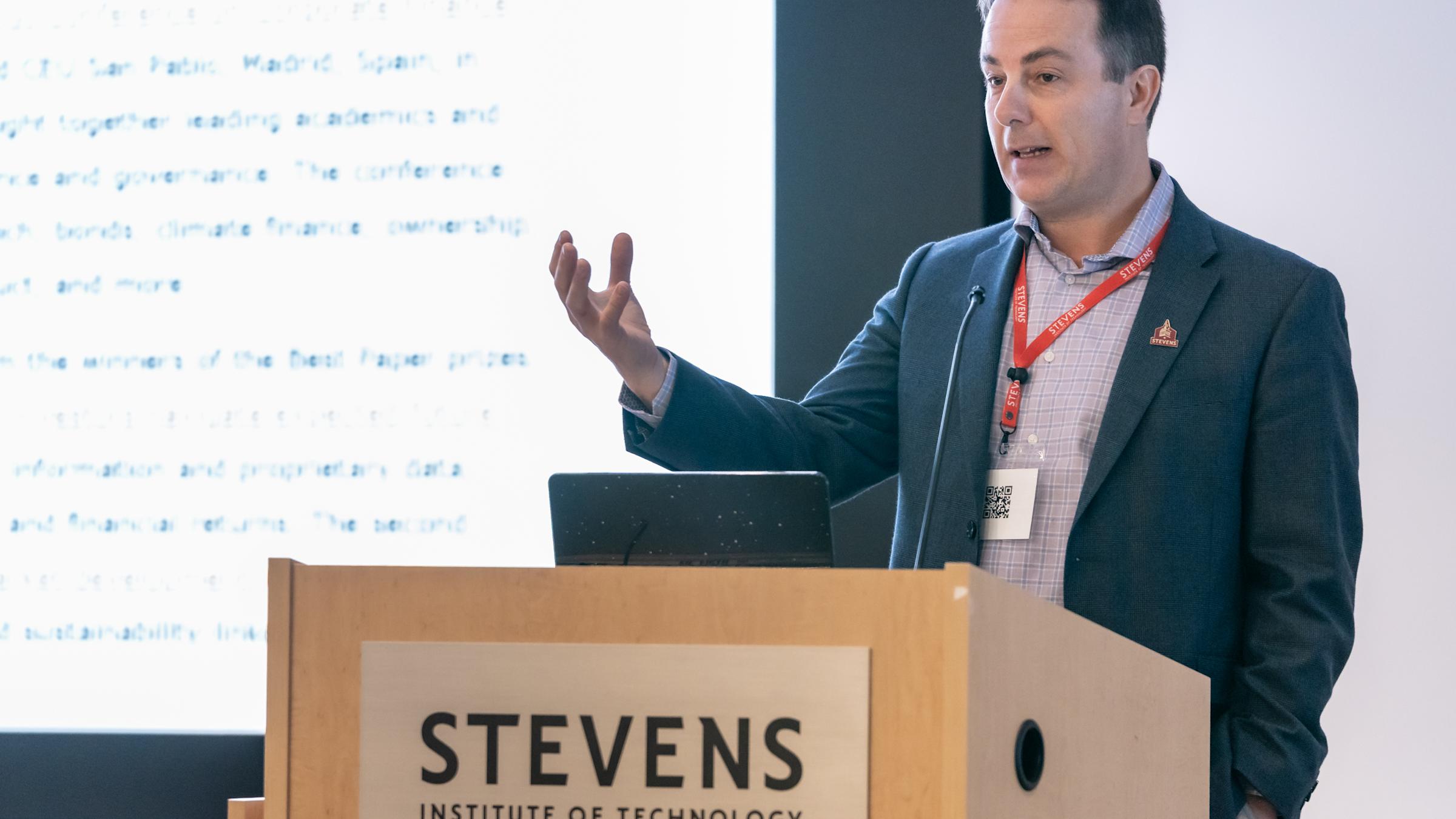
It wasn’t a whisper in a cornfield like the iconic Kevin Costner movie, but Douglas Cumming heard the call of, “Build it, and they will come.”
Instead of a baseball field for the greats of the past, Cumming, who is in his first year as professor and the Steven Shulman ’62 Endowed Chair for Business Leadership, constructed a forum designed to build the future of finance and governance research. The RCF-ECGI Corporate Finance and Governance Conference is a partnership between the Review of Corporate Finance journal, which Cumming also helped create, and the European Corporate Governance Institute.
The sixth edition of the gathering took place on the Stevens campus December 13-14, bringing together scholars from around the world to present their research on a wide range of issues, including fintech, artificial intelligence, politics and corporate finance, corporate social responsibility, tax and corporate finance, venture capital, private equity and IPOs, regulation, employees, mergers and acquisitions, equity crowdfunding, CEOs and directors, ownership, voting and monitoring, banking infrastructure, innovation, carbon and culture, banking and shareholder values, compensation, biodiversity, media, and investments.
Due to the pandemic, the inaugural conference was conducted online. From 2021-23, it was held at Florida Atlantic University before traveling to Madrid, Spain in 2024. The 2026 version will go back to Spain at the Real Centro Universitario Escorial-Maria Cristina.
“The subject of the event covers finance and corporate governance, which are great topics that are highlighted by the excellent faculty at Stevens,” Cumming said. “Stevens is also really big on innovation, doing a lot of things in fintech and digital innovation. A large part of the papers that are submitted every year have to do with financial innovation, the impact of finance on innovation, digital assets and other financial innovations, and given the focus of these topics at Stevens, plus the being in the New York City metro area, made it seem like a really good fit.”

By combining governance and finance, the conference allows researchers in both areas to broaden their knowledge and networks.
“My area of research is law and finance, so I straddle both areas,” said conference co-founder Sofia Johan, an associate professor at the Florida Atlantic University College of Business. “As a finance academic, it's nice to get ideas from what's happening in the corporate governance field. It’s important to understand how corporate finance is affected by what's happening in corporate governance. I think it's a very symbiotic relationship, and it's great because we can sit in small sessions and network, meeting new people and sharing ideas.”
Another unique aspect of the conference is its hybrid format, with many of the participants and presenters joining virtually. Not only does the format eliminate travel issues that might prevent people from attending, but also reduces costs, encouraging younger faculty and Ph.D. students to engage.
“When the idea of this conference came about, we wanted to include junior academics who would be able to get discussion comments from senior academics,” Johan said. “This is one of the reasons we're very excited about this event. It's very expensive to be an academic. I know many people think the university pays for everything, but to a certain extent, there's a high cost to advancing your career. We wanted to make sure that we were able to help junior scholars as they were doing their research and get new ideas.”
Many of those younger academics that benefitted study at Stevens.
“We have an excellent Ph.D. program at Stevens,” Cumming said. “The students get to see these excellent researchers present their most recent papers, and the Ph.D. students are actively participating in the events. Some had their papers accepted on the program by external reviewers, and others participated as discussants, which is a great opportunity for them to learn, give feedback, develop a network and improve their chances on the job market. It's a win-win for the students, especially as some of the junior faculty can take advantage of these opportunities without having to travel afar to other places to meet these folks.”
 In addition to the research presentations, attendees, in-person and virtual alike, were able to engage with keynote speaker David Yermack, the Albert Fingerhut Professor of Finance and Business Transformation at New York University’s Stern School of Business and an adjunct professor at NYU’s law school. He is also the Co-Director of the NYU Pollack Center for Law and Business. A former visiting scholar at the U.S. Federal Reserve Bank, Yermack’s research, including works on cryptocurrency and blockchains, has been cited more than 34,000 times.
“Having the conference locally and getting this opportunity to meet people that are working on similar topics to is a really fantastic opportunity, and I look forward to it every year,” Cumming said. “We had a really great keynote speaker, David Yermack, who is an expert on financial technologies and other things in corporate governance and finance. We were very excited to have him, as several top scholars from all over the U.S, Europe and Asia.”
With the topics, access to the leading researchers, and success of this year’s conference, there is little doubt what happens next. Just like in the movie — people will come, Douglas. People will most certainly come.
6th Annual RCF-ECGI Corporate Finance and Governance Conference Awards
Best Discussant
Kevin Zhang (University of Oregon)
Serdar Aldatmaz (Northeastern University)
Best Paper
“Breaking Network Barriers in the Era of Data-Driven Venture Capitalists” — Melissa Crumling (Drexel University)
“How Does Competition Affect Firms’ Carbon Performance? Firm-Level Evidence from Tariff Cuts” — Manuel Kathan (University of Augsburg), Raphaela Roeder (University of Augsburg), Sebastian Utz (University of Augsburg), Martin Nerlinger (University of St. Gallen)