Every Gift Tells a Story: School of Computing
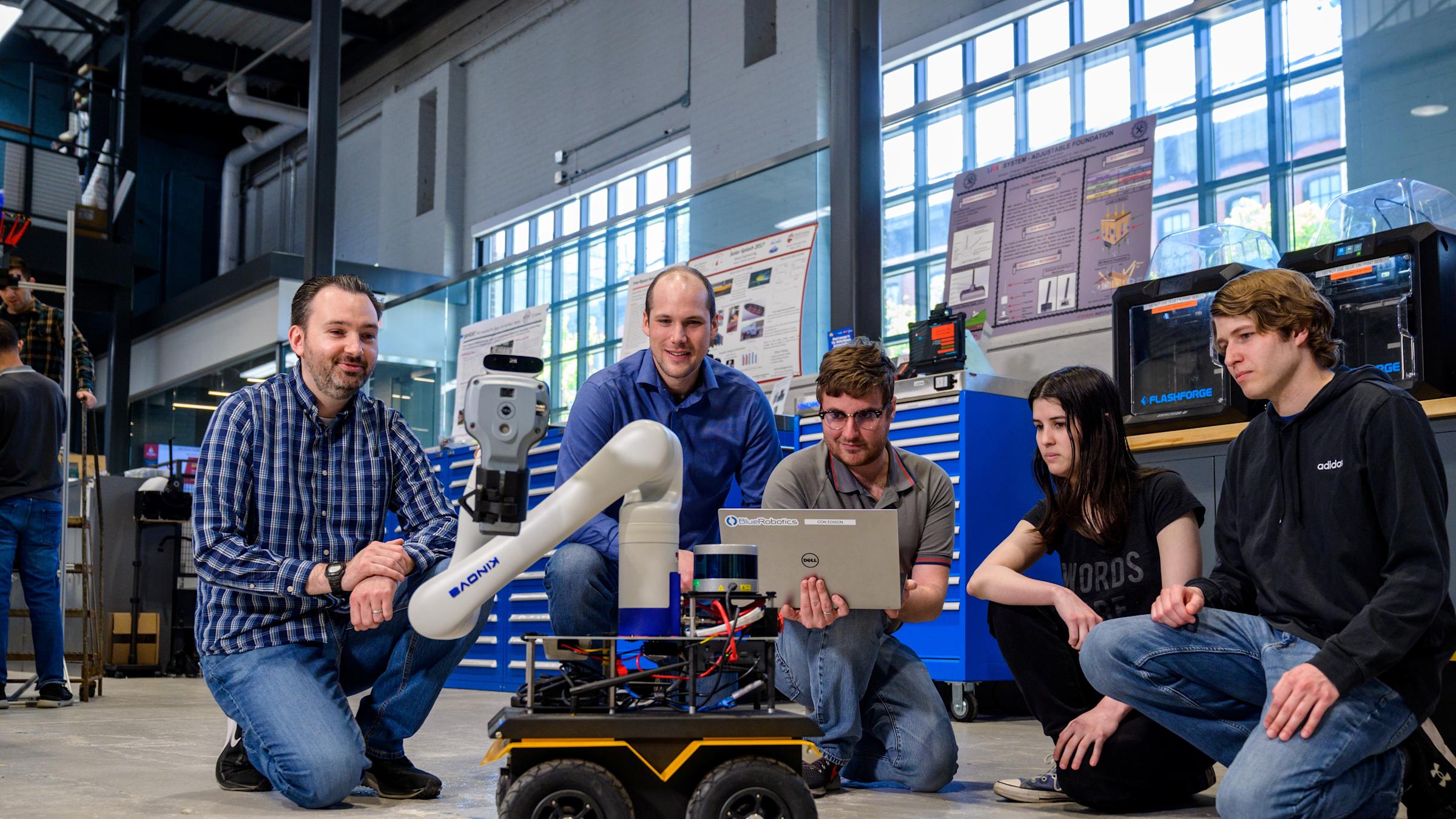
The new School of Computing, bolstered by $36 million in initial donor support, is elevating Stevens’ position as a leader in computing and AI
Philanthropic investments are helping build the programs, attract the faculty expertise and create hands-on learning opportunities that will expand the School of Computing’s reach and impact. By bringing together expertise from across disciplines, the school is creating new opportunities for collaborative research and education, preparing Stevens students to lead in a rapidly evolving technological landscape.
Launched this fall, the School of Computing distinguishes Stevens as one of only a few universities in the nation with a school dedicated to computing education and research. The school will feature a “Computing + X” model, combining computing and expertise from a range of disciplines, including finance, healthcare, robotics, engineering and the arts. Through this integrative approach, students and faculty can explore how computing can be applied across fields to drive discovery and innovation. The school emerged from a two-year planning process involving faculty, deans, administrators, the Board of Trustees and an external advisory panel of computing experts.
Stevens Trustees and leadership supporters championed the vision for the school with early generous commitments.
“We worked with the Board of Trustees on the concept behind the School of Computing, the importance of the school and the way computing and artificial intelligence are permeating every aspect of life,” says President Nariman Farvardin. “The new school will serve as a hub to build connections and collaboration across fields. The vision was compelling to donors and the trustees, and they embraced the concept wholeheartedly.”
Philanthropic Momentum
An anonymous $10 million principal gift supporting computing excellence at Stevens helped lay the foundation for the school’s launch.
“The anonymous gift has been tremendously helpful because the donor gave Stevens the flexibility to make early investments in recruiting new faculty members, building an infrastructure and creating the foundation for the school,” Farvardin says. “In addition, the remaining funds will go into an endowment, which will support a variety of activities within the school in perpetuity. This support has been extremely impactful.”
“Universities don’t have a decade to figure out AI,” the anonymous donor says. “The transformation has to happen now, and computing is the center of it. What that school looks like in five years, none of us can say with certainty, which is exactly why I wanted Stevens to have the room to pivot as the field does. The uncertainty is real, but so is the size of the opportunity, and I have full confidence that our president, administration and faculty will know how to seize it.”
Tom Richardson, the grandson of Randolph T. Ode who was a Stevens alumnus of the Class of 1898, has been a generous benefactor supporting scholarships and faculty fellowships at Stevens. He is the retired founder of the T.O. Richardson Company (TOR), Inc., an investment advisory firm.
When President Farvardin approached him about the idea of a School of Computing, he immediately recognized the value, inspired by his own experience at the Tuck School of Business at Dartmouth. “I was there when ‘time sharing’ was invented at Dartmouth, and we were taught how to program using Fortran on the first-ever remote terminals tied into their IBM mainframe,” Richardson says. “From that point on, computers and computing played a big part in my business career. Without that knowledge, I would have been left behind in the hugely competitive investment arena.”
Investing in Students and Faculty
Richardson made generous leadership gifts to support students and faculty in the School of Computing, establishing the Thomas Ode Richardson Endowed Scholarship, the Randolph T. Ode Professorship and the Randolph T. Ode Career Development Professorship for early career faculty.
“My grandfather was an inspiration in many ways,” Richardson says. “He educated us on the importance of good health, moral integrity, hard work and giving back. I am proud to honor him and especially excited about the future of Stevens. Engineering, math and computers are so vital for America’s future, and Stevens will be a leader in all three.”
Several Trustees also stepped forward with generous support. Larry Babbio ’66 Hon. D.Eng. ’01 established the Lawrence T. Babbio, Jr. Pinnacle Endowed Scholarship for Computing. Sean Hanlon ’80 and his wife Cathy made a generous gift to support the intersection of business and computing by establishing the Sean and Cathy Hanlon Endowed Chair in Finance and Computing. Emeritus Trustee Richard R. Roscitt ’73 established the Richard Roscitt 1973 Endowed Chair in Computing and Automation. Devon E. Brooks created the Valerie and Devon Brooks Ph.D. Fellowship to support doctoral research that advances AI for meaningful societal benefit.
Alumni Trustee Jared Donnelly ’24 also made a gift to support the school. “Stevens has always been a hidden gem, a great school with the faculty and student body to meet the challenges of changing technology,” says Donnelly, who graduated with a bachelor’s degree in computer science and works as a technical product manager at Merck. “Our new School of Computing gives us the opportunity to propel our students and provide resources for our faculty.”
“I’ve had the honor of seeing the thought and intentionality Stevens has put into crafting this new school,” Donnelly adds. “I believe, in order to be successful, this new initiative needs to be met with an equal amount of support from the alumni community as the effort put into its creation.”
Excellence in Leadership
Brendan Englot, Anson Wood Burchard Endowed Professor and former director of the Stevens Institute for Artificial Intelligence, has been appointed interim dean. Stevens also welcomed three accomplished new faculty members and appointed three associate deans to help guide the school’s early development.
“The launch of our school would not have been possible without the generous philanthropic support of our alumni and friends,” Englot says. “We are deeply grateful. The support will allow us to build and foster a vibrant community, in which students and faculty learn from one another, pursue ambitious ideas and work together to creatively and responsibly shape the future of computing and its impact on society.”
With the school’s launch, Stevens expanded its academic offerings to include a new B.S. in artificial intelligence, an M.S. in human-centered AI and an undergraduate minor in AI. This fall, 23 students in the Class of 2030 enrolled in the inaugural bachelor’s degree program in AI.
The new school will strengthen the Stevens experience. “The School of Computing will serve as a hub for all students at Stevens to acquire knowledge and skills in AI, at a time when AI literacy is increasingly valuable for students across all disciplines,” Englot says. “We are very excited about the debut of our undergraduate minor in artificial intelligence, which can help all Stevens students prepare for today’s AI-enabled workforce.”
Future Impact
Looking ahead, the School of Computing is poised to expand Stevens’ influence on education, innovation and interdisciplinary work.
“I hope that in the next five to 10 years, the School of Computing will be nationally recognized for its curricular, research and entrepreneurial innovation, as well as its role in catalyzing impactful interdisciplinary collaboration,” Englot says. “Furthermore, I hope we can rise to prominence as a convening center for thoughtful dialogue about the impacts of artificial intelligence on society and play a leading role in ensuring that AI is developed and used responsibly.”
“The establishment of a dedicated School of Computing is a natural evolution of the Stevens legacy and a strategic investment in ensuring our students lead in this transformation,” Farvardin says. “I am immensely grateful for the donor support that is helping us to advance our goal and launch the school. It’s inspiring, it’s encouraging, and it gives us more energy to put into this university and do greater things in the future.”