
Taking CTRL of Smartphone Use

It couldn’t be more timely: an app designed by four Stevens seniors to help their peers, and themselves, resist the pull of addictive social media algorithms. The goal: to take back control of their phones, their time and their ability to focus on what matters most.
“That’s why we called it CTRL,” says Hazem Abo-Donia of the Senior Design project he developed with three friends and teammates — Mohamed Bengabsia, Omar Elkhafif and Brandon Peralta, all Class of 2026. “We didn’t want people to feel they were being restricted from using their phones. We wanted them to feel they have control over their phone use.”
The team of three software engineering majors and one mechanical engineering major (Peralta), which took second place and a $5,000 prize in this year’s Ansary Entrepreneurship Competition, was originally organized by Bengabsia to pursue a more ambitious project: an EEG headset that could translate thoughts into words.
“We quickly realized it wasn’t feasible, given the cost of the hardware and our limited timeline,” Abo-Donia says. But the team had been thinking how exciting it would be if they could use the device to monitor their ability to focus.
“That’s how we started pivoting towards CTRL, software designed to counteract algorithms produced by companies to addict you,” he says.
With guidance from their advisors David Darian Muresan, professor of systems engineering [see sidebar], and Matthew Rhys Wade, who runs the Ansary Competition, they realized they needed to consider why they were making the product, who would use it, and what those users actually wanted and needed, before embarking on the design process.
“We wanted to build something we would use,” says Elkhafif. “We felt our phones were robbing us of time, that we’d lost a lot of our ability to focus. So we did interviews and online surveys to find out if other students felt the same, and they did. It was like, ‘I’m spending a third of my day on the phone, a third sleeping, and when am I actually living?’ It was scary.”
They say the app is distinct from apps being produced by competitors because it doesn’t infantilize users by simply blocking social media sites or penalizing them for “doomscrolling.” Instead, they provide a menu that allows users to tailor their own strategies — focus sessions, brain-healing techniques to help them re-focus, options of blocking only the most addictive social media features, and choosing when to be notified that they’ve unconsciously descended into scrolling.
Post-graduation, all of the team members have full-time jobs in their respective disciplines, but they are committed to getting the app approved for the App Store, and then continuing to refine it.
“This is very personal to us, which is why I think we got so far in the competition,” Elkhafif says. “We are determined to make it happen.”
-Joan Cramer
LIGHTING THE FIRE IN BUDDING ENTREPRENEURS
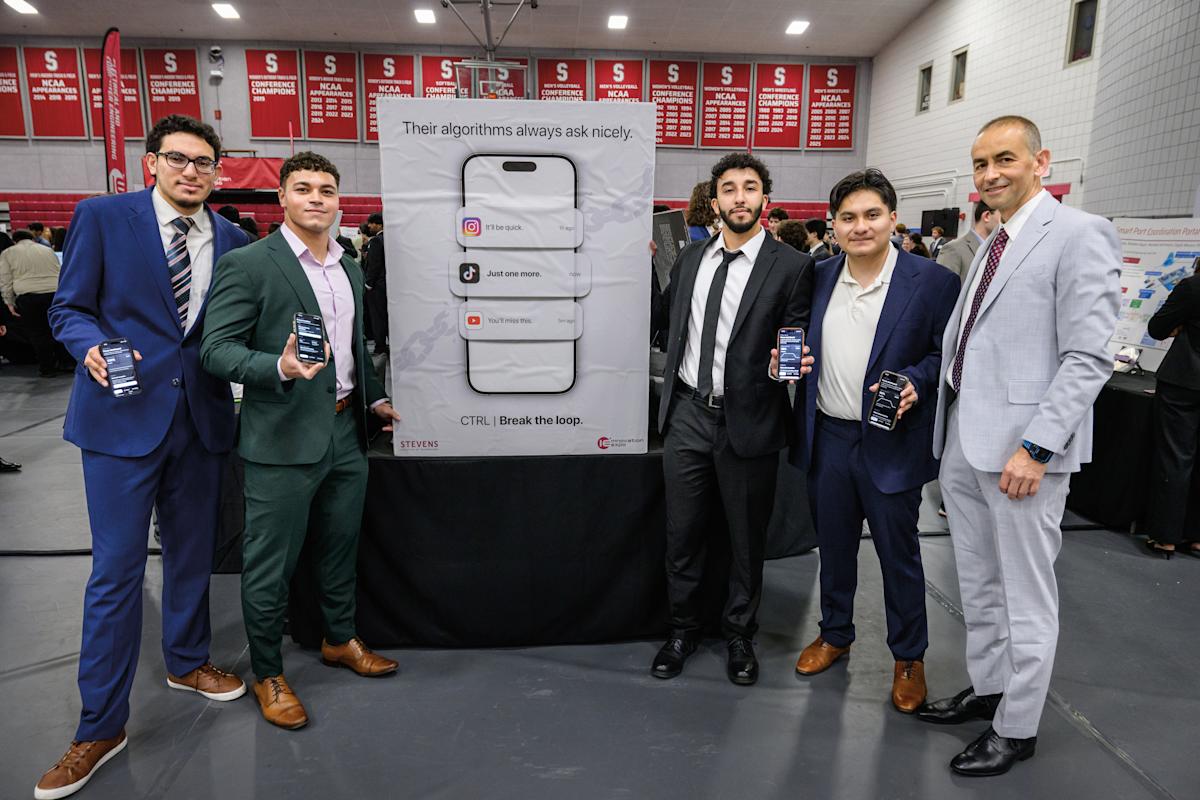
Senior Design, a two-semester capstone experience, and the Ansary Entrepreneurship Competition offer Stevens students an extraordinary opportunity to use everything they’ve learned “to build a product that could have a real impact on society,” says David Darian Muresan, professor of systems engineering and advisor this past year to nine Senior Design teams, including the creators of CTRL.
Muresan, recipient of the 2024 Henry Morton Distinguished Professor Award, sees Senior Design as lighting an entrepreneurial “fire in the heart” of his students, instilling a lifelong confidence in their ability to create something new.
An industry veteran and entrepreneur, Muresan teaches his interdisciplinary teams to apply the formal processes of systems engineering to their ideas, which “almost guarantees a successful outcome,” he says. “I tell my students if you want to go fast, slow down and build a map before you go.”