Department of Mathematical Sciences Hosts Groups, Logic and Computation Conference
Three-day gathering attracted expert and student researchers to explore exciting connections among these disciplines
Over the past few years, mathematics researchers have driven developments in the connections among the studies of geometric group theory, model theory and computer science. These disciplines share a focus on rules, patterns and structures, but current investigations into these associations have only scratched the surface.
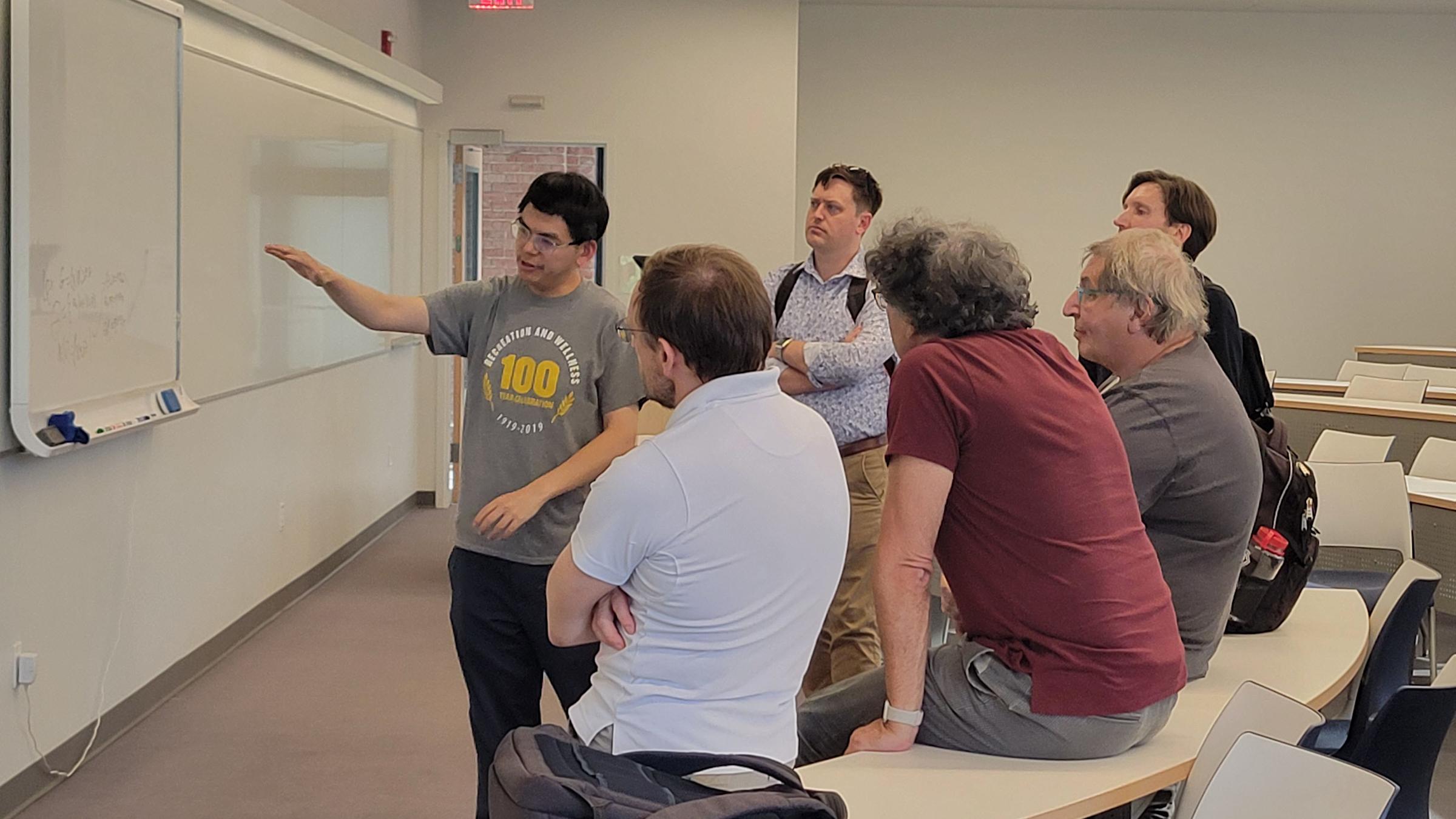
From June 12-14, 2024, more than 25 mathematics experts from nearly 20 universities across the U.S., Europe and Israel came together – in person and virtually – to explore these connections at the first Stevens Institute of Technology “Groups, Logic and Computation: Interactions Between Geometric Group Theory, Model Theory and Computer Science” Conference.
The program was sponsored by the Charles V. Schaefer, Jr. School of Engineering and Science and the Department of Mathematical Sciences at Stevens, as well as the National Science Foundation (NSF).
Among the notable speakers were Olga Kharlampovich, of Hunter College of City University of New York; Denis Osin, of Vanderbilt University; and Simon Thomas, of Rutgers University. These were but three distinguished professors of mathematics and fellows of the American Mathematical Society.
“Researchers use group theory to understand things like symmetry within geometric objects,” explained Mahmood Sohrabi, teaching associate professor and associate chair for graduate studies in the Department of Mathematical Sciences at Stevens, and a member of the conference’s organizing committee.
“With model theory, we consider how to use logical statements in a restricted formal language associated to a mathematical structure to analyze the structure,” he continued. “Computability Theory looks at what problems an ideal computer can and cannot solve and to some extent how hard it is for a computer to solve a problem or check the validity of a proposed solution to that problem. Groups have been suggested as possible sources for such schemes. The conference was meant to further explore all these fascinating connections with groups at the center of attention.”
Dozens of graduate students, post-doctoral fellows and faculty from around the world were on hand to hear the discussions and share their perspectives. Seven graduate students, including three from Stevens, also gave presentations – for some, their first opportunity to publicly share their research. Several of the students received valuable feedback from top researchers during the Q&A sessions after their talks.
“The conference offered a unique range of topics,” said remote conference participant Laura Ciobanu, codirector and professor at the Maxwell Institute for Mathematical Sciences at Heriot-Watt University in Edinburgh, Scotland. “The topics were interesting, and I learned a lot, especially in the direction of model theory. It was also nice to see early-career researchers give talks alongside established mathematicians and computer scientists.”
The interest was strong enough that the team is considering the possibility of a follow-up conference.
“In terms of forming new collaborations and inspiring young researchers and giving them exposure, it was a powerful event,” said Sohrabi.
Learn more about academic programs and research in the Department of Mathematical Sciences: