
Just Follow the Data
Last September, five second-year quantitative finance majors in Stevens’ School of Business were given a million virtual dollars to invest in Vanguard exchange-traded funds (ETFs).
The “Quack Attack,” so-named in honor of Stevens’ Attila the Duck mascot, was one of 50 teams participating in the 2025 Vanguard ETF Trading Competition. (Vanguard specializes in exchange-traded funds, which are baskets of securities, rather than individual securities, traded on the stock market.)
During the two-month competition, the team met regularly to discuss strategy, run simulations and update one another on market trends and their competitors’ activities.
“The success came from following the data,” says Connor Byhre, whose teammates included Matthew Ginzburg, Gabriel Malek, Vikram Vegiraju and Armaan Seth.
“Toward the end, the market got pretty choppy, which makes it easy to start second-guessing, but we kept reminding ourselves to stick to our framework, to manage with our charts, not our hearts,” says Seth, whose teammates relied on mathematical modeling techniques they’d been introduced to in their quantitative finance classes.
All five students say they were attracted to Stevens, where they became good friends, because of its quantitative finance program. Launched by Stevens professor and trustee and former high-tech entrepreneur George Calhoun [see sidebar], quantitative finance is now the business school’s most popular major, and the third-most popular major at Stevens. Less subjective than traditional finance, it uses math and computer science to model financial markets.
Ultimately, Quack Attack took second place in the competition, with a Sharpe ratio of 1.49 — almost twice that of the S&P 500 in the same period. Scoring an excellent Sharpe ratio is critical to success in the Vanguard competition because the Sharpe ratio measures risk-adjusted performance rather than just total returns, rewarding teams that generate the highest returns with the least volatility, a hallmark of stable, long-term investing. The team also finished first in total returns on their investments and were the only team to outperform the S&P 500.
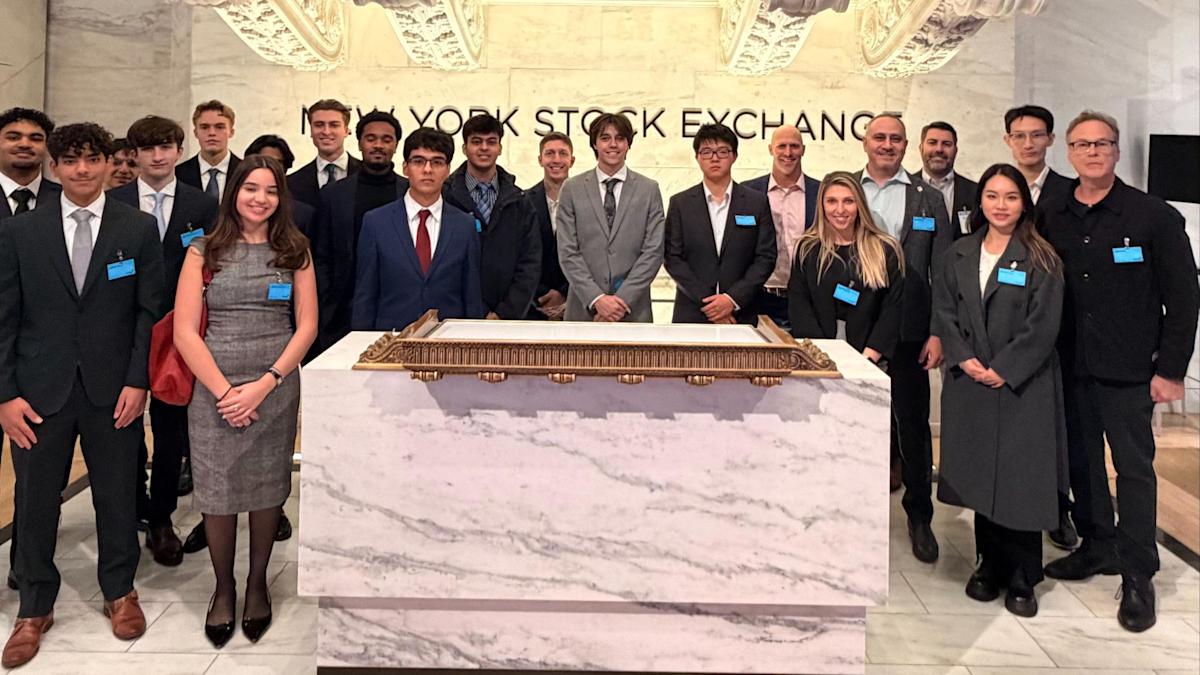
As finalists, the Quack Attack was one of the teams chosen to pitch their own ETF to a panel of judges from Vanguard and the Fox School of Business at Temple University. An hour after that pitch, they learned they’d earned the opportunity to tour the New York Stock Exchange in November and witness the iconic closing bell.
“It was a lot of fun,” says Vegiraju. “Everywhere you looked there were computer screens, people working. CNBC was doing its news stream right in front of us. And that bell was loud.”
Ginzburg, a Brooklyn native who’d passed the building many times but never been inside, concurs. “Being inside that building reframed for me what the markets represent,” he says. “It’s not just a symbol, it’s a working system built on analysis, structure and decision-making, and that’s exactly the space I want my career to live in.”
– Joan Cramer