
How-To: Make Hypersonic Flight a Reality
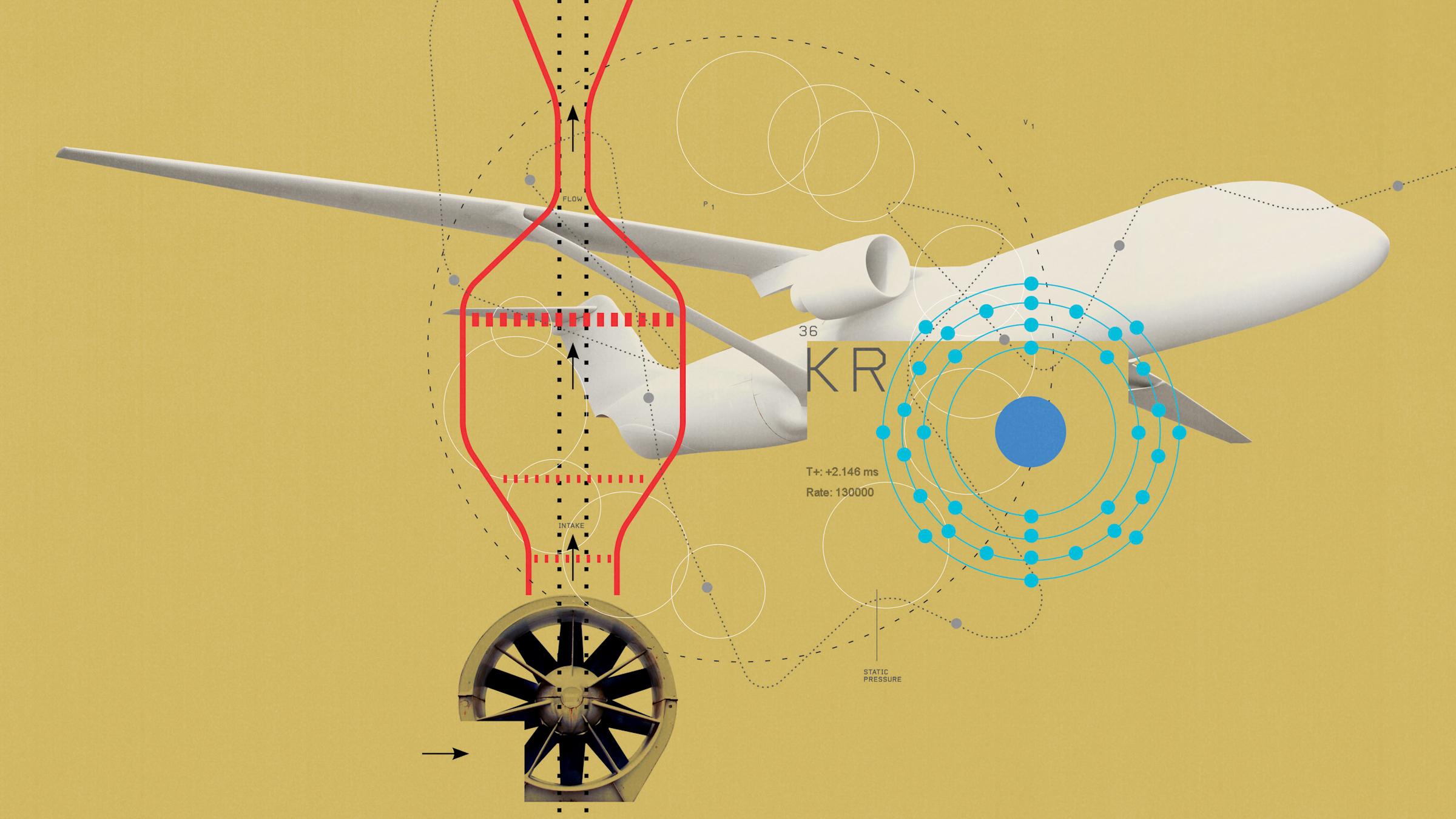
Long the realm of science fiction, hypersonic flight could revolutionize global travel, transforming day-long international flights into brief commutes.
“It really shrinks the planet,” says Stevens professor Nicholaus Parziale, whose fluid mechanics research focuses on making such hypersonic flight a reality. “If we can build airplanes that fly at hypersonic Mach number, we might also fly them into space, rather than launching rockets, which would make transportation to and from low Earth orbit easier.”
To build hypersonic planes, scientists must understand how airflow works at five or 10 times the speed of sound. And that remains a bit of an enigma, save for the so-called Morkovin’s hypothesis. It postulates that when air moves at Mach 5 or Mach 6, the turbulence behavior doesn’t change all that much from slower speeds (those below or close to the speed of sound). Although air density and temperature change more in faster flows, the basic “choppy” motion of turbulence stays mostly the same, the hypothesis goes. “Basically, the Morkovin’s hypothesis means that the way the turbulent air moves at low and high speeds isn’t that different,” says Parziale.
Yet no one has been able to provide sufficient experimental evidence to support Morkovin’s hypothesis — until now. Parziale’s new study, published in Nature Communications, brings us one step closer to hypersonic flight.
Here’s how he did it:
1. Create a Line of Krypton Atoms
Parziale devised a clever setup (which took him 11 years to perfect) that ultimately uses lasers to ionize a gas called krypton that is seeded into the air flowing inside a wind tunnel. That temporarily makes krypton atoms form an initially straight, glowing line.
2. Take Ultra High-Resolution Photos
Then he used ultra high-resolution cameras to take pictures of how that fluorescent krypton line moves, bends and twists through the wind tunnel’s air. “As that line moves with the gas, you can see crinkles and structure in the flow, and from that, we can learn a lot about turbulence,” says Parziale. “What we found was that at Mach 6, the turbulence behavior is pretty close to that at much lower speeds.”
3. Confirm Through Measurement
Parziale utilized an optical measurement technique (laser differential interferometry) to detect very small, fast changes in density to provide confidence that the observed turbulence statistics genuinely represented hypersonic conditions.
By providing experimental support for Morkovin’s hypothesis, Parziale’s study suggests that planes don’t need an entirely new design to fly at hypersonic speeds. And that simplifies things.
“Today, we must use computers to design an airplane, and the computational resources to design a plane that will fly at Mach 6 — simulating all the tiny, fine little details — would be impossible,” says Parziale. “The Morkovin’s hypothesis allows us to make simplifying assumptions so that the computational demands to design hypersonic vehicles can become more doable.”
– Sue DePasquale