
Campus News
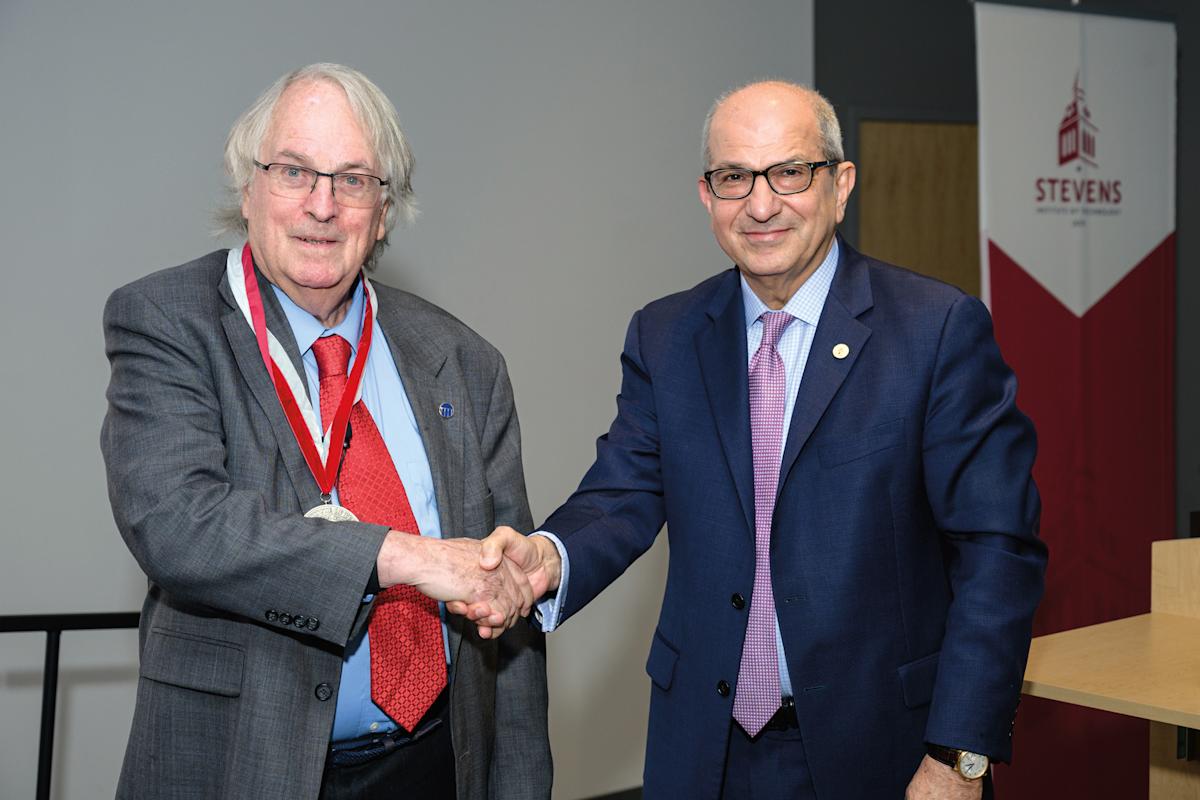
Nobel Prize Winner Headlines Lecture Series
When the 2019 Chemistry Nobel Laureate M. Stanley Whittingham came to Stevens last September to headline the President’s Distinguished Lecture Series, he returned close to where his journey began. Nearly 50 years ago, at Exxon’s Linden, New Jersey, labs, Whittingham helped create the first rechargeable lithium-ion battery — a discovery that transformed modern life, powering devices such as electric vehicles and satellites. Now a Distinguished Professor of Chemistry and Materials Science at Binghamton University, Whittingham says that today’s lithium-ion batteries remain far from their full potential. He urges that closing that gap could yield enormous benefits: vehicles that go farther, renewable grids that store power reliably and devices that last longer.
Higher Ed Leaders Gather At Castle Point
The Inside Higher Ed US Universities Summit gathered 150-plus presidents, chancellors and provosts at Stevens for two days of dialogue about higher education’s future. Co-organized with Stevens, this invitation-only summit held last October addressed what participants called the “perfect storm” — declining federal funding, demographic shifts, political pressures and AI’s rapid evolution. Through panels and featured speakers, closed-door roundtables and a Hudson River dinner cruise, leaders tackled difficult topics: the tension between consensus and innovation, shared governance challenges and whether higher education’s fundamental approach needs to change.
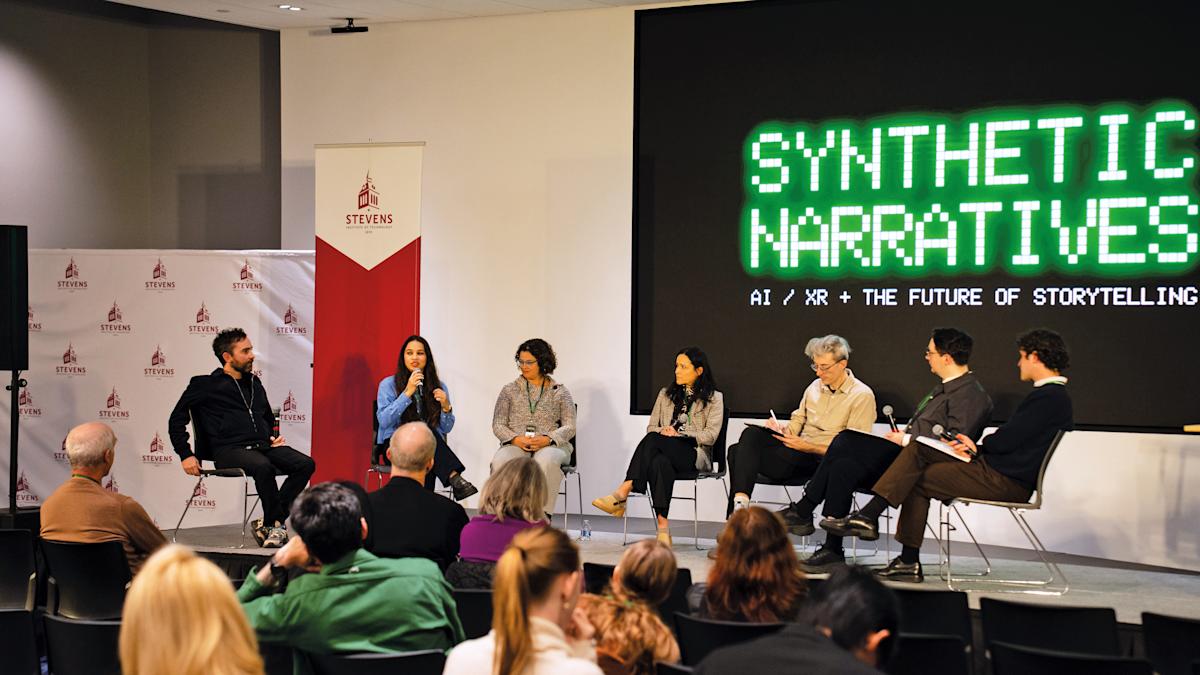
Exploring AI and Storytelling
The two-day symposium, “Synthetic Narratives: AI/XR + The Future of Storytelling,” brought international voices to Stevens last fall to grapple with such questions as: What happens to storytelling when human and machine authorship blur? How do we navigate the creative possibilities and ethical tensions of generative AI and immersive media? The event featured AI-driven interactive and immersive artworks, a film festival of generative AI films, panel discussions and guest speakers. The symposium was co-led by Stevens professors Jonah King and Christopher Manzione from the Visual Arts and Technology program in the School of Humanities, Arts and Social Sciences.
Top Faculty Honored
The University Investiture Ceremony last fall recognized nine faculty who have distinguished themselves and Stevens through teaching and research accomplishments and have been honored with endowed chairs, made possible by donors. They include: Gabriela Ciocarlie, Dr. Stephen Bloom Endowed Chair, Computer Science; Douglas Cumming, Steven Shulman ’62 Endowed Chair of Digital Innovation, School of Business; Brendan Englot, Anson Wood Burchard Professor, Mechanical Engineering; Yuping Huang, Viola W. and Elbert C. Brinning Professor, Physics; Jennifer Kang-Mieler, George Meade Bond Professor, Biomedical Engineering; Nicholaus Parziale, George Meade Bond Professor, Mechanical Engineering; Igor Pikovski, Geoffrey S. Inman Career Development Professor, Physics; Marouane Temimi, Gallaher Career Development Professor, Civil, Environmental and Ocean Engineering; and Hongjun Wang, George Meade Bond Professor, Biomedical Engineering.