Tailoring quantum optical states in atomically patterned 2D materials

Department of Physics
Location: Babbio Center, Room 219
Speaker: Gabriele Grosso, Associate Professor, Advanced Science Research Center and Graduate Center of the City University of New York (CUNY)
ABSTRACT
Artificial atomic and mesoscale structures in two-dimensional materials provide a powerful platform to engineer light–matter interactions, explore emergent quantum optical phenomena, and access regimes that are difficult to realize in conventional materials. In this talk, I will discuss our recent progress in controlling quantum light and excitons in atomically engineered van der Waals materials, spanning defect-based quantum emitters in wide-bandgap materials and excitonic confinement in phase-patterned semiconductors.
In the first part, I will present recent advances in defect-based quantum emitters in hexagonal boron nitride (hBN), including our observation of elementary excitations associated with single-photon emission and evidence of delocalized donor–acceptor-like recombination processes within hybrid defect complexes. These results reveal a new microscopic picture of quantum emission in hBN and establish a pathway toward electrically programmable quantum light sources and novel realizations of spin–boson coupling in solid-state systems.
In the second part, I will discuss the emergence of optical states beyond standard bright excitons in transition-metal dichalcogenide monolayers, including dark excitonic states and excitons confined by nanoscale phase boundaries. Our methods to directly visualize and manipulate dark excitons have enabled the observation of interaction-driven long-range transport and established these states as sensitive probes of local strain and many-body dynamics.
Finally, I will present our recent progress in atomically phase-patterned semiconductors. By spatially defining semiconducting and metallic phases within a single two-dimensional crystal, we create nanoscale one-dimensional channels that strongly reshape the excitonic energy landscape. Beyond exciton confinement, our latest measurements reveal highly localized optical states at selected phase-patterned regions, including single-photon emission. These results suggest that atomic-scale phase engineering can provide a route to simultaneously sculpt excitonic potentials and create localized quantum light sources within the same material platform.
[1] Pelliciari, J. et al. Elementary excitations of single-photon emitters in hexagonal boron nitride. Nature Materials 23, 1230-1236 (2024).
[2] Mejia, A.E. et al. Dynamic interplay of nonlocal recombination pathways in quantum emitters in hexagonal boron nitride. J. Phys. Chem. C 129, 2044 (2025)
[3] Chand, S.B. et al. Interaction-driven transport of dark excitons in 2D semiconductors with phonon-mediated optical readout. Nature Communications 14, 3712 (2023)
[4] Quan, J. et al. On-site enhancement and control of spin-forbidden dark excitons in a plasmonic heterostructure. Nature Photonics 20, 49–54 (2026).
[5] Chand, S.B., et al. Visualization of dark excitons in semiconductor monolayers for high-sensitivity strain sensing, Nano Letters 22, 3087-3094 (2022)
[6] Chand, S.B. et al. Phonon-dressed states of dark excitons in transition metal dichalcogenides. Advanced Optical Materials 14, no. 13 (2026): e03833.
[7] Woods, J. M. et al. Emergent optical resonances in atomically phase-patterned semiconducting monolayers of WS2, ACS Photonics 11, 3784-3793 (2024)
BIOGRAPHY
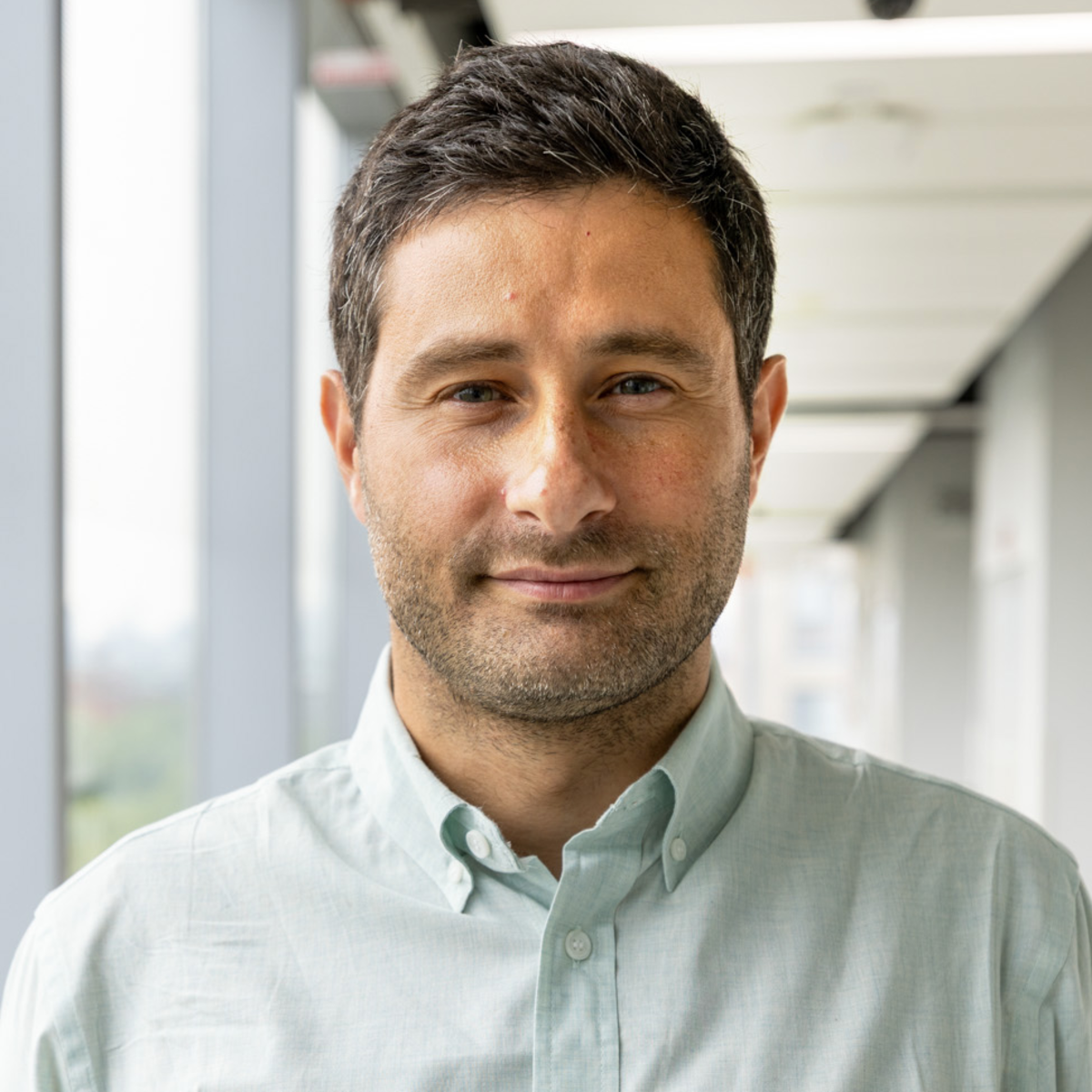
Gabriele Grosso is an Associate Professor at the Advanced Science Research Center and the Graduate Center of the City University of New York (CUNY). He received his B.S. and M.S. degrees in physics from the University of Padova. During his graduate studies, he was a visiting researcher at the University of California, San Diego. He earned his Ph.D. in physics from the École Polytechnique Fédérale de Lausanne (EPFL), where he studied polariton quantum fluids. He subsequently joined the Massachusetts Institute of Technology (MIT) as a postdoctoral researcher in the Quantum Photonics Group. He is a recipient of the Swiss National Science Foundation Fellowship, the NSF CAREER Award, the Felix Gross Award, and the Gordon and Betty Moore Foundation Experimental Physics Investigator Award. His research focuses on light–matter interactions, quantum optics, and low-dimensional materials.
Discrimination notice: Persons of all identities are invited to and included in this group. Stevens does not discriminate against any person on the basis of sex, race, religion, disability, sexual orientation, gender expression, or any other basis prohibited by law.
Photo and video notice: At any time, photography or videography may be occurring on Stevens’ campus. Resulting footage may include the image or likeness of event attendees. Such footage is Stevens’ property and may be used for Stevens’ commercial and/or noncommercial purposes. By registering for and/or attending this event, you consent and waive any claim against Stevens related to such use in any media. See Stevens' Privacy Policy for more information.