Controlling Mobile Manipulators for Robotic Lacrosse

Department of Electrical and Computer Engineering
Location: Burchard Hall, Room 104
Speaker: Xinchi Huang, Ph.D. Student, Stevens Institute of Technology
ABSTRACT
Ball sports are a demanding testbed for mobile manipulation: a robot must perceive, predict and act within a short timeframe of ball flight. Lacrosse adds additional difficulty including a soft pocket at the lacrosse stick head, which deforms during ball contact. This talk presents three studies on a lab-made lacrosse mobile manipulator (LMM), a mobile base carrying a two-joint arm and a standard lacrosse head.
The first study addresses autonomous passing between two robots. Physics-based planners are corrected by learned residuals: a multilayer perceptron maps the desired ball velocity to the lacrosse head's striking velocity, and a recurrent network corrects the landing point predicted from early observations. Over 100 real passes, the system achieved 83% contact and 40% catch.
The second study targets the gap between contact and catch. A two-stage PD controller is designed for the pre-contact and post-contact phases with smooth switching between the phases. A Lyapunov stability analysis is conducted to establish closed-loop stability after contact without additional force or contact sensing. The ball-catching rate increases from 52% to 96%.
The third study, in progress, scoops a resting ball off the ground. An open-loop control, tested on a simulation grounded in the real robot's physics, succeeds in 96–100% of randomized runs. Future work includes sim-to-real transfer and integration of onboard sensing on the LMM platform.
BIOGRAPHY
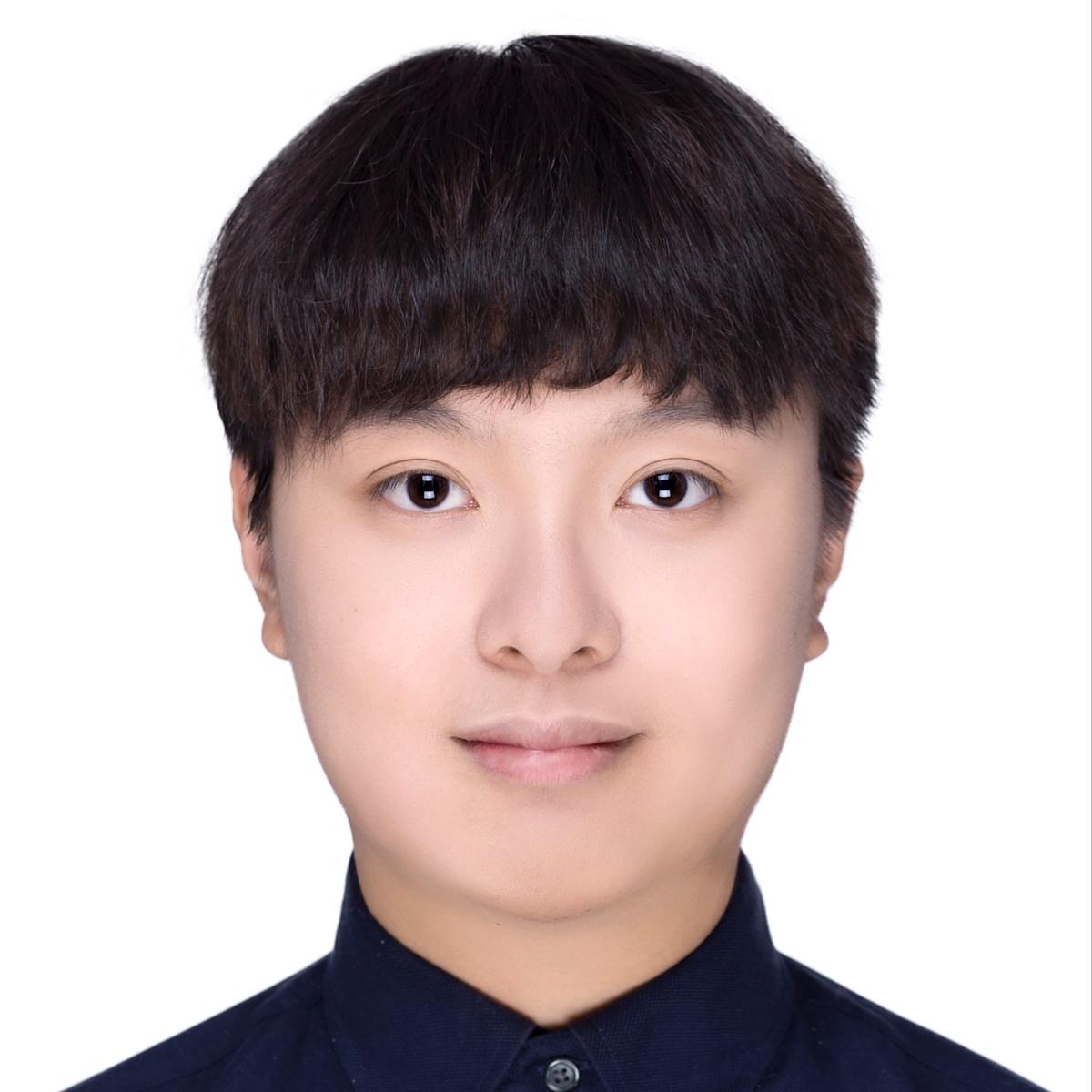
Xinchi Huang is a Ph.D. student in the Department of Electrical and Computer Engineering at Stevens Institute of Technology, advised by Professor Yi Guo in the Robotics and Automation Laboratory. His current research focus is on mobile manipulation for dynamic tasks that combine physics-based planning and control with learning. He received his B.S. in Computer Science from Harbin Institute of Technology in June 2019 and his M.S. in Computer Engineering from New York University in June 2021. His research has been presented at the IEEE/RSJ International Conference on Intelligent Robots and Systems (IROS 2025) and the Modeling, Estimation and Control Conference (MECC 2026).
Discrimination notice: Persons of all identities are invited to and included in this group. Stevens does not discriminate against any person on the basis of sex, race, religion, disability, sexual orientation, gender expression, or any other basis prohibited by law.
Photo and video notice: At any time, photography or videography may be occurring on Stevens’ campus. Resulting footage may include the image or likeness of event attendees. Such footage is Stevens’ property and may be used for Stevens’ commercial and/or noncommercial purposes. By registering for and/or attending this event, you consent and waive any claim against Stevens related to such use in any media. See Stevens' Privacy Policy for more information.