ACC Seminar: Model Theory and Algorithms for One-Relator Groups

Department of Mathematical Sciences
Location: North Building Room 316 and Zoom (Passcode: ACC)
Speaker: Olga Kharlampovich, Professor, Hunter College and the CUNY Graduate Center
ABSTRACT
We study the elementary theories and algorithmic properties of one-relator groups. We give a first-order sentence characterizing Baumslag-Solitar-freeness in this class. For fixed $|m|>1$, we regularly interpret $\BS(1,m)$ as a definable subgroup in every one-relator group containing it. We uniformly, regularly and injectively interpret integer arithmetic in countable groups of cohomological dimension at most two. We obtain one uniform interpretation for all one-relator groups containing a non-unimodular Baumslag-Solitar subgroup. Every fixed finitely presented group is regularly interpretable in these groups, and their elementary theories are undecidable. We also describe the GBS overgroups of a non-unimodular Baumslag-Solitar subgroup. For the unimodular groups we construct finite-index direct products of free groups and $\Z$, and reduce the elementary theory of $\BS(k,k)$ to that of a free group with a named periodic automorphism.
Using the recent Open AI result that BS-free one-relator groups are hyperbolic we obtain a terminating algorithm recognizing this class and obtain consequences. From the virtual compact specialness result of another Open AI paper, we obtain an effective construction of virtual free-by-cyclic presentations for hyperbolic one-relator groups, the free kernel may have infinite rank. For classes of torsion-free one-relator groups in which CSA implies toral relative hyperbolicity, we give a uniform algorithm deciding CSA and, in the affirmative case, the existence of a subgroup isomorphic to $\Z^2$.
These are joint results with A. Miasnikov.
BIOGRAPHY
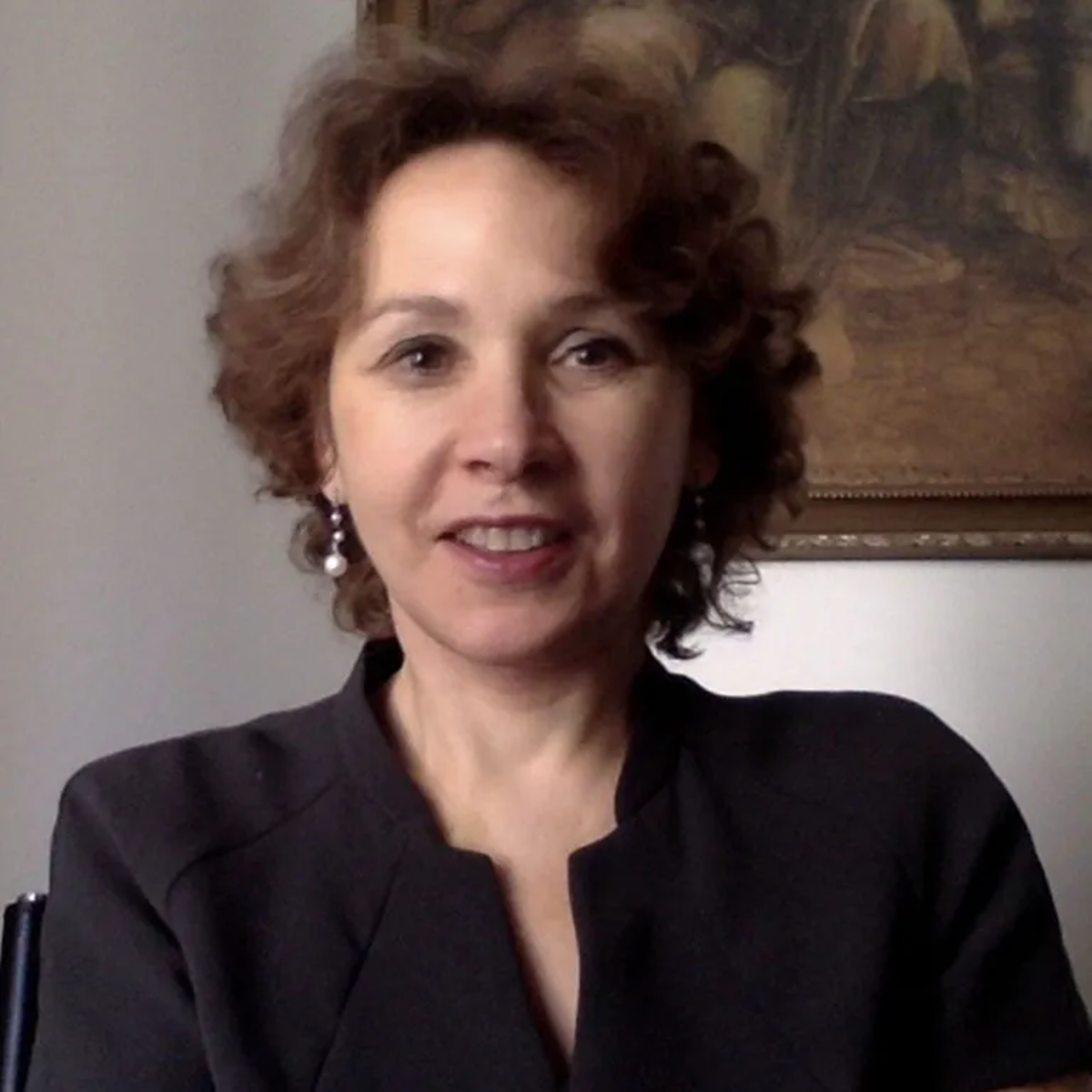
Olga Kharlampovich, PhD, is a Russian and Canadian mathematician who currently serves as the Mary P. Dolciani Professor of Mathematics at Hunter College and the CUNY Graduate Center.
Olga Kharlampovich is known for her example of a finitely presented 3-step solvable group with unsolvable word problem (solution of the Novikov–Adian problem) and for the solution together with A. Myasnikov of the Tarski conjecture (from 1945) about equivalence of first order theories of finitely generated non-abelian free groups (also solved by Zlil Sela) and decidability of this common theory. Algebraic geometry for groups, that was introduced by Baumslag, Myasnikov, Remeslennikov and Kharlampovich, is now one of the new research directions in combinatorial group theory.
In 1981, she was awarded a medal from the Soviet Academy of Sciences for her undergraduate work on the Novikov-Adian problem. She gave a negative answer to a question, posed in 1965 by Kargapolov and Mal'cev about the algorithmic decidability of the universal theory of the class of all finite nilpotent groups.
In 1996, she was awarded the Krieger–Nelson Prize of the Canadian Mathematical Society for her work on algorithmic problems in varieties of groups and Lie algebras (the description of this work can be found in the survey paper with Sapir and on the prize web site). In 2015, she was awarded the Mal'cev Prize for the series of works on fundamental model-theoretic problems in algebra.
Olga Kharlampovich was elected a Fellow of the American Mathematical Society in the 2020 class "for contributions to algorithmic and geometric group theory, algebra and logic."
Attendance: This is a technical talk open to all.
A campus map is available at https://tour.stevens.edu.
Additional information is available at https://web.stevens.edu/algebraic/.
Discrimination notice: Persons of all identities are invited to and included in this group. Stevens does not discriminate against any person on the basis of sex, race, religion, disability, sexual orientation, gender expression, or any other basis prohibited by law.
Photo and video notice: At any time, photography or videography may be occurring on Stevens’ campus. Resulting footage may include the image or likeness of event attendees. Such footage is Stevens’ property and may be used for Stevens’ commercial and/or noncommercial purposes. By registering for and/or attending this event, you consent and waive any claim against Stevens related to such use in any media. See Stevens' Privacy Policy for more information.