
Enduring Flight: Alexander Calder
Alexander Calder (Class of 1919) — who changed the world of art — died 50 years ago this fall. But the works of the man who originated the mobile — suspended, kinetic sculpture — soar in the 21st century. Calder’s creations have been exhibited worldwide and reside in numerous spaces across the globe. Calder Gardens, an art institution devoted to his work, opened in Philadelphia in 2025, with 2026 marking the 100th anniversary of his work of performance art, “Cirque Calder,” recently at the Whitney. At Stevens, his art and artifacts inspire.
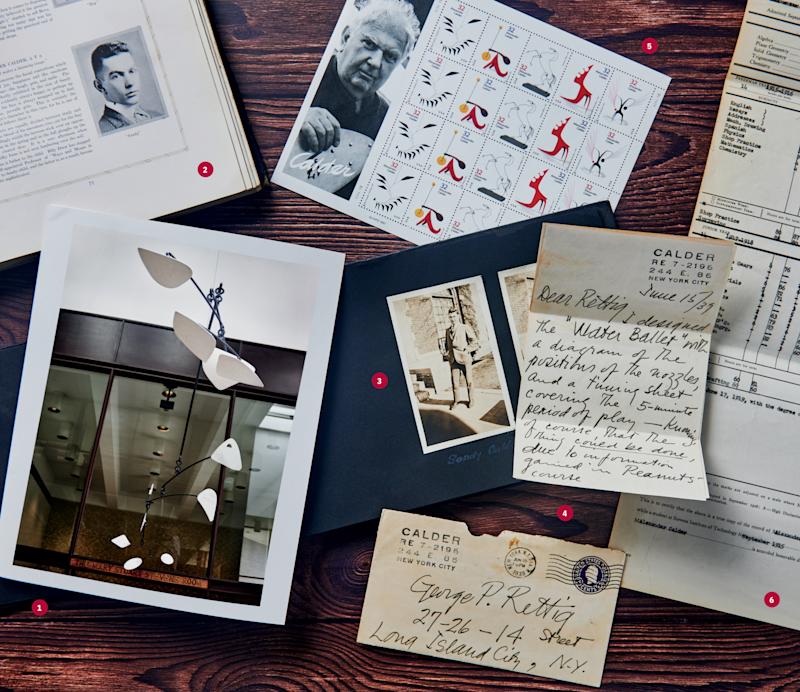
1. Stevens Mobile
Calder created “The Stevens Mobile” for the Samuel C. Williams Library’s Great Hall; it was installed in 1970, one year after the library’s grand opening. His sculpture, “Hard to Swallow” (1966), donated by his widow Louisa Calder, is exhibited on the library’s second floor.
2. The Link Yearbook, 1918
“Sandy” Calder’s senior entry mentions his Delta Tau Delta fraternity membership and his exuberant play on the lacrosse and football teams. But it mostly reveals his mischievous nature: “a blithe heart makes a blooming visage.”
3. Scrapbook
Sherman Loud (Class of 1921), grandson of Stevens’ then-President Alexander C. Humphreys, photographed young Calder on campus in 1915. Loud’s granddaughter Kay Ciganovic donated his scrapbook to Stevens as part of the Alexander C. Humphreys Collection.
4. Letter
Calder wrote to George P. Rettig (Class of 1930) in June 1939, discussing his “Water Ballet” fountain designed for the 1939 World’s Fair. Rettig, who worked as an engineer at the fair, later became a beloved Stevens professor.
5. Stamp
In 1998, to mark the 100th anniversary of the artist’s birth, the U.S. Postal Service issued five 32-cent Alexander Calder commemorative stamps on March 25, featuring five of his sculptures.
6. Transcript
Calder’s student transcript shows particularly strong grades in discrete geometry, mathematics, mechanical drawing and logic. He graduated with the degree of Mechanical Engineer, as all Stevens undergraduates did up until the late 1950s.
– Beth Kissinger
More at calder.org
More at library.stevens.edu/archives
Photo: Michael Marquand
Historic Items: Archives & Special Collections, Samuel C. Williams Library
All works by Alexander Calder © 2026 Calder Foundation, New York / Artists Rights Society (ARS), New York