
MBA and Master's in Computer Engineering Dual Degree Program
Program Details
Degree
Master of Engineering, Master of Science, or Dual-Degree MBASchool
School of BusinessAvailable
On CampusThe dual MS/ME-MBA degree will enhance your strategic thinking, and management skills while providing you with technical expertise in areas such as computer architecture, embedded systems, networking, and algorithms.
The combination of computer engineering and business education prepares you for leadership roles that require a deep understanding of both business operations and advanced technical knowledge. Choose from a Master of Science degree involving research or a Master of Engineering degree which does not.
Program Benefits:
Specialization Opportunities: Gain the skillset to manage teams in specialized areas of computer engineering, such as cybersecurity, artificial intelligence, robotics, or software engineering.
Leadership: Acquire the knowledge needed for leadership roles within technology teams or research projects.
Project Management: Excel in project management roles, overseeing technical projects while understanding the broader organizational and business contexts.
Careers:
Technical Project Manager
Systems Integration Manager
Data Science Manager
IT Project Manager
Information Security Manager
Digital Transformation Manager
About The Stevens MBA Program
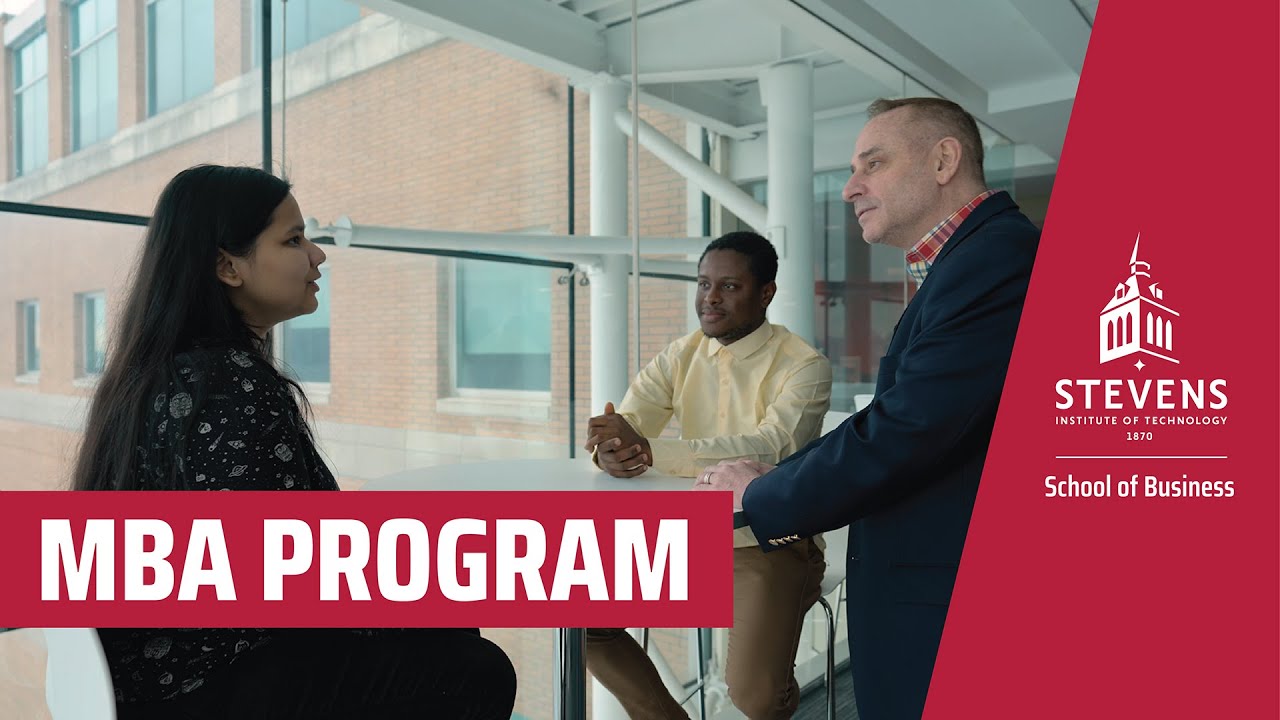
Program Highlights
A STEM-Designated MBA: Applicable concentrations of the MBA program hold the STEM designations, setting it apart from ordinary MBA offerings by infusing technology at the forefront of the curriculum. This designation also allows students from outside of the U.S. to be eligible for a 24-month extension of their Optional Practical Training (OPT).
Traditional Business Through the Technology Lens: At Stevens, conventional business disciplines are taught from a technological perspective, ensuring graduates are well-versed in leveraging leading-edge tools and methodologies to drive innovation across all aspects of a business.
AI and Machine Learning are Here to Stay: Students gain an essential understanding and practical application of AI and machine learning, equipping them to take the lead in navigating the fourth industrial revolution and propel industries forward.
Real-World Consulting Experience: The hallmark of the full-time MBA, the Industry Capstone Program, immerses students in consulting engagements with real-world companies. Students and their peers, under faculty mentors, take what they’ve learned in their courses to develop solutions to real business problems and present their recommendations to senior executives. This experience provides students with something they can speak about to hiring managers and recruiters. Open to students across graduate programs, the Industry Capstone Project encourages interdisciplinary collaboration, nurturing diverse perspectives and skill development.
Invaluable Networking Opportunities: Capstone projects involve partnering with companies, providing students with networking opportunities and allowing them to foster connections that can lead to career advancement.
GMAT/GRE test scores are optional for all master’s programs. Applicants who think that their test scores reflect their potential for success in graduate school may submit scores for consideration.
An MBA for Today's Digital Era
In today's data-driven world, the traditional business skills taught in traditional MBA programs are no longer enough. Few MBA programs fully address how the data revolution has transformed how managers recognize opportunities and identify trends. The Stevens MBA stands out by integrating technology, data analytics and advanced business practices into its core curriculum.
Taught by expert faculty, this innovative MBA program combines foundational business disciplines such as marketing, strategy and finance with cutting-edge skills in technology and business analytics. You will engage in applied exercises and real-world projects that train you to make fast, data-informed decisions. With a curriculum emphasizing collaboration through group projects, presentations and hands-on experience, you will foster both creativity and critical thinking skills.
This unique approach ensures you are prepared to lead in a rapidly evolving business landscape.
MBA Core Courses
FIN 500 Financial and Managerial Accounting - 3 Credits
This course will provide the student with the principles and techniques of financial and managerial accounting for technical organizations. The emphasis will be on the use of financial data for decision making. The basics of accounting will briefly be covered, with the major amount of time spent on ways to understand, analyze and use the data for decision making. Budgeting and analysis of performance, as well as, recognizing fixed and variable expenses are other key areas of financial management. Issues of valuation, time value of money, uncertainty and risk will be integrated in the material. The one-term course will make extensive use of the text by Weygandt et al (see below), supplemented by cases, exercises, homework and examinations. Emphasis will be on real-world, practical application of the tools of finance to management decision making.
FIN 523 Financial Management - 3 Credits
This course covers the fundamental principles of finance. The primary concepts covered include the time value of money, principles of valuation and risk. Specific applications include the valuation of debt and equity securities as well as capital budgeting analysis, financial manager’s functions, liquidity vs. profitability, financial planning, capital budgeting, management of long term funds, money and capital markets, debt and equity, management of assets, cash and accounts receivable, inventory and fixed assets. Additional topics include derivative markets.
MGT 506 Economics for Managers - 3 Credits
This course introduces managers to the essence of business economics – the theories, concepts and ideas that form the economist’s tool kit encompassing both the microeconomic and macroeconomic environments. Microeconomic topics include demand and supply, elasticity, consumer choice, production, cost, profit maximization, market structure, and game theory while the Macroeconomic topics will be GDP, inflation, unemployment, aggregate demand, aggregate supply, fiscal and monetary policies. In addition the basic concepts in international trade and finance will be discussed.
MGT 612 Leader Development - 3 Credits
Project success depends, largely, on the human side. Success in motivating project workers, organizing and leading project teams, communication and sharing information, and conflict resolution, are just a few areas that are critical for project success. However, being primarily technical people, many project managers tend to neglect these "soft" issues, assuming they are less important or that they should be addressed by direct functional managers. The purpose of this course is to increase awareness of project managers to the critical issues of managing people and to present some of the theories and practices of leading project workers and teams.
MGT 635 Managerial Judgment and Decision Making - 3 Credits
Executives make decisions every day in the face of uncertainty. The objective of this course is to help students understand how decisions are made, why they are often less than optimal, and how decision-making can be improved. This course will contrast how managers do make decisions with how they should make decisions, by thinking about how “rational” decision makers should act, by conducting in-class exercises and examining empirical evidence of how individuals do act (often erroneously) in managerial situations. The course will include statistical tools for decision-making, as well as treatment of the psychological factors involved in making decisions.
MGT 641 Marketing Management - 3 Credits
The study of marketing principles from the conceptual, analytical, and managerial points of view. Topics include: strategic planning, market segmentation, product life-cycle, new product development, advertising and selling, pricing, distribution, governmental, and other environmental influences as these factors relate to markets and the business structure.
MGT 663 Discovering & Exploiting Entrepreneurial Opportunities - 3 Credits
In this course, students will evaluate and create their own prospective business strategies. They will develop an understanding of entrepreneurship and innovation in starting and growing a business venture. Students will be given an opportunity to actually start their own business or create a business in their company by learning how to take advantage of the new order of business opportunities of the information age. This course’s main objective is to show students how to identify these opportunities, be able to formulate and evaluate both qualitatively and quantitatively whether the opportunity is worth pursuing, and, of course, how it may be pursued. Actual case studies and experiences will be intertwined with the course content.
MGT 699 Strategic Management - 3 Credits
An interdisciplinary course which examines the elements of, and the framework for, developing and implementing organizational strategy and policy in competitive environments. The course analyzes management problems both from a technical-economic perspective and from a behavioral perspective. Topics treated include: assessment of organizational strengths and weaknesses, threats, and opportunities; sources of competitive advantage; organizational structure and strategic planning; and leadership, organizational development, and total quality management. The case method of instruction is used extensively in this course.
MGT 808 Fundamentals of Consulting - 0 Credit
This course introduces students to fundamental soft skills, work techniques, and technologies employed by management consultants. Topics covered in this course include project scoping, creating statements of work, meeting facilitation, project planning, design of presentations and written reports, management briefs, and delivery of status reports. The course will improve students’ ability to present analyses of issues and organizational problems in a concise, accurate, clear and interesting manner from the perspective of a consultant. This course is designed to be taken prior to the experiential graduate courses in the School of Business, including MGT 809: Industry Capstone Project.
MGT 809 Industry Capstone Experience - 3 Credits
In this course students work on an industry project with a team of their peers under the supervision of a faculty advisor and industry mentor. Students will work on project tasks and manage client expectations while applying their disciplinary and technical knowledge to the project. In addition to the project-specific deliverables, students will produce a statement of work, present weekly project updates, and a final presentation and project report to management. This one to two-credit course is tied to the Industry Capstone Program in the School of Business. Students must first apply for a project before registering for this course.
About The M.S. Or M.E. In Computer Engineering Program
The computer engineering master’s program trains you for careers in the computer engineering field that require advanced and specialized knowledge in areas like computer systems, real-time and embedded systems, data communications and networks, digital system design, image processing and multimedia, information systems, information systems security and intelligent systems.
By the end of the program, you’ll have impressive accomplishments in hardware and software development under your belt — as well the highly respected reputation of a Stevens engineering degree.