Honoring Dr. King’s Legacy on the 5th Annual MLK Week of Service
Each January, the Stevens community comes together to honor the life and legacy of Reverend Dr. Martin Luther King Jr., a transformative political leader who changed the course of American history through his dedication to a more just world, both domestically and globally. The annual MLK Week of Service is planned and implemented by a collaborative planning committee, led by the Office of Student Culture and Belonging with input from partner offices, faculty and students.
For the 5th annual MLK Week of Service, the planning committee has deepened our focus on the great influence and contributions of Dr. King, centering his advocacy for racial and economic justice, his legacy of nonviolent resistance, and the values of the Beloved Community, as they continue to shape our understanding of justice today. The planning committee developed 5 new learning outcomes related to all programs and engagement opportunities for the 2026 week of service. We have also introduced a dedicated education subcommittee, which is entirely dedicated to deepening the historical and contemporary relevance of the week’s programming. Inspired by the Freedom Schools, citizenship education workshops, and political teaching that fueled the Civil Rights Movement, the committee curates opportunities for passive and interactive education for students to accessibly engage with King’s legacy. Throughout the week, participants encounter educational materials, presentations, and multimedia resources that explore topics in line with Dr. King’s legacy, such as racial inequity, poverty, and housing and food insecurity. Historical speeches and oral histories from King and other civil rights leaders highlighted throughout the week offer a deeper understanding of the sociohistorical contexts of contemporary movements, to provide insight on the ongoing struggle for racial and economic justice in the United States.
The Office of Student Culture and Belonging’s annual MLK Week of Service has always been rooted in this legacy. Dr. King understood service beyond the idea of charity and demonstrated what it means for service to serve as a mechanism to address systemic inequities and to lead and work with, not for, communities. Through Dr. King and the many leaders of the Civil Rights Movement we understand that visions of a more just world cannot be achieved without addressing social, economic, and political inequality. From the Montgomery Bus Boycott to the Birmingham Campaign, from the March on Washington to the Poor People’s Campaign, Dr. King paired community care and action with education, showing us, that social transformation requires both compassion for our neighbors and critical consciousness. In this spirit, Stevens’ MLK Week of Service integrates hands-on service with intentional learning, reflection, and dialogue that illuminate the systemic harms of our present day to support our student's development as conscious leaders.
During this time of service, we remember Dr. King’s teachings and affirm those values of leadership, justice, community, and social action as they stand in alignment with the mission of the Office of Student Culture and Belonging and our collaborative partners. Click below to view the Office of Student Culture and Belonging's Pillars of Community, the MLK Week of Service learning outcomes, educational resources and selected quotes from Dr. King.
Educational Resources
Office of Student Culture and Belonging's Pillars of Community
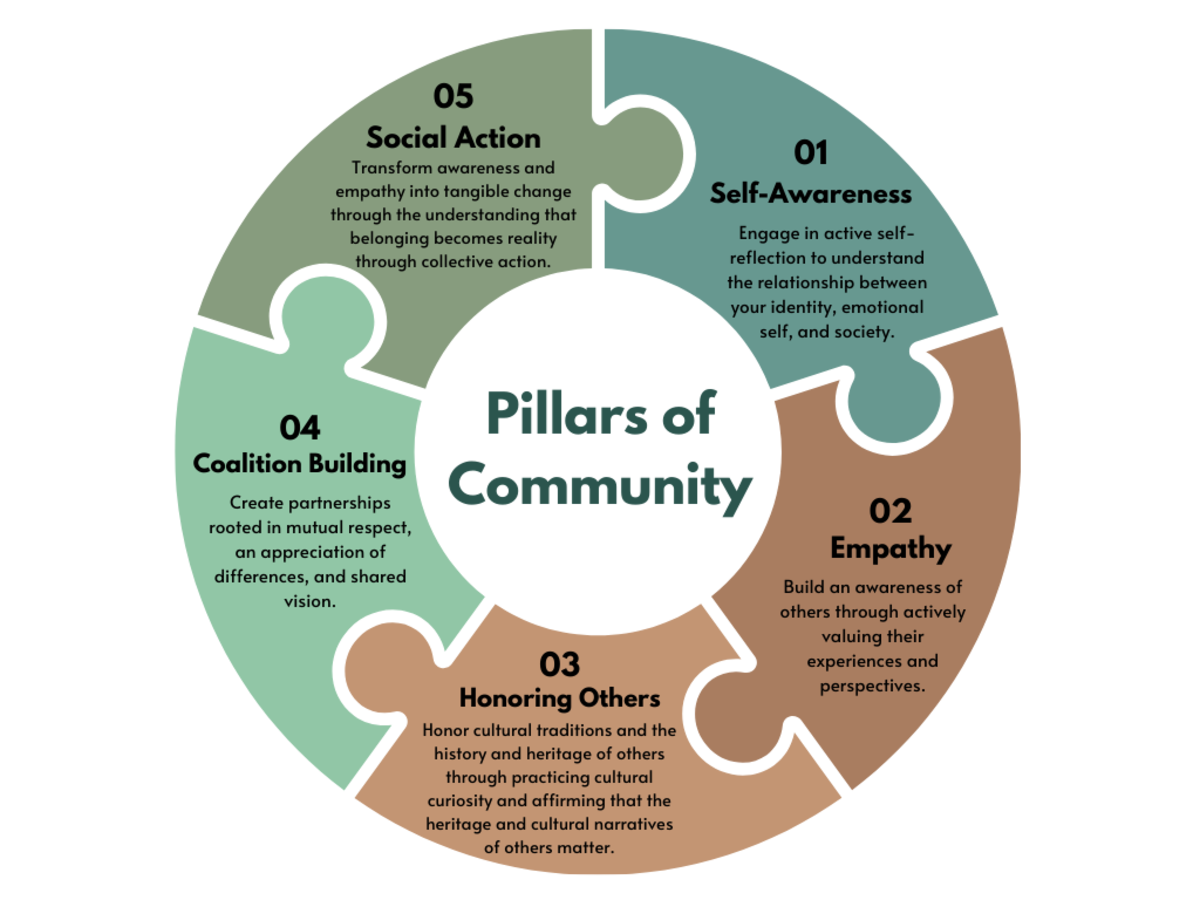
Pillars of Community:
1. Self-Awareness and Reflection
Engage in active self-reflection to understand the relationship between your identity, emotional self, and society.
2. Empathy and an Awareness of Others
Build an awareness of others through actively valuing their experiences and perspectives.
3. Honoring Others’ Culture, History, and Traditions
Honor cultural traditions and the history and heritage of others through practicing cultural curiosity and affirming that the heritage and cultural narratives of others matter.
4. Coalition Building
Create partnerships rooted in mutual respect, an appreciation of differences, and shared vision.
5. Social Action
Transform awareness and empathy into tangible change through the understanding that belonging becomes reality through collective action.
MLK Learning Outcomes
By engaging in MLK Week of Service, participants will be able to:
Articulate the significance of Dr. Martin Luther King Jr.’s legacy and understand how service and social action contribute to equality and justice today.
Explain the concept of the Beloved Community and examine its relevance for building inclusive communities of belonging.
Reflect on their own values and lived experiences to better understand how personal purpose shapes their approach to community engagement.
Identify one meaningful way to contribute to a more connected and caring community.
Digital Collections & Readings
Selected quotes from Rev. Dr. Martin Luther King, Jr.
“Injustice anywhere is a threat to justice everywhere. We are caught in an inescapable network of mutuality, tied in a single garment of destiny. Whatever affects one directly, affects all indirectly.”
Letter from Birmingham Jail, April 16, 1963
“Intelligence plus character—that is the goal of true education.”
From “The Purpose of Education,” The Maroon Tiger, 1947
“We have also come to this hallowed spot to remind America of the fierce urgency of Now. This is no time to engage in the luxury of cooling off or to take the tranquilizing drug of gradualism. Now is the time to make real the promises of democracy.”
From “I Have a Dream” speech, August 28, 1963
“I believe that unarmed truth and unconditional love will have the final word in reality. This is why right, temporarily defeated, is stronger than evil triumphant.”
From his Nobel Peace Prize acceptance speech, December 10, 1964
“The time is always right to do what is right.”
From his Oberlin College commencement speech, 1965
“We’ve got some difficult days ahead. But it really doesn’t matter with me now because I’ve been to the mountaintop... I’ve looked over and I’ve seen the promised land. I may not get there with you. But I want you to know tonight that we as a people will get to the promised land.”
From “I’ve Been to the Mountaintop” speech, April 3, 1968