Adam Overvig Receives $450K Air Force Office of Scientific Research Young Investigators Award
The physics professor is breaking from traditional metasurface research to embrace “bugs” as features in the control of light waves

Adam Overvig, an assistant professor in the Department of Physics, has received a $450,000 Air Force Office of Scientific Research (AFOSR) Young Investigators Award for his project, “Nonlocal Metasurfaces for Spectro‐Spatial Control of Light.” The three-year project will introduce novel design principles and develop new theoretical frameworks to categorize, model and study nonlocality in flat optical devices made from thin films called metasurfaces to aid in the control and specification of light waves.
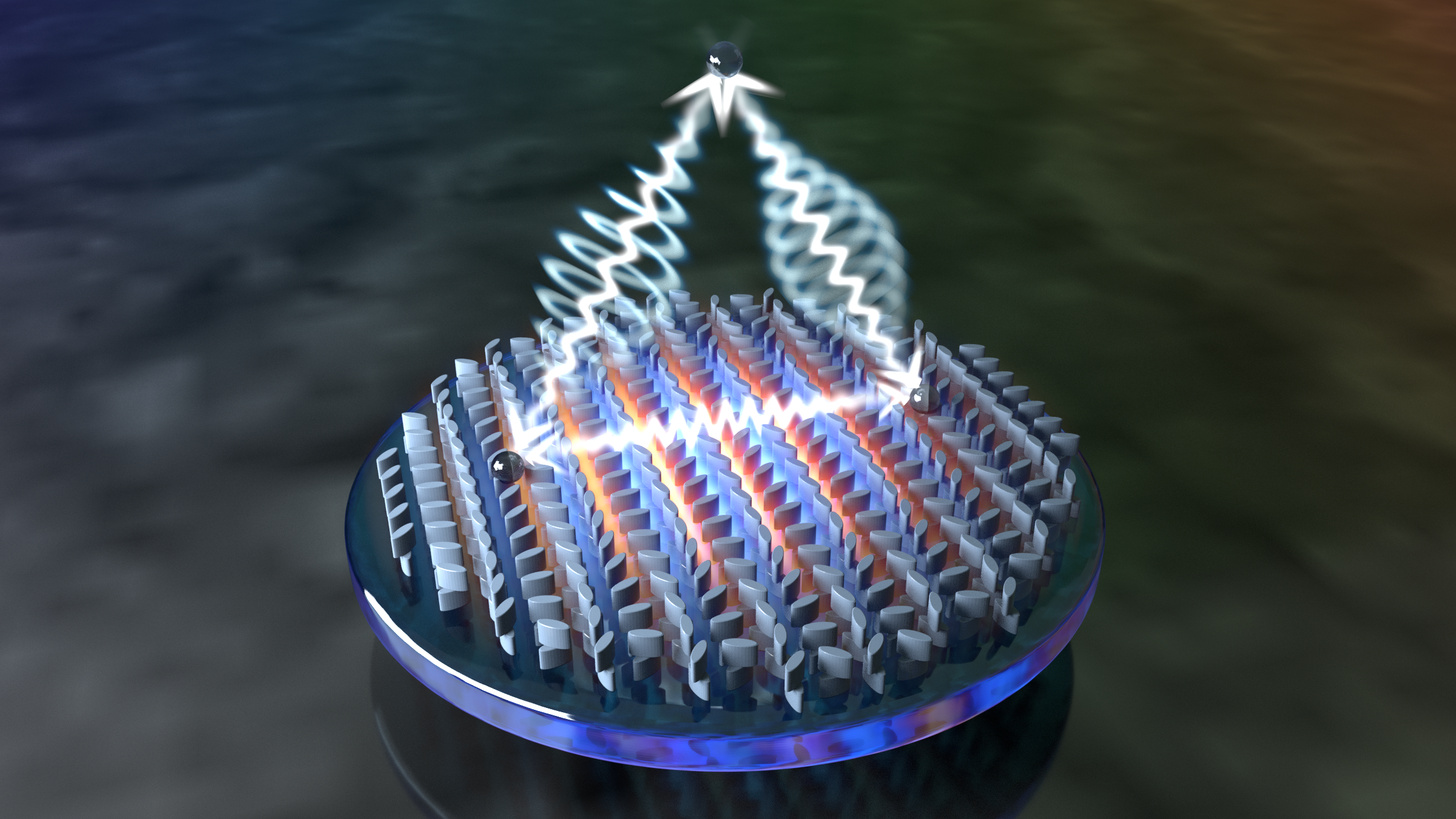
The goal is to clarify two important aspects of how nonlocal metasurfaces function and create devices that can control both the spatial properties (which include amplitude, phase and polarization) and the momentum properties (which include frequency and angular direction) of light.
Most past approaches to metasurface research have ignored the effects of neighboring nanopillars, and instead assumed each nanopillar acts alone (i.e., locally). The goal was usually to “shape” the outgoing wavefront of light when an unpatterned laser beam was shone on the metasurface. Any crosstalk between neighboring nanopillars was unwanted.
“In this research, the goal is to embrace the coupling between nanopillars to go beyond the usual responses in metasurfaces — to turn a ‘bug’ into a feature,” explained Overig.
“These ‘nonlocal’ effects can include briefly trapping light as it couples along the surface between nanopillars, before finally re-emitting it, in a phenomenon called ‘resonance.’ In most resonant devices, we have limited ability to select which light beams resonate, and also limited ability to control the shape of the re-emitted light. Here, we aim to find and study methods to increase the amount of control in both aspects: which light beam will resonate, and the shape of the light when it re-emits.”
This research will further our understanding of fundamental science and enhance the capabilities of flat optical devices for use in such areas as quantum technology, augmented reality, high-capacity and security communications, and nonlinear and active optical devices.
Overvig was selected as one of only 48 researchers nationwide to receive the honor for 2024. The Young Investigators Award is bestowed on early-career investigators who “show exceptional ability and promise” for conducting research that is relevant to the U.S. Department of the Air Force.
“I am excited by metasurfaces because they are a true ‘sandbox,’” he said. “In order to control light, we shape and arrange nanoscale features such as nanopillars, carved into materials such as silicon and silicon dioxide — literally, sand.”
Learn more about academic programs and research in the Department of Physics: