Active and Passive Gravitational Mass in Classical and Quantum Physics

Department of Physics
Location: Babbio Center, Room 219
Speaker: Vasileios Fragkos, Postdoctoral Researcher, Department of Physics, Stevens Institute of Technology
ABSTRACT
In Einstein’s theory of general relativity, matter plays a dual role: it sources spacetime curvature and responds to the resulting geometry. The presumed reciprocity between these roles, as embodied in the equality of action and reaction, is a foundational tenet of the theory. Nevertheless, its precise formulation is surprisingly subtle, both within general relativity and in alternative theories of gravity, and has received little experimental scrutiny. In this talk, we investigate possible violations of this equality in Newtonian gravity by distinguishing between active gravitational mass, as the parameter responsible for sourcing the gravitational field, and passive gravitational mass, which determines a body’s response to it. We revisit phenomenological violation parameters and their experimental tests, and show how a broader class of high-precision tests can probe the equivalence of passive and active mass in new experiments. This question acquires new significance in quantum physics, where quantized internal energy contributes to mass through mass–energy equivalence, and source–probe asymmetries may acquire genuinely quantum signatures, opening the door to novel tests lying at the interface of gravity and quantum mechanics. Emerging quantum technologies, which allow for unprecedented precision in preparation, control and measurement of quantum systems, can bring this fundamental source–probe reciprocity, and possible departures from it, within experimental reach.
BIOGRAPHY
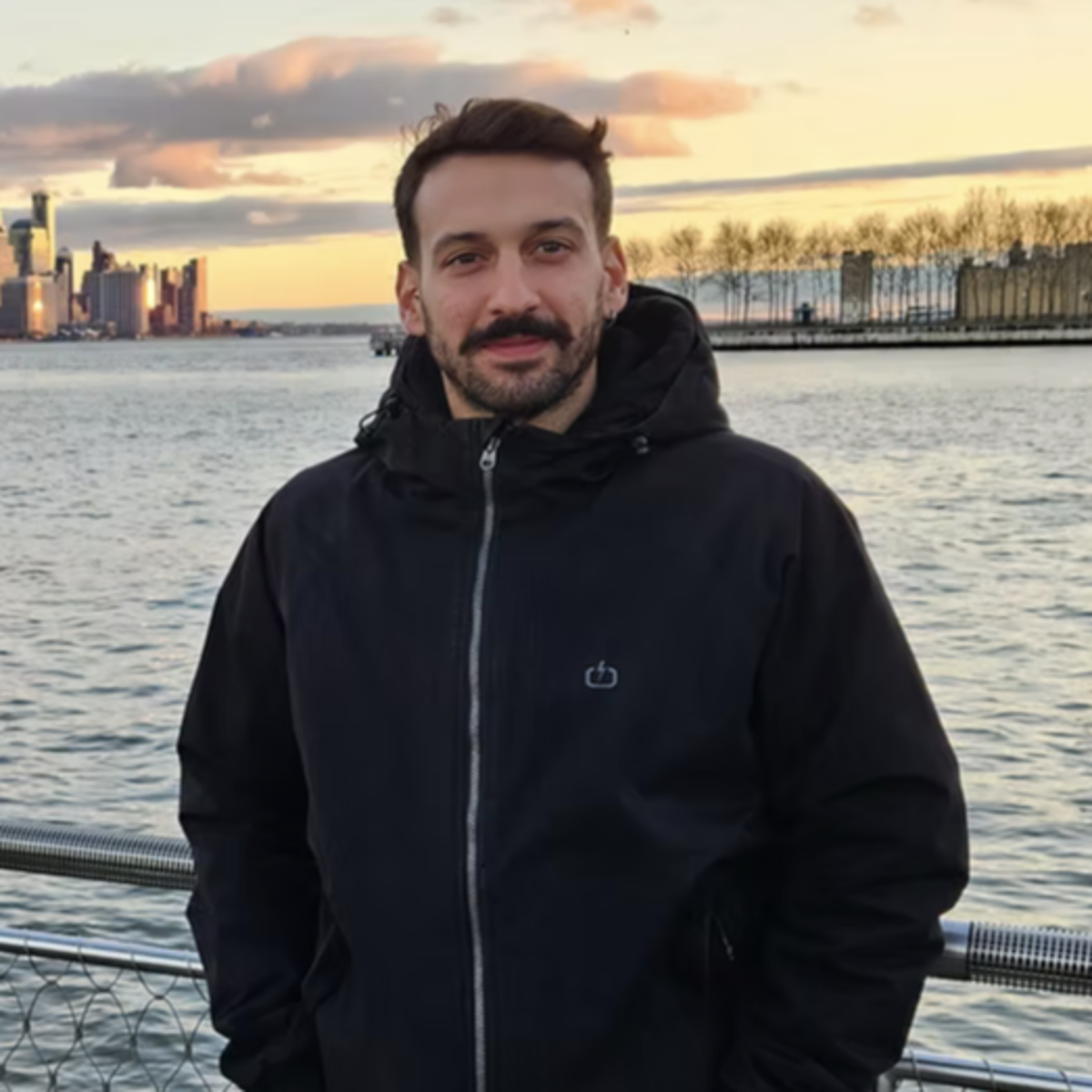
Vasileios Fragkos is a postdoctoral researcher in the Department of Physics at Stevens Institute of Technology, where he is a member of Igor Pikovski’s research group. His work lies at the intersection of quantum mechanics, gravitation, and cosmology. He received his PhD in Physics from Stockholm University, Sweden, where his doctoral research explored quantum and classical aspects of dark matter and gravity. He previously earned an MSc in Theoretical Physics from Utrecht University, the Netherlands, and a BSc in Physics from the National and Kapodistrian University of Athens, Greece.
Discrimination notice: Persons of all identities are invited to and included in this group. Stevens does not discriminate against any person on the basis of sex, race, religion, disability, sexual orientation, gender expression, or any other basis prohibited by law.
Photo and video notice: At any time, photography or videography may be occurring on Stevens’ campus. Resulting footage may include the image or likeness of event attendees. Such footage is Stevens’ property and may be used for Stevens’ commercial and/or noncommercial purposes. By registering for and/or attending this event, you consent and waive any claim against Stevens related to such use in any media. See Stevens' Privacy Policy for more information.